Painting that wanted to be music
Wassily Kandinsky trained in law and economics in Moscow before turning to painting in Munich in his thirties. In 1911 he co-founded the Blue Rider group and published 'Concerning the Spiritual in Art', arguing that color acts directly on the soul, like sound. Around the same years he moved toward complete abstraction, and he is often named among its first pioneers.
He grouped his paintings as Impressions, Improvisations and Compositions, words taken from music. At the Bauhaus (1922–1933) his work became more geometric, and he wrote 'Point and Line to Plane'. In his last Paris years, forms became softer and almost biological.
Visual anatomy
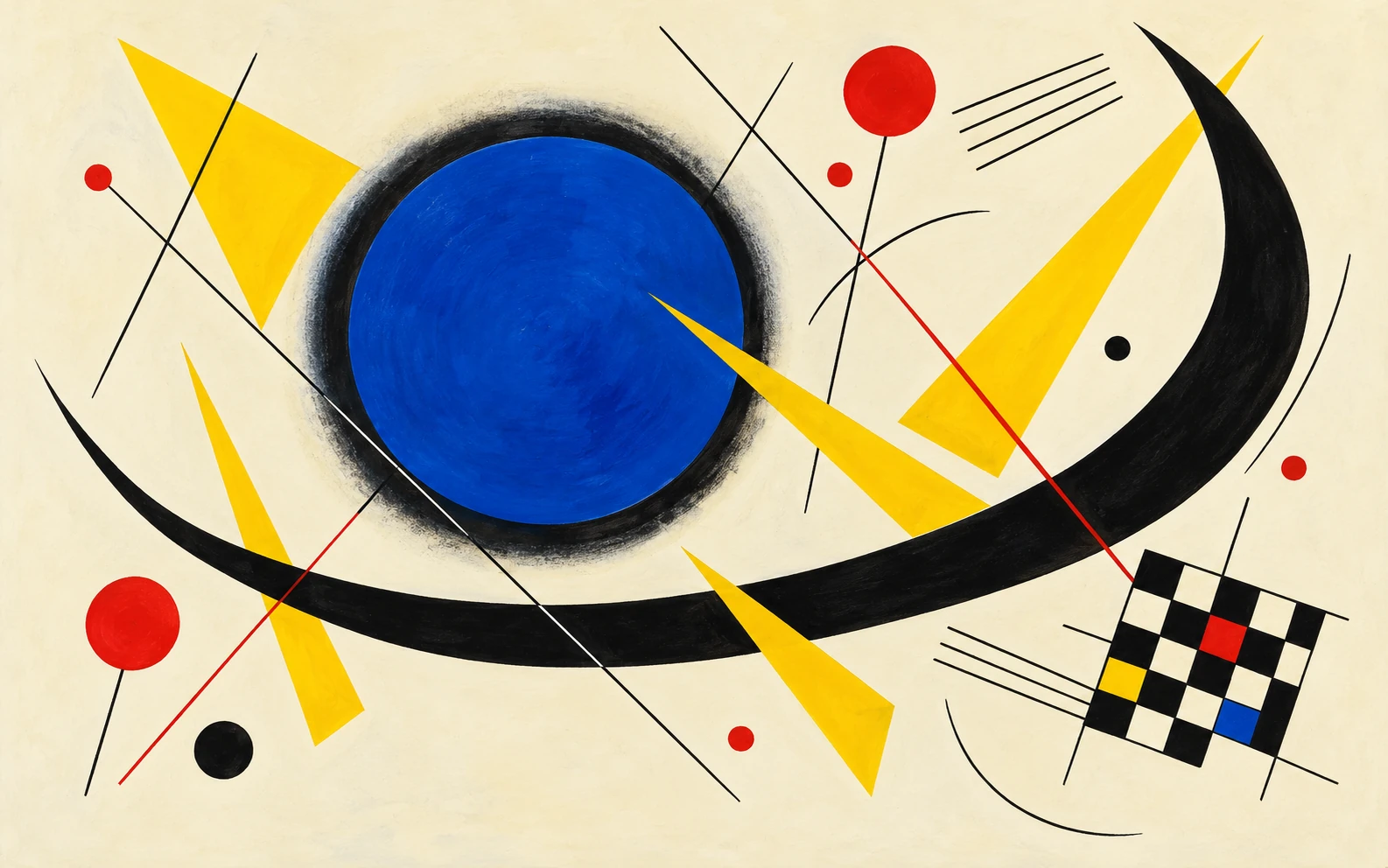
Vivid and symbolic: yellow feels sharp and advancing, blue deep and calm, red alive and warm.
Lines carry direction and tension: straight, curved, angled, thick or thin.
Circles, triangles, grids and free shapes meet and collide.
Many elements held in balance, like instruments in an orchestra.
Forms float with no horizon; depth comes from overlap and color.
Repetition and contrast create a sense of tempo and sound.
How to recognize his work
- No recognizable object, yet the image feels full of events.
- Strong colors and lines seem to push and pull.
- Circles, diagonals and arcs recur like musical motifs.
Where people get it wrong
Kandinsky is not 'random shapes'. Each period has its own logic: the stormy, colorful Munich years, the precise geometry of the Bauhaus, the soft biomorphic forms of Paris. Calling all of it one 'Kandinsky style' hides how much he changed.
The words to describe it
Words for what you see and feel in this work. They are for describing and understanding, not a recipe for copying an artist.
- non-objective abstraction
- colors as sound
- dynamic diagonals
- circles and arcs
- black lines of tension
- vivid yellow, blue and red
- floating forms
- layered transparency
- orchestral composition
- biomorphic shapes
An abstract painting with no horizon: a large blue circle with a black halo, sharp yellow triangles, a sweeping black arc and a grid of small checkered squares, all floating on a pale cream ground. The image feels like a loud chord answered by a quiet one.
What to learn from it
- Describe a color by what it does, not only by its name.
- Think of a composition as tensions between elements.
- Borrow words from music: tempo, accent, chord, silence.
Choose one Kandinsky composition in an online collection. Describe it as if it were a piece of music: what is loud, what is quiet, where the rhythm speeds up, where there is silence.