Painting for the future
Hilma af Klint was academically trained, yet her most radical body of work moved away from naturalistic representation. Beginning in the early twentieth century, she developed an abstract vocabulary tied to spiritual inquiry, symbolic systems, and the idea of art made for a future audience.
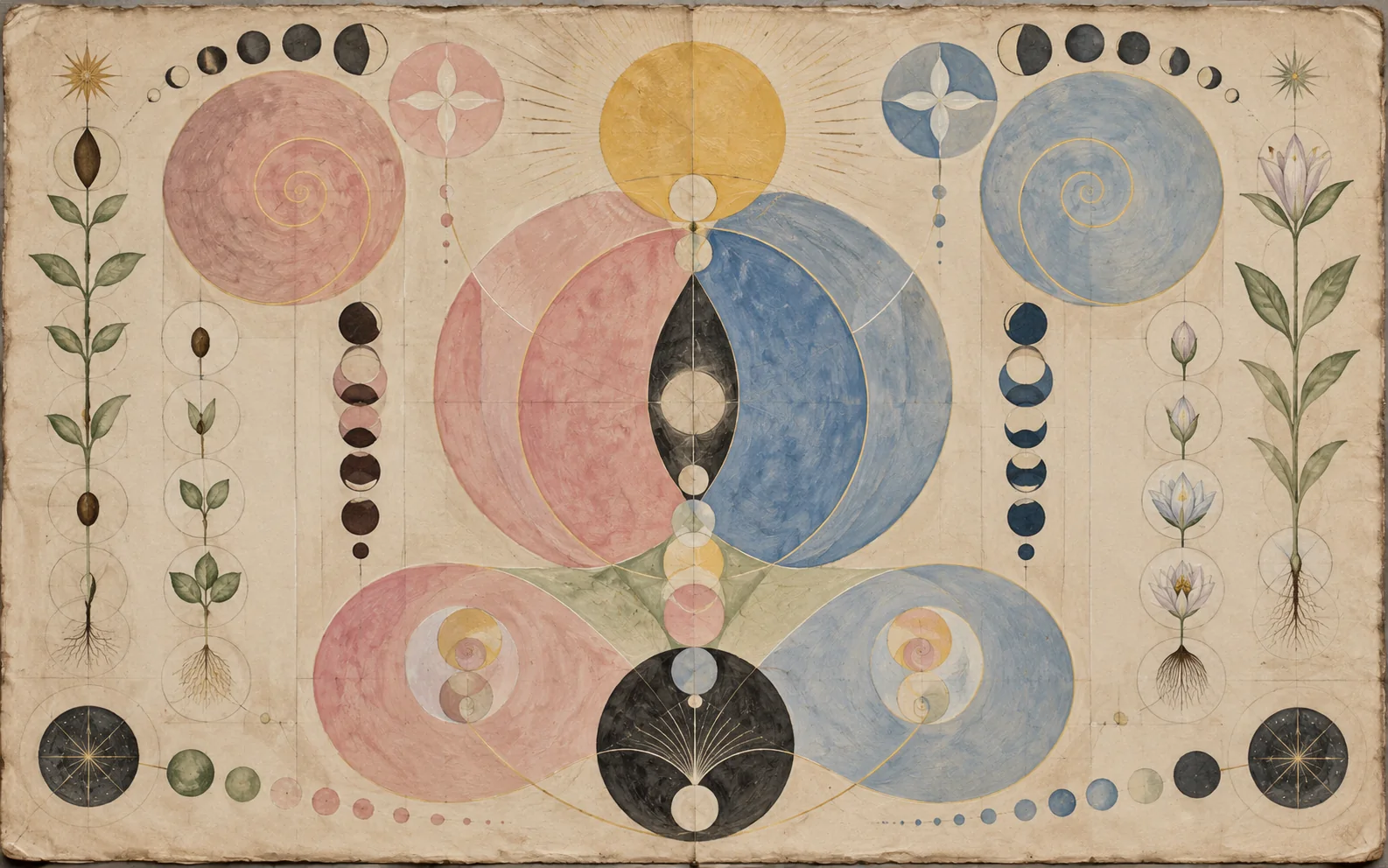
Her images often join geometry and organic growth. Circles, spirals, petals, letters, and mirrored forms behave less like decoration than elements in an evolving cosmology.
Visual anatomy
Large forms float, mirror, overlap, or balance across a field. Symmetry is present but rarely inert.
Pastels and strong accents carry symbolic relationships. Color often distinguishes forces, states, or polarities.
Circles, triangles, spirals, and axes propose order without becoming purely mathematical.
Seed, shell, petal, cell, and tendril shapes suggest growth, transformation, and life cycles.
Letters and signs appear as parts of a private visual grammar. Their ambiguity is intentional.
Monumental size turns looking into a bodily encounter and gives abstract relations architectural force.
How to recognize it
- Geometry and biology feel inseparable.
- Dualities are held in tension rather than resolved into one side.
- The image reads like a diagram, but its system remains poetic and partly unknowable.
Where people get it wrong
Her work should not be flattened into a pastel mood board or generic “mystical geometry.” Its force lies in sustained inquiry, serial thinking, symbolic structure, and the tension between private revelation and public visual form.
The words to describe it
Words for what you see and feel in this work. They are for describing and understanding, not a recipe for copying an artist.
- monumental abstraction
- pastel pinks, ochres and blues
- mirrored symmetry
- spirals and concentric circles
- petals, seeds and shells
- floating letters
- paired opposites
- diagrammatic composition
- matte tempera on paper
- works in series
A large vertical abstract painting. Concentric circles and a spiral float on a soft ochre ground, mirrored petal shapes in pink and pale blue, a few floating letters, matte tempera texture.
What to learn from it
- Create a personal symbol system from experiences, not borrowed motifs.
- Let a series develop one question across many images.
- Use abstraction to hold uncertainty rather than illustrate a fixed answer.
Choose one pair of opposites that matters to you. Invent two forms and two colors for them, then make three compositions where their relationship changes without copying any existing symbol.