Thin labels make thin images
The anthropologist Clifford Geertz, borrowing from the philosopher Gilbert Ryle, called it 'thick description' (1973): describing an action together with the context that gives it meaning, the way a wink differs from a twitch. In narrative therapy, Michael White and David Epston used a similar idea: a 'thin' label like 'a failure' hides the richer, 'thick' stories of a life.
Prompts work the same way. 'A sad woman' is a thin label, and a model fills it with its most common cliché. A thick description adds layers, what is visible, what things are made of, how people relate, where and when we are, so the image has a life of its own instead of a stereotype.
The five layers
The thin starting point: 'a sad woman', 'an old man', 'a city at night'.
Posture, gesture, expression, clothing, what is in the hands.
Surfaces, textures, light on things: a chipped cup, wet wool, a flickering bulb.
Who or what she is with or apart from: an empty chair, a letter, a window to the street.
Time, place, season, history: a Tuesday evening in late autumn in an old Tehran apartment.
In practice
Delete the adjective (sad) and let the layers show it.
Three precise details beat ten generic ones.
Thick does not mean closed; avoid explaining everything.
A short paragraph reads more like a caption, which models understand well.
Thick description resists stereotypes about people and places.
Words to describe Thick Description Prompting
Precise words for the qualities above. Combine a few of them instead of naming the style or artist alone.
- thin label
- thick layered description
- visible gesture
- material detail
- relational detail
- specific time and place
- telling details
- room for other stories
- scene-like prompt
- stereotype-resistant
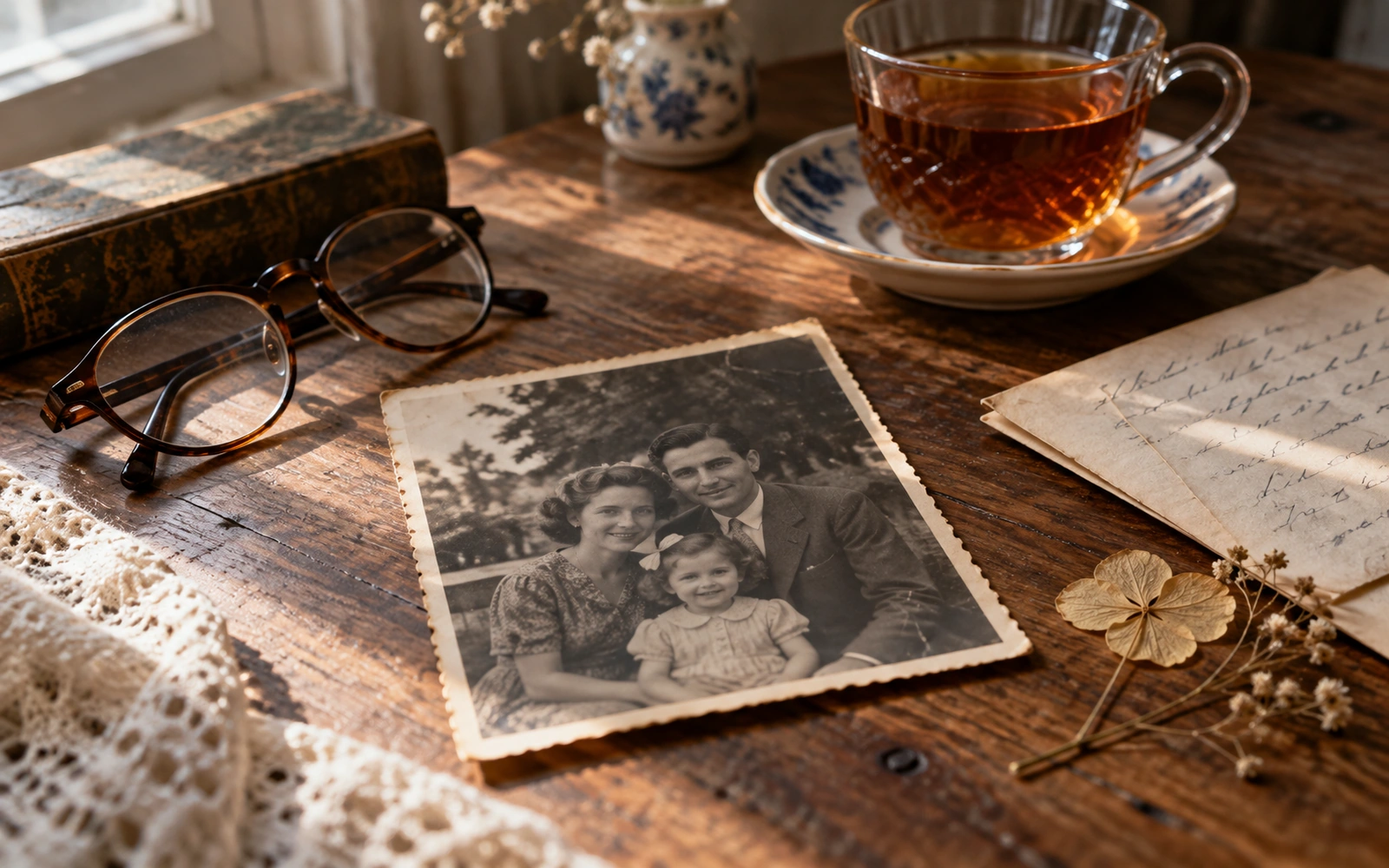
Thin: 'a sad woman'. Thick: 'A woman in her fifties sitting at a kitchen table on a late autumn evening, holding a cold glass of tea with both hands, a folded letter in front of her and an empty chair across the table, a single yellow bulb above, rain on the dark window.'
How to describe Thick Description Prompting in words
- Write the thin label, then cross it out.
- Add one detail per layer.
- Read the result: does it suggest a person with a story, not a type?
Where we usually get it wrong
Thick does not mean long. Adding many decorative adjectives produces a thick-looking but still thin prompt. The point is meaningful detail: each one should change what we understand about the scene.
Take the label 'a lonely old man'. Write one detail for each of the four layers after the label, and generate both the thin and thick versions. Compare which one gives you a person instead of a cliché.