A prompt is a description with a job
Every text-to-image tool, Midjourney, Stable Diffusion, Firefly, DALL·E, Flux or Imagen, reads a prompt the same basic way: it looks for a subject, then for clues about how the image should look. A strong prompt is not a pile of keywords; it is a short, clear description where each part answers one visual question.
The anatomy below is the same one a photographer, art director or painter uses to describe an image. Learn the parts once and you can use them in any tool, and in any language. The settings that sit outside the words, such as aspect ratio or seed, are a separate layer, covered in image generation settings.
The core
What is in the picture, as concretely as possible: not 'a cat' but 'an old ginger cat asleep on a stack of newspapers'.
What the subject is doing and where things are in relation to each other: leaning, facing away, behind the glass.
Where and when: a laundromat at 2 a.m., a terraced tea field after rain, a 1970s kitchen.
What the image is made of: 35mm photograph, gouache, linocut, 3D render, charcoal, risograph print.
The look
A movement or visual language described by its qualities: 'flat colour and bold outlines like a 1960s screenprint'.
Framing and viewpoint: close-up, wide shot, low angle, subject in the lower third, lots of empty space.
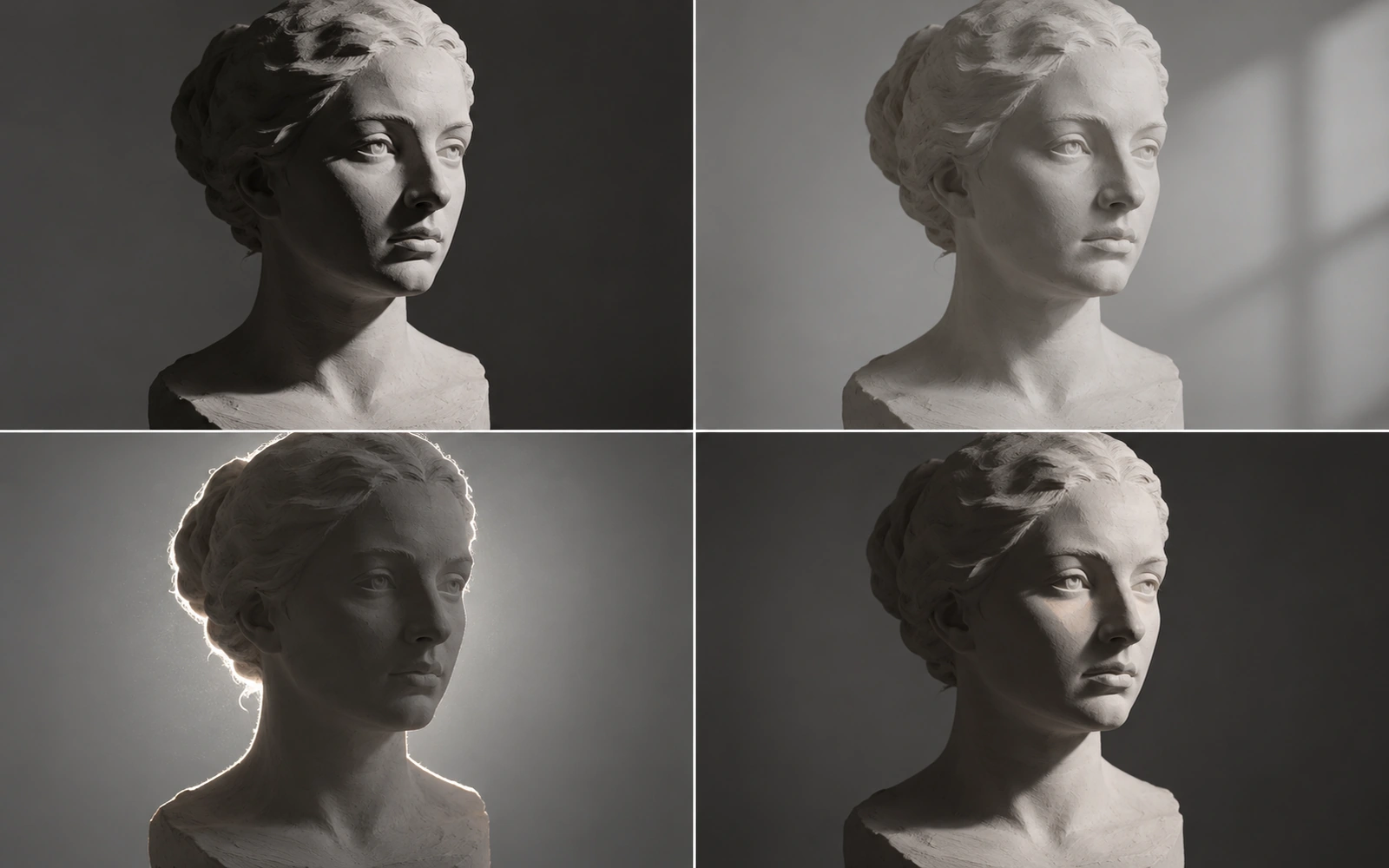
Source, direction and quality: soft window light from the left, hard noon sun, neon from below, candlelight.
Named hues and their relations: muted teal and rust, a monochrome blue, one red accent in a grey scene.
Texture and feeling
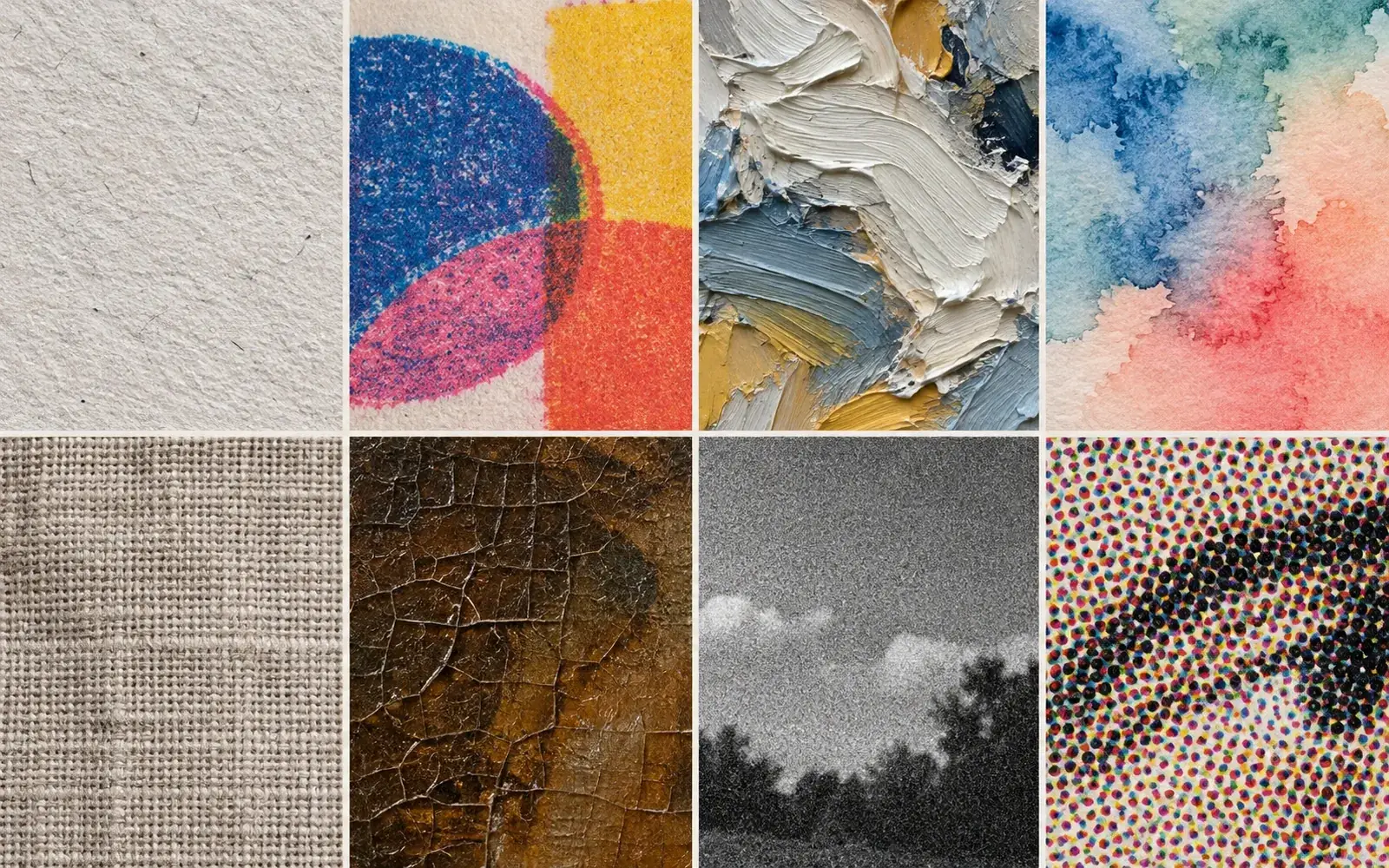
Surfaces that carry light: wet asphalt, brushed brass, linen, chipped enamel, frosted glass.
What fills the air: haze, steam, dust, drizzle, smoke, snow.
One clear emotional tone, shown through the parts above rather than piled on as adjectives.
How finished the image is: loose sketch, clean graphic, intricate, hyper-detailed.
How much to specify
Decide the two or three things that must be right: often subject, light and medium.
Leave secondary things open, a face, the exact trees, so the model can surprise you.
Most tools give more weight to what comes first; put the subject and the essential look early.
Short prompts give the model's defaults; very long ones dilute each word. Aim for one clear paragraph.
Describe light, not mood
Source, direction, hard or soft, how much contrast, what colour. 'Warm tungsten light from a desk lamp on the left falls across her face, leaving the right side in soft shadow.'
A visible lamp, candle or screen motivates the light: 'lit only by a desk lamp visible in frame, a warm pool of light falling away'.
If the source is off-frame, say where it is and what it hits: 'a TV below frame on the left casts a cold blue flicker across his face'.
Say what stays in shadow: 'the room behind her remains almost black', 'deep shadow under the brim of his hat'.
Beams need something to pass through: thin haze, dust, steam or mist.
Words like softbox or reflector can appear as objects in the image. Describe the effect: large soft light from the left, gentle falloff.
Instead of 'colourful lighting': warm lamp on the face, faint blue from the window.
In video, tie the change to a cause: 'as she opens the door, warm hallway light spills across the floor'.
Classic lighting, in words
Key light 45 degrees to the side and above eye level, a small triangle of light on the shadow-side cheek.
Hard side light, one half of the face lit, the other in deep unbroken shadow.
'A thin silver rim light traces her hair and shoulders against a black background.' Strong backlight gives silhouette and mystery.
'Soft window light from camera left, diffused through a sheer curtain'; 'overcast daylight, nearly shadowless'.
Water, glass and materials
Say where the light patterns land: 'water caustics on the skin and the tiled floor', 'on the pale stones beneath the water'.
'Sunlight passing through the rippling surface, casting shimmering bands that crawl across the pool floor.' Keep caustics pale white or blue, never neon.
Start simple: 'sunlight filtering through water'. For clear shallow water without a blue cast: 'neutral underwater light, natural colours'.
Reflection sits on the surface; refraction bends the view through it: 'faint sky reflections on the surface, the riverbed distorted below'.
Refraction reads only against a known background: 'the window frame appears bent through the curved glass'. Frosted glass gives soft silhouettes and diffused light.
Give the finish a direction: 'brushed aluminium, fine horizontal scratches, long highlights running the same way'.
'A brass handle dark in the engraved recesses, polished bright where hands touch it.' Condition words, weathered, chipped, rusted, add history.
Instead of 'hyper-detailed': 'coarse linen with visible threads, soft creases at the elbows, slightly frayed cuffs'.
Expression and gaze
Instead of 'she looks nervous': 'she twists a ring between her fingers and glances toward the door'.
'Her head faces forward, but her eyes glance toward the doorway on her right.'
'He looks down at the unopened letter between his hands', or 'at something just out of frame'.
Instead of 'confident CEO': 'upright posture, shoulders relaxed, hands resting loosely on the table'.
'One child holds the flashlight while the other examines the map', not two children beside a map.
A couple of distinctive details anchor a person: 'short silver bob, small scar through the left eyebrow'.
Framing and camera
'Tight close-up of her face' or 'wide shot' before any atmosphere; framing decides what the image is about.
'Low angle looking up at the statue' is clearer than 'low angle'.
'Eyes in sharp focus, background falling into soft blur' tells the model where attention goes.
'Her face stays sharp while passing headlights stretch into soft streaks behind her.'
Framing through rain-covered glass, a fence or leaves makes a shot feel observed and intimate.
'Full-length portrait, both shoes visible, a small margin above the head.'
Instead of 'professional photo': 'candid compact-camera snapshot, direct flash, casually off-centre'.
For one exact pose or layout, an image reference does more than another paragraph.
Rules that hold across tools
Put the subject and its key visual trait first; many models weigh early words more, though it varies by model.
'Masterpiece, stunning, beautiful' do almost nothing; 'wet cobblestones, muted greens, overcast light' do.
Modern models read natural language; a clear sentence beats a list of tags.
Instead of 'no people': 'an empty platform after midnight'.
'Exactly three red apples in a row', knowing counting is still a weakness.
'A red ceramic cup beside a blue linen notebook', not colours and materials scattered across the prompt.
Instead of 'luxury apartment': 'travertine walls, walnut cabinets, hidden lighting, floor-to-ceiling glass'.
Choose soft even light or hard light with deep shadows, not both.
Overloaded prompts average out; build complexity across generations.
'Change only the coat to dark green wool; keep the face, pose, framing and light.'
Words to describe The Anatomy of an Image Prompt
Precise words for the qualities above. Combine a few of them instead of naming the style or artist alone.
- clear subject and action
- named medium
- specific setting and time
- framing and viewpoint
- light source and direction
- named colour palette
- material and surface
- atmosphere in the air
- one clear mood
- level of detail
A prompt in four lines: 'An old ginger cat asleep on a stack of newspapers in a corner shop at dawn. Shot on 35mm film, low angle, the cat in the lower third. Cold blue daylight from the door, one warm lamp behind the counter. Dusty, quiet, slightly melancholy.'
How to describe The Anatomy of an Image Prompt in words
- Start with the subject and what it is doing, in one plain sentence.
- Add medium, light and composition, each in a few words.
- End with one mood or atmosphere, then stop.
Where we usually get it wrong
The most common prompt is all style and no subject: 'cinematic, moody, 8k, masterpiece'. Those words add clichés, not information. A clear subject, a named light source and a medium will do more than any list of quality tags.
Take any photograph you like and write its prompt in four lines: subject and action; setting and time; medium and composition; light, colour and mood. Then cross out every word that is not doing a job.