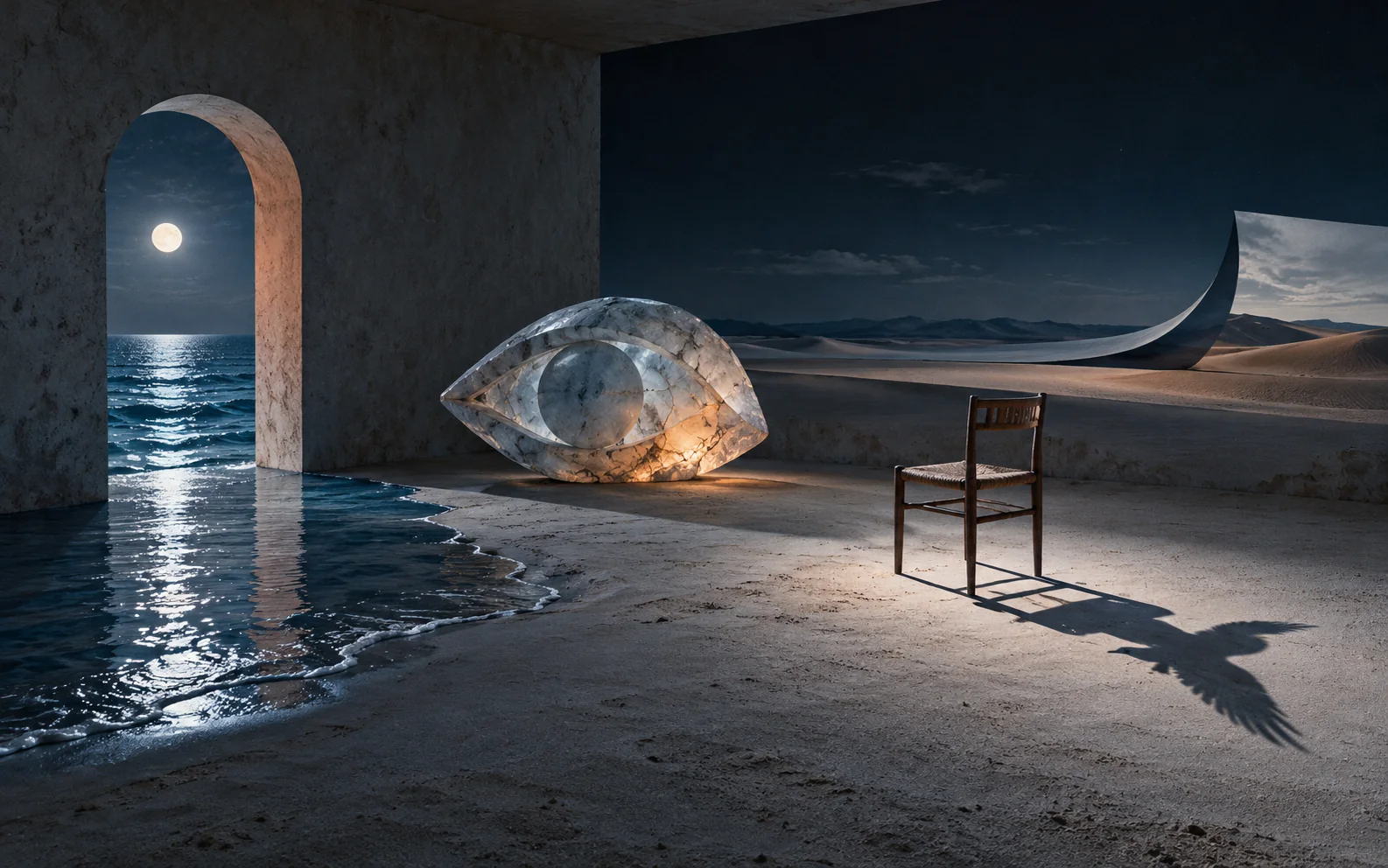
The reality under logic
Surrealism emerged in the 1920s from a desire to move beyond rational control. Writers and artists treated dreams, automatic thought, unexpected encounters, and psychic tension as ways to reach a reality beneath everyday logic.
Its power does not come from adding random strange objects. A convincing surreal image makes the impossible feel internally inevitable: familiar things obey an unfamiliar but consistent law.
Visual anatomy
Stable-looking scenes are interrupted by one impossible relationship. Calm structure makes the rupture more persuasive.
Color may look natural and quiet, or become emotionally charged. The palette supports the dream logic instead of merely decorating it.
Objects become monumental, miniature, or physically incompatible. Scale is used to unsettle meaning and hierarchy.
Perspective often appears credible at first, then folds, loops, or contradicts itself.
Everyday objects are displaced, fused, repeated, or given an unexpected role. Recognition and estrangement happen together.
Repetition and visual silence slow the viewer down. The image works through suspense rather than constant spectacle.
How to recognize it
- A familiar world follows one or two impossible rules.
- The scene creates psychological tension before it explains itself.
- Metamorphosis, displacement, dream space, and unlikely juxtapositions carry meaning.
Where people get it wrong
Surrealism is often reduced to “weird imagery.” Randomness alone is not enough. Dada may emphasize disruption and anti-art; fantasy often builds a separate fictional world. Surrealism usually destabilizes the world we already know.
The words to describe it
Precise words for the qualities above. Combine a few of them instead of naming the style or artist alone.
- dreamlike juxtaposition
- impossible scale
- displaced everyday objects
- uncanny stillness
- metamorphosis
- long raking shadows
- deep empty perspective
- smooth illusionistic painting
- collage
- automatic drawing
An ordinary sunlit room painted with smooth, precise realism. One window opens onto the open sea instead of the street. Long late-afternoon shadows, a quiet muted palette, everything calm except one impossible rule.
What to take from it today
- Start with an ordinary scene and change only one governing rule.
- Use material, scale, or gravity to express an emotional conflict.
- In motion, let the transformation arrive slowly enough for the viewer to register the original reality.
Photograph or sketch a completely ordinary room. Choose one emotional state, then alter only one physical law to embody it. Remove every strange detail that does not support that law.