New tools, new ways of seeing
László Moholy-Nagy brought an experimental view of photography, film, typography, sculpture, and industrial material into the Bauhaus. He believed new tools could train new ways of seeing rather than simply imitate older art.
Photograms, oblique viewpoints, transparency, reflection, and moving light made perception itself visible. The work asks how technology changes not only what we make, but what we are able to notice.
Visual anatomy
Strong diagonals and off-center balance make the frame feel active and provisional.
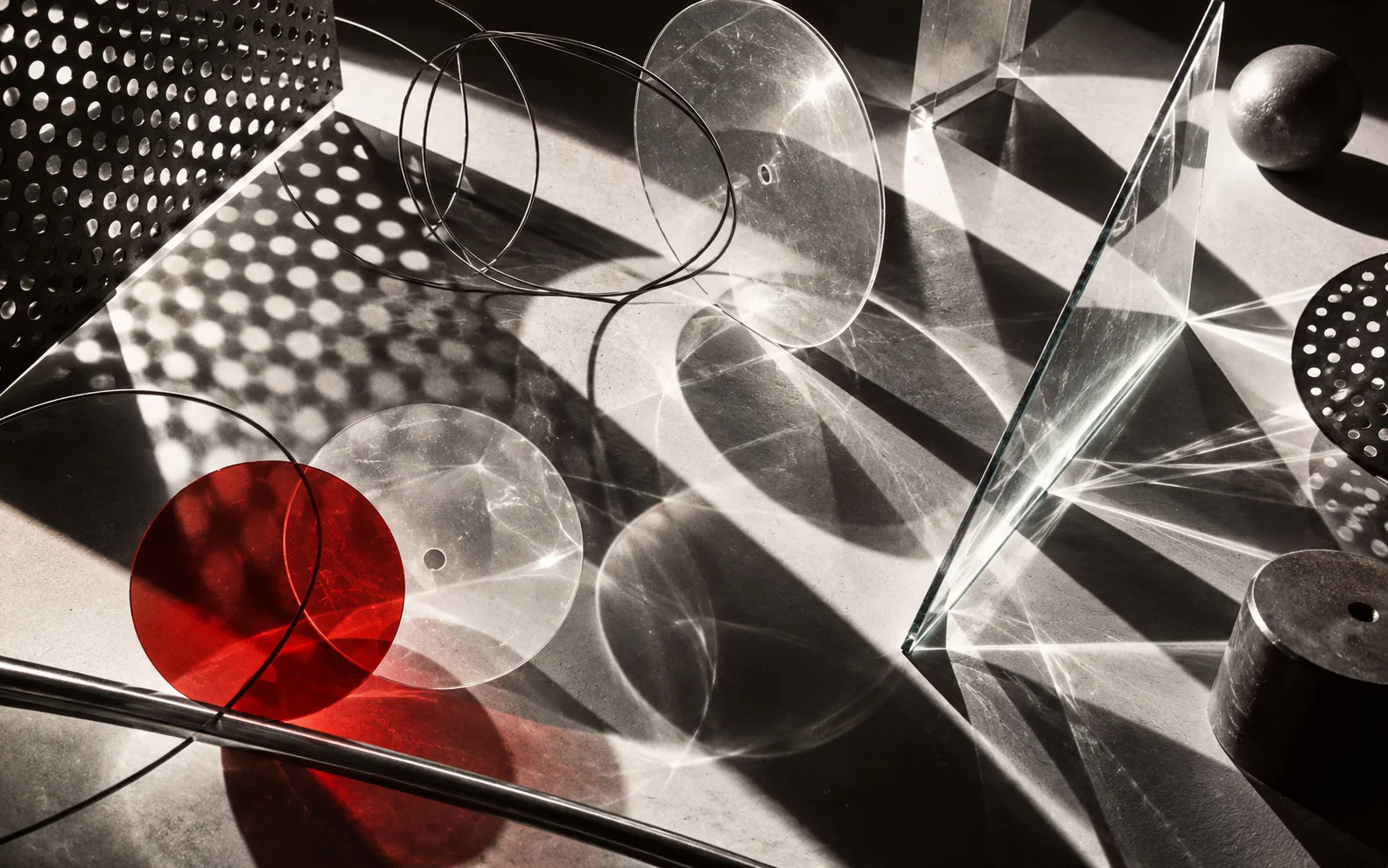
Light is treated as material. Shadow, reflection, projection, and exposure produce form.
Glass, mesh, film, and overlapping shapes create layered depth without heavy mass.
High and low camera angles interrupt habitual vision and reveal new spatial relations.
Typography becomes construction: scale, direction, and spacing carry meaning alongside words.
The result grows from testing processes and instruments. Failure is information, not waste.
How to recognize it
- Light and material appear to be in conversation.
- The viewpoint makes ordinary structure feel newly engineered.
- Photography or typography is used as construction, not neutral documentation.
Where people get it wrong
His work is more than metallic geometry or a “Bauhaus filter.” The central lesson is experimental perception: test what a medium can reveal, especially where light, material, movement, and technology meet.
The words to describe it
Words for what you see and feel in this work. They are for describing and understanding, not a recipe for copying an artist.
- photogram
- raking light
- cast shadows
- transparency and overlap
- perforated metal
- glass and Plexiglas
- bird’s-eye and worm’s-eye views
- diagonal composition
- kinetic light
- constructivist typography
A black-and-white photogram: translucent glass discs, a strip of perforated metal and a coil of wire laid on paper and exposed to a single light. Soft overlapping shadows, a strong diagonal.
What to learn from it
- Use a tool to discover an image, not only execute a predetermined one.
- Photograph reflections, shadows, and transparent layers as subjects in their own right.
- Let type change direction or scale only when it clarifies the structure of information.
Make a camera-less image study with translucent objects and one light source. Change distance and angle five times, recording how each variable changes the result.