Nearly ninety years of looking
Katsushika Hokusai worked across prints, illustrated books, drawing manuals, and painting. His long career changed repeatedly, but sustained curiosity and close observation remained constant.
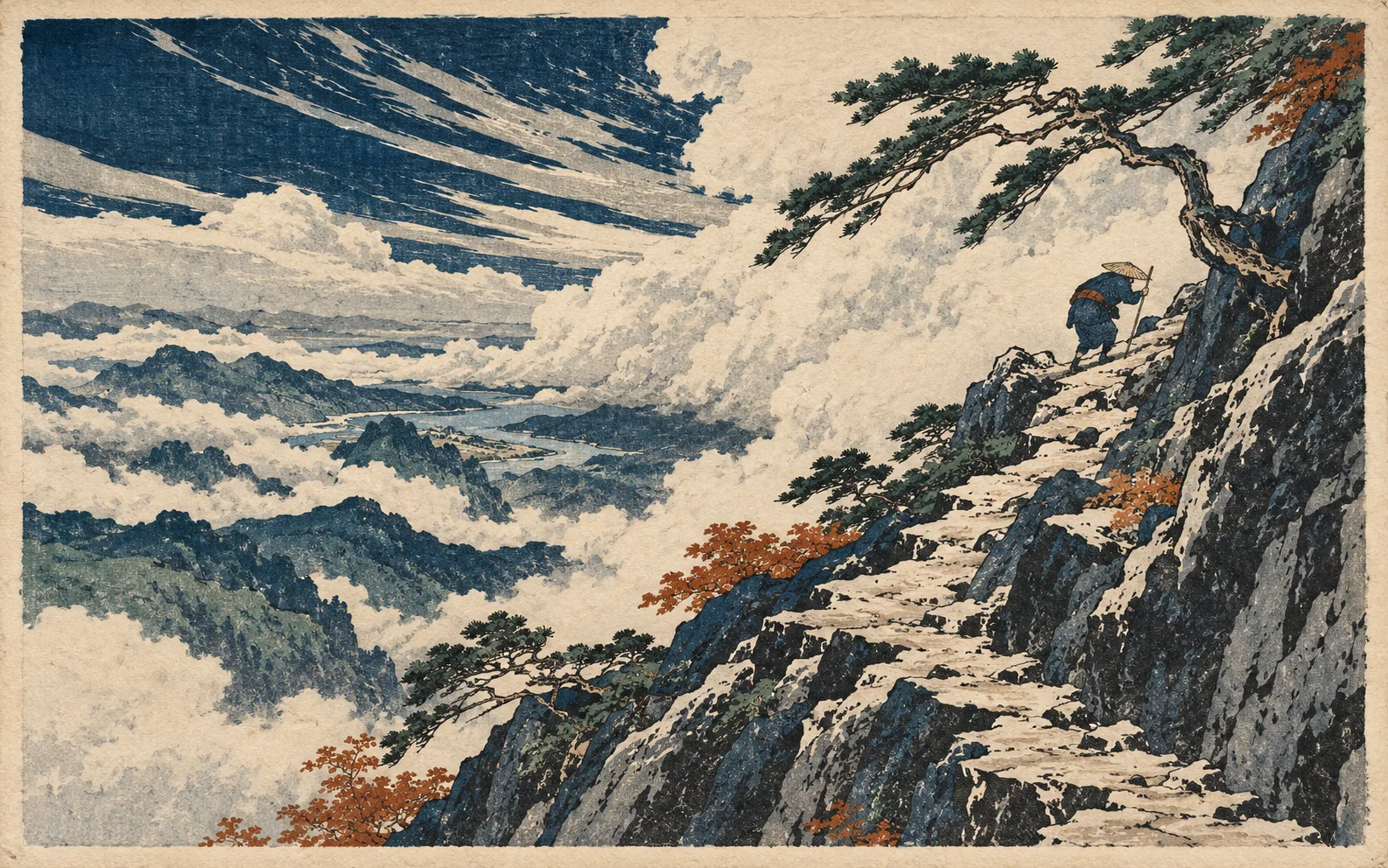
He made landscape active rather than passive. Mountains, waves, wind, bridges, workers, and travelers form systems of force where human scale and natural scale meet.
Visual anatomy
Diagonal structures, abrupt crops, and foreground obstacles create depth and immediacy.
Line changes behavior to describe weight, speed, surface, and gesture. It is analytical and expressive at once.
Small human figures clarify the magnitude of weather and landscape without disappearing from the story.
Curves and repeated marks map forces such as wind, water, cloth, and labor.
The scene may be seen from above, below, through an opening, or behind an object. Looking itself becomes a subject.
Revisiting one motif across many conditions reveals difference inside repetition.
How to recognize it
- Natural forces organize the entire image.
- A surprising viewpoint makes a familiar subject newly visible.
- Human activity and landscape are joined through rhythm and scale.
Where people get it wrong
Hokusai is not one famous wave, and his visual language is not a shortcut for generic Japanese imagery. Studying him means studying observation, serial variation, line intelligence, and the relationship between people and natural force.
The words to describe it
Words for what you see and feel in this work. They are for describing and understanding, not a recipe for copying an artist.
- woodblock print
- Prussian blue
- strong diagonal
- tiny figures against vast nature
- curling wave crests
- Mount Fuji as a recurring motif
- unusual viewpoints
- rhythmic contour line
- series of views
- sketchbook studies
Travelers bent against the wind on a mountain path, tiny under a vast sky. Leaves and paper scattered in a diagonal gust, Prussian blue and pale ochre print colors, crisp contour lines.
What to learn from it
- Revisit one subject in different seasons, distances, and social contexts.
- Use line to describe forces you cannot hold, such as wind or pressure.
- Place the viewer somewhere specific instead of defaulting to a neutral camera angle.
Draw the same local landmark from five positions: very low, very high, partly blocked, extremely close, and from far away with people in the foreground.