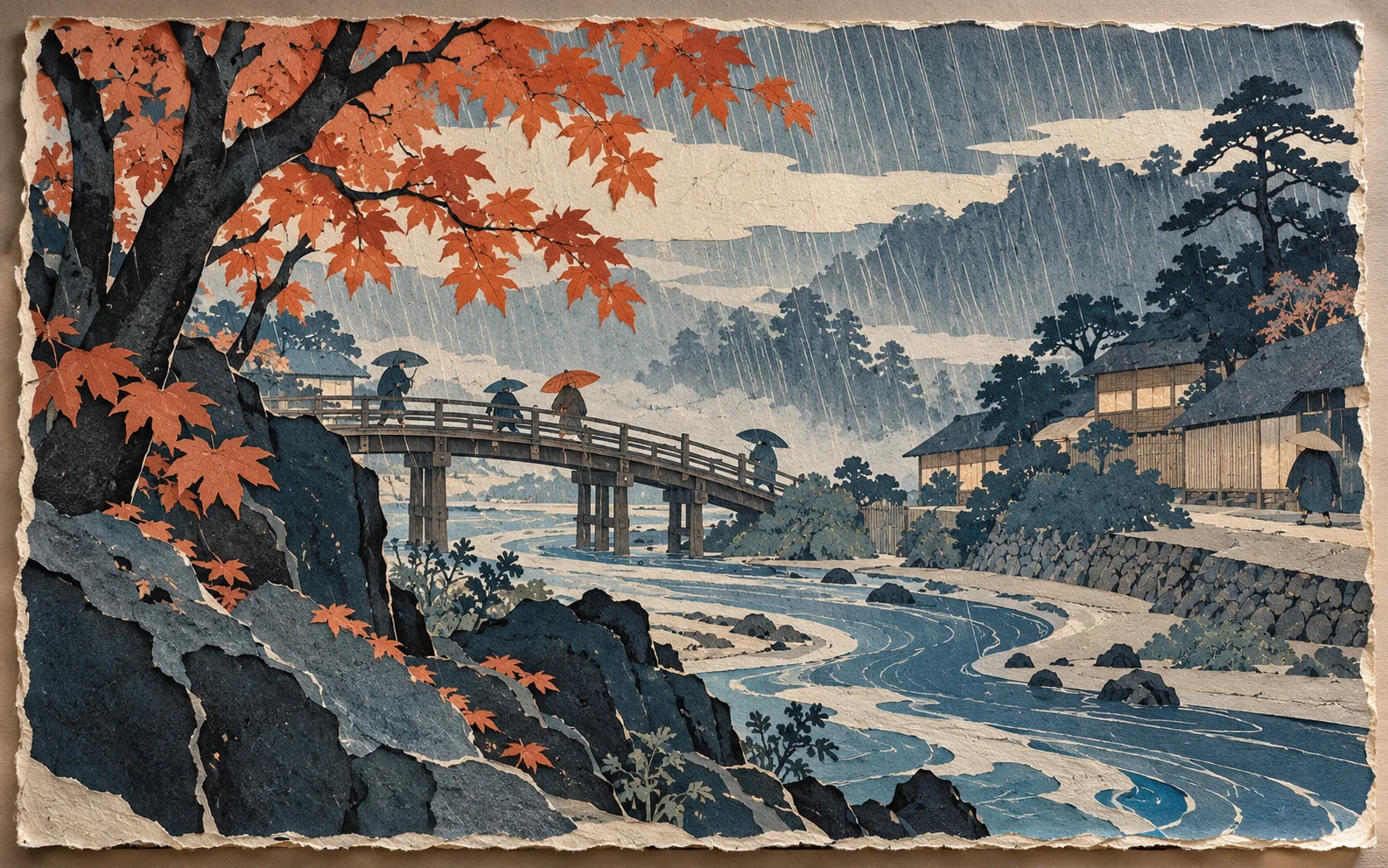
Prints for the people of the city
Ukiyo-e developed in Edo-period Japan as a popular culture of woodblock prints. It pictured actors, courtesans, city pleasures, travel, weather, and landscape for a broad urban audience.
Its economy came from collaboration among designer, carver, printer, and publisher. The image had to survive translation into carved lines and layered impressions, making clarity and rhythm essential.
Visual anatomy
Cropping is bold and viewpoints can be high, low, or sharply diagonal. The frame feels like a selected instant.
Flat color areas are layered with restraint. A limited palette creates atmosphere through relationship rather than shading.
Contour carries weight, movement, texture, and character. Different lines describe wind, cloth, water, and architecture.
Overlapping planes and scale shifts create space without depending on Western linear perspective.
Rain, snow, mist, waves, and wind are active structures. Nature shapes how the whole composition moves.
Repeated marks and curves guide the eye across the sheet like a visual tempo.
How to recognize it
- Decisive contour and flat color do most of the descriptive work.
- The viewpoint or crop feels unusually active.
- Weather, pattern, and human gesture form one rhythmic system.
Where people get it wrong
Ukiyo-e is broader than a decorative “Japanese look.” It is a specific print culture with subjects, production methods, and audiences. Nihonga is a later painting category; manga has different historical and narrative structures despite important continuities.
The words to describe it
Precise words for the qualities above. Combine a few of them instead of naming the style or artist alone.
- woodblock print
- flat color areas
- bold black keyline
- Prussian blue
- bokashi gradient
- high viewpoint
- dramatic cropping
- diagonal rain lines
- washi paper grain
- layered planes
A woodblock print of a narrow bridge in heavy rain. Diagonal rain lines, flat indigo and muted green areas, a soft bokashi gradient in the sky, figures with umbrellas cut off at the edge, visible paper grain.
What to take from it today
- Use cropping to make an ordinary moment feel observed rather than staged.
- Describe movement through repeated lines instead of blur.
- Build atmosphere with a limited palette and layered planes.
Choose a familiar street in one kind of weather. Draw it using five flat colors and three line behaviors: one for built space, one for people, and one for weather.