A name that started as an insult
In 1874 a group of painters rejected by the official Paris Salon held their own exhibition. A critic mocked one canvas, Monet's 'Impression, Sunrise', and the name stuck. Monet, Renoir, Pissarro, Sisley, Morisot and others shared an interest in modern life and in the changing effects of light.
New tools helped: paint in portable tubes made working outdoors practical, and new pigments brightened the palette. Instead of blending colors smoothly, they placed strokes side by side and let the eye mix them, so the surface stays alive and vibrating.
Visual anatomy
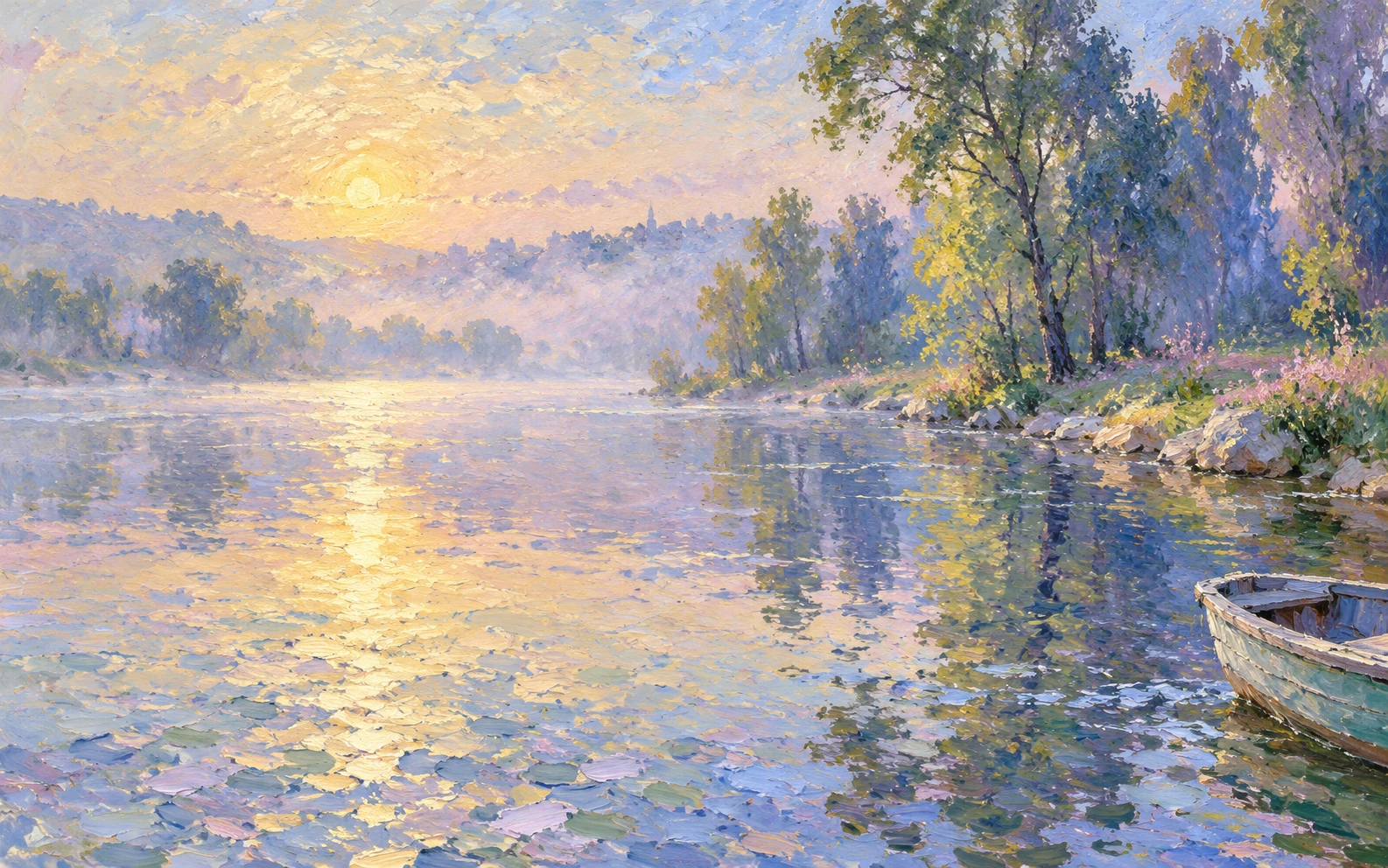
Short, visible, broken strokes. The hand and the speed of painting stay on the surface.
The real subject. The same haystack or cathedral changes completely with the hour and the weather.
Bright, unmixed colors placed side by side. Shadows are colored, often blue or violet, not black.
Casual, cropped, off-center views, like a glance; Japanese prints and photography both influenced this.
Modern everyday life: boulevards, cafés, railway stations, gardens, rivers, leisure.
Soft and dissolving. Forms melt into atmosphere instead of being outlined.
How to recognize it
- You can see every stroke, but the scene reads from a distance.
- Shadows are full of color.
- It feels like one specific time of day.
Where people get it wrong
Impressionism is not 'blurry' or careless; it is a precise study of how light behaves. Post-Impressionists such as Van Gogh, Cézanne and Seurat built on it but pulled in different directions: structure, emotion, or systematic dots.
The words to describe it
Precise words for the qualities above. Combine a few of them instead of naming the style or artist alone.
- broken brushstrokes
- en plein air
- dappled sunlight
- colored shadows
- high-key palette
- hazy atmosphere
- impasto texture
- casual cropping
- soft dissolving edges
- fleeting moment
A river bank in early morning haze, painted outdoors in short broken strokes. Pale yellow light on the water, lilac and blue shadows under the trees, a small boat cropped at the edge, no hard outlines anywhere.
What to take from it today
- Choose a time of day before choosing a subject.
- Make shadows from color, not from black or grey.
- Keep the mark visible; let the eye finish the mixing.
Look at the same window or street at three different hours. Make three quick color studies, ten minutes each, using no black at all. Compare how the shadows change.