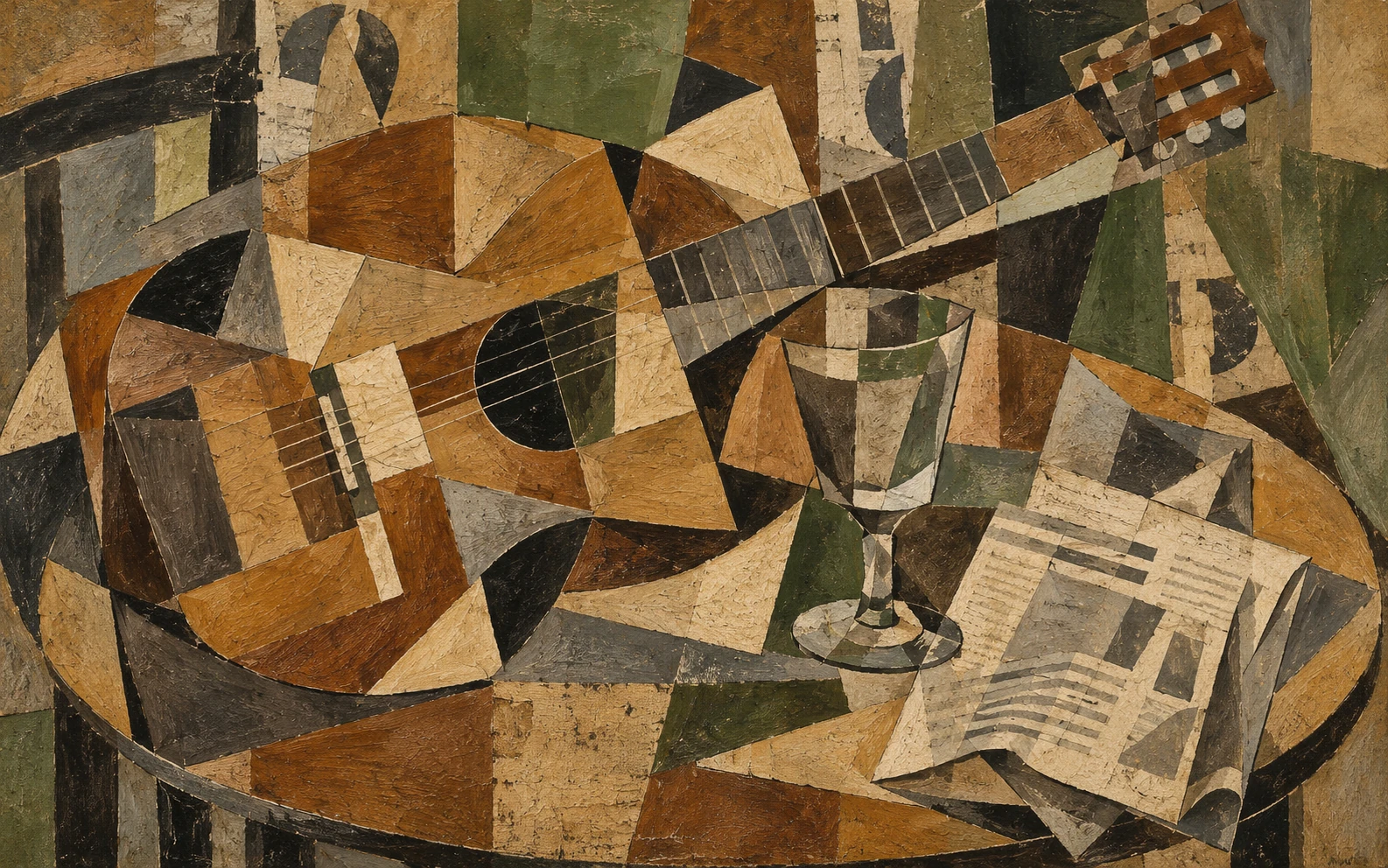
What if the eye could move?
Pablo Picasso and Georges Braque developed Cubism in Paris from around 1907, working so closely that their paintings were sometimes hard to tell apart. Cézanne's late work, which built nature from simple volumes, and non-European sculpture were key influences.
Painting since the Renaissance had assumed one fixed eye. Cubism asked what happens if you walk around a guitar, a face or a bottle, and put all those views onto one surface. The first, 'analytic' phase (about 1909–1912) splits forms into small facets in muted browns and greys; the 'synthetic' phase (from about 1912) builds images from larger flat shapes, brighter color and pasted paper.
Visual anatomy
Several angles appear at once: a profile and a front view, the top and the side of a table.
Objects are broken into flat, overlapping facets that slide into the background.
Analytic Cubism keeps to ochre, brown, grey and green so that structure dominates; Synthetic Cubism brings color back.
Shallow and ambiguous. There is no clear horizon or vanishing point.
Everyday, quiet things: guitars, bottles, glasses, newspapers, pipes, portraits of friends.
Letters, wood-grain imitation, sand and pasted paper bring real-world fragments into the painting.
How to recognize it
- One object seen from more than one side.
- Forms broken into angular planes.
- Little depth: everything presses toward the surface.
Where people get it wrong
Cubism is not just 'pointy shapes' or a face with two noses. It is a method for rebuilding vision. Futurism borrowed its fragmented planes to show speed and motion, which Cubism, mostly still and quiet, did not aim for.
The words to describe it
Precise words for the qualities above. Combine a few of them instead of naming the style or artist alone.
- multiple viewpoints
- fragmented planes
- faceted forms
- shallow space
- muted ochre and grey
- overlapping transparent planes
- still life with guitar
- stenciled letters
- papier collé
- geometric simplification
A still life of a guitar, a glass and a folded newspaper on a café table, broken into overlapping flat planes. Muted ochre, brown and grey, stenciled letters on one fragment, the guitar seen from the front and the side at once, shallow space with no horizon.
What to take from it today
- Draw what you know about an object, not only what one eye sees.
- Limit the palette when structure is the point.
- Mix drawn, painted and real materials on the same surface.
Put a cup on a table. Draw it from the front, from above and from the side on separate pieces of paper, then cut and recombine them into one image that still reads as a cup.