Nothing to look through, only something to look at
Minimalism emerged in the United States in the 1960s with artists such as Donald Judd, Dan Flavin, Carl Andre, Sol LeWitt and Robert Morris, with Frank Stella's black paintings and Agnes Martin's grids close by. It reacted against the emotional, gestural painting of the previous generation.
Many of these works were fabricated industrially from plywood, steel, aluminum, bricks or fluorescent tubes. Without a story or an expressive hand, attention shifts to proportion, material, the room and the body of the person walking around it. The word was later borrowed by design, music and lifestyle, often with a looser meaning.
Visual anatomy
Simple geometric units: cubes, rectangles, lines, grids.
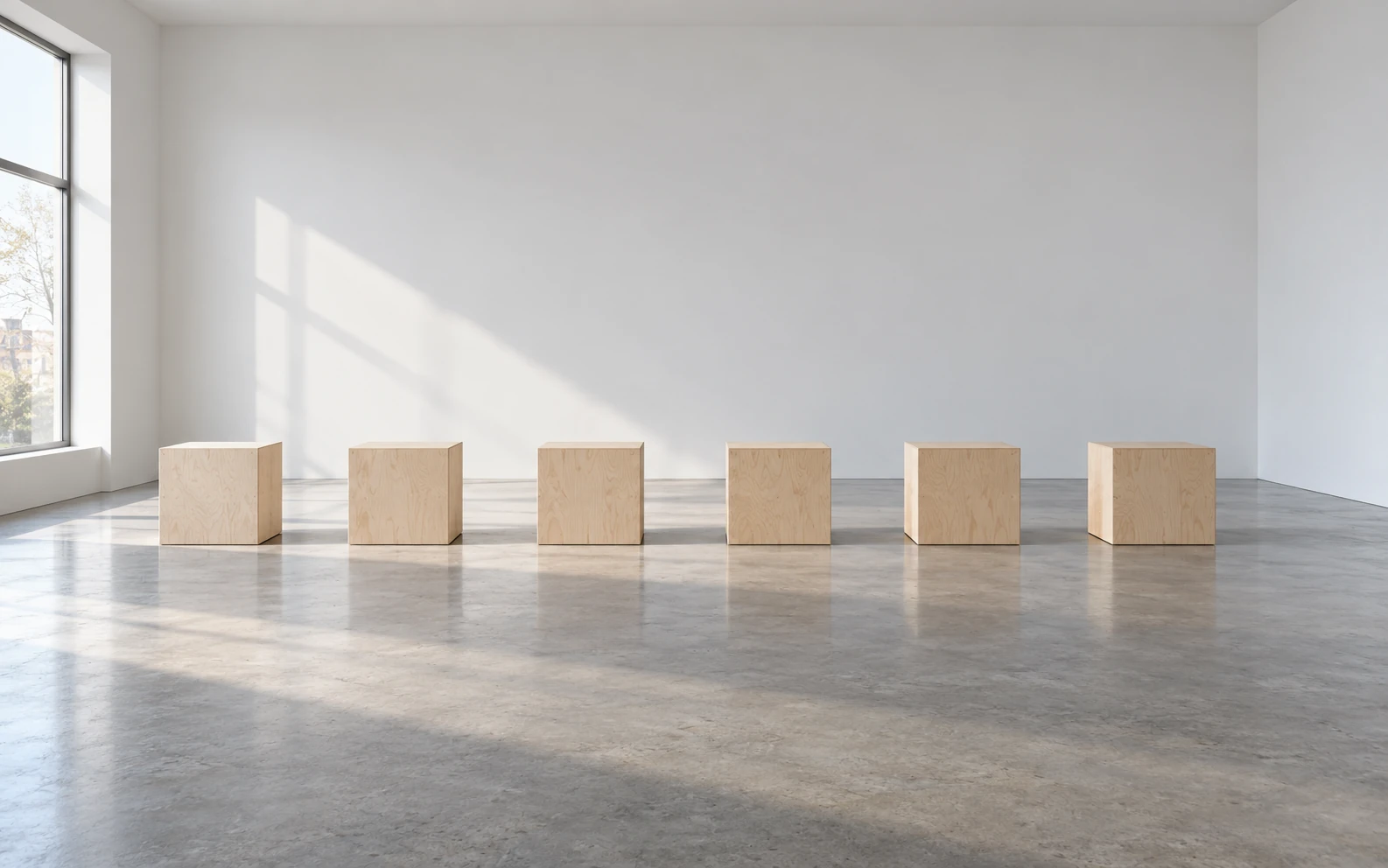
Identical units in a series or at regular intervals; order replaces composition.
Industrial and untreated: steel, aluminum, plywood, Plexiglas, brick, fluorescent light.
Either the material's own color or a single, even, factory-like color.
The room is part of the work. Floor, walls, light and distance matter.
Smooth, impersonal, without visible brushwork or the artist's hand.
How to recognize it
- Very few elements, often repeated exactly.
- The material is presented as itself.
- You become aware of the space and your own position.
Where people get it wrong
Minimal art is not the same as 'minimal design' or a clean interior with few objects. Its emptiness is not decoration; it is a way of changing how you pay attention. Reductive does not mean easy: proportion and placement carry everything.
The words to describe it
Precise words for the qualities above. Combine a few of them instead of naming the style or artist alone.
- geometric primary forms
- serial repetition
- industrial materials
- fluorescent light
- neutral palette
- gallery white cube
- precise proportion
- unpainted plywood
- floor-based sculpture
- negative space
A white gallery room with a polished concrete floor. Six identical pale plywood boxes placed in a straight line at equal intervals, soft daylight from one side, long quiet shadows, nothing else in the room.
What to take from it today
- Remove until each remaining element has a reason to stay.
- Let one material speak instead of mixing many.
- Design the space around the object, not only the object.
Take ten identical objects (cups, books, stones). Arrange them in three different ways on the floor: a line, a grid and an irregular cluster. Photograph each from the same spot and compare how the room changes.