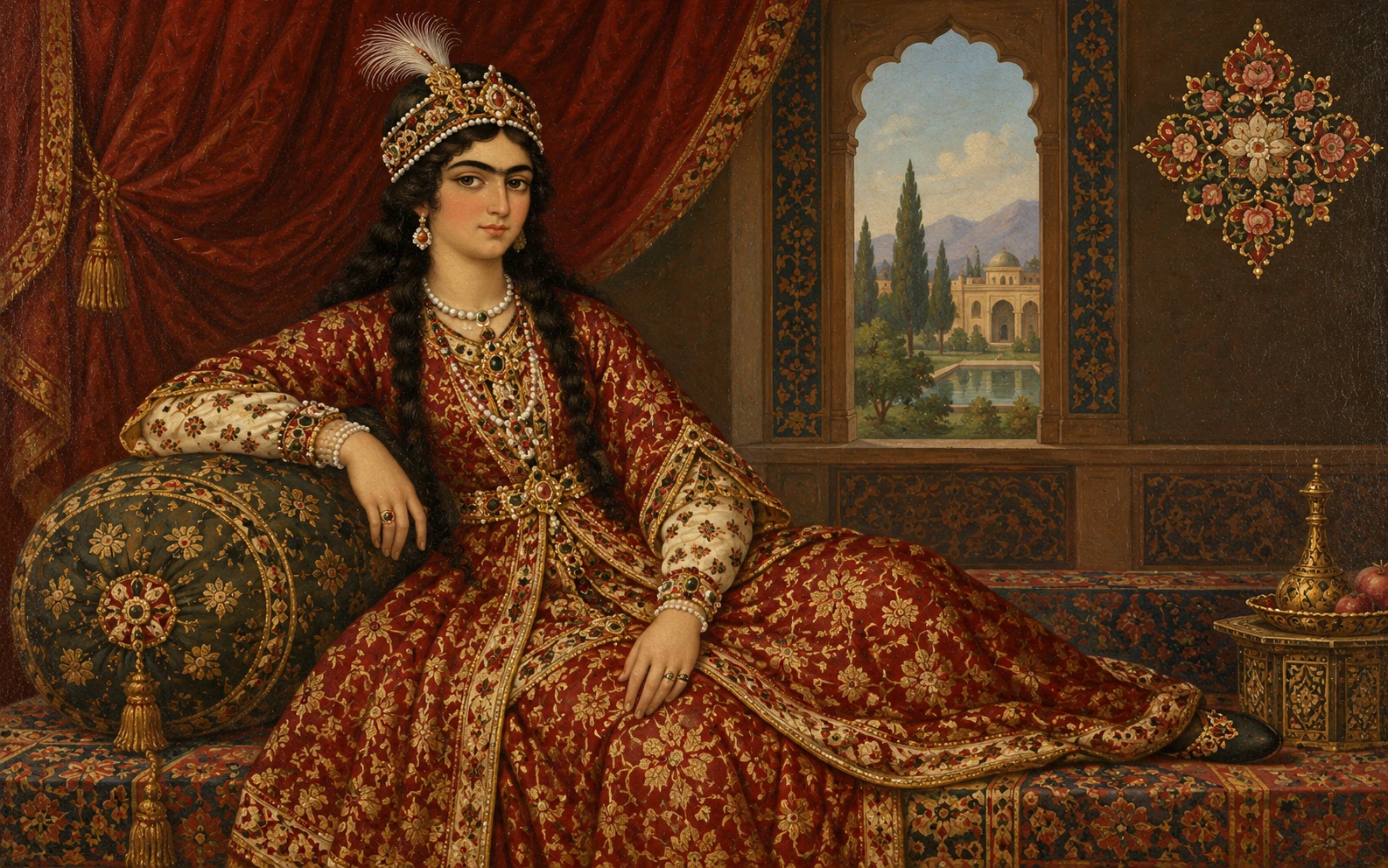
A court that wanted to be seen
The Qajar dynasty ruled Iran from the late eighteenth century until 1925. Under Fath-Ali Shah, court painters made large oil portraits of the ruler, princes, dancers and musicians: imposing figures with long beards, narrow waists, jeweled clothes and almond eyes, set before curtains and arches. Painters such as Mihr Ali shaped this image of power.
Over the century, contact with Europe brought oil painting, perspective and, under Naser al-Din Shah, the camera; the shah himself photographed his court. Lacquer pen boxes, tilework, textiles and later the coffeehouse paintings of storytellers carried the same visual world into everyday objects. Kamal-ol-Molk, at the end of the era, pushed toward European realism.
Visual anatomy
Frontal or three-quarter poses, idealized faces, joined eyebrows and almond eyes; status matters more than likeness.
Deep red, gold, black and dark green dominate, with jewel-like accents.
Textiles, jewelry, carpets and borders are painted with as much care as faces.
Flat, decorative backgrounds mixed with European curtains, windows and partial perspective.
Oil on canvas, lacquer on papier-mâché, enamel, tile, and early photography.
Inscriptions and cartouches in Persian calligraphy name the sitter or praise the ruler.
How to recognize it
- A mix of Persian flatness and European oil modeling in one image.
- Rich patterns of fabric and jewels fill the surface.
- Poses are formal and ceremonial, almost iconic.
Where people get it wrong
Qajar art is often reduced to 'old Persian portraits' or a vintage filter. It is a period of intense experiment: Persian painting absorbing oil, perspective and photography while keeping its own sense of pattern, flatness and display.
The words to describe it
Precise words for the qualities above. Combine a few of them instead of naming the style or artist alone.
- Qajar court portrait
- almond eyes
- joined eyebrows
- deep red and gold
- jeweled textiles
- draped curtain and arch
- flat decorative background
- lacquer pen box
- Persian calligraphy cartouche
- early albumen photograph
A seated figure in a heavily patterned robe of red and gold, one hand resting on a cushion, painted in oil with flat, decorative background, a draped curtain and an arched window behind, a calligraphic cartouche in the upper corner, warm varnished surface.
What to take from it today
- Treat pattern and textile as part of the composition, not background.
- Mix two visual systems on purpose and let the seam show.
- Use pose and costume to say who someone is.
Make a portrait of a friend in one formal pose. Paint or collage the clothing with a dense pattern, keep the background flat, and add one European-style element: a curtain, a window or a cast shadow.