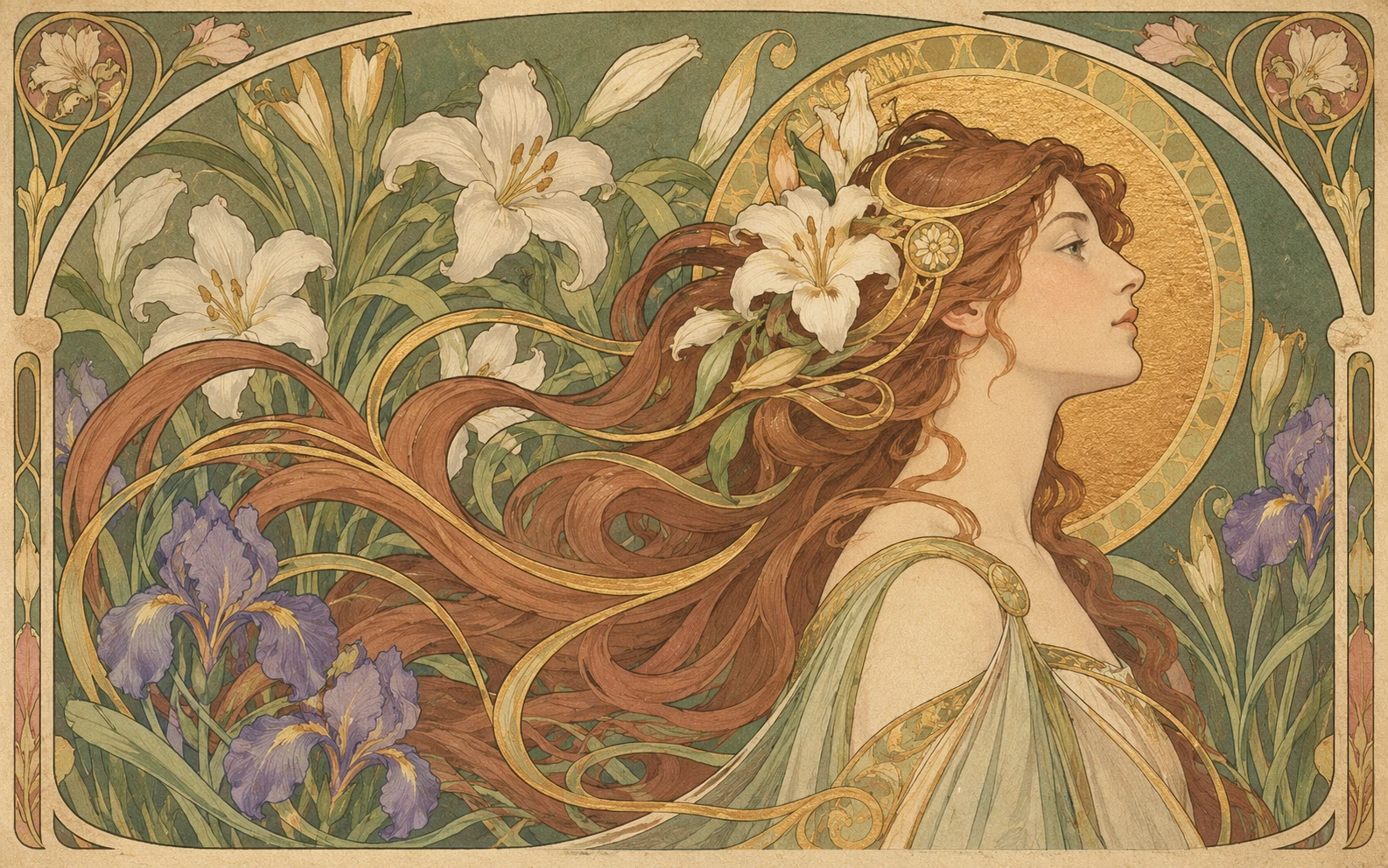
A line that grows
Art Nouveau spread across Europe and beyond around 1890–1910, under many local names: Jugendstil in Germany, Secession in Vienna, Modernisme in Barcelona, Stile Liberty in Italy. Designers wanted a new art that did not borrow from past styles, and they found it in the structure of plants, insects and water.
Its ambition was total. The same curve could shape a lamp, a staircase railing, a book cover and a poster, so that everyday life felt designed as one organism. Japanese prints, newly popular in Europe, taught it flat color, bold outline and asymmetric framing.
Visual anatomy
The long whiplash curve is the signature: it swells, thins and doubles back like a stem or a strand of hair.
Decoration is structural. Frames, borders and lettering grow from the same motifs as the image.
Lilies, irises, poppies, peacocks, dragonflies and seaweed are drawn as rhythm rather than botany.
Women with flowing hair often anchor posters, framed by halos, arches and circular motifs.
Soft, harmonious palettes: sage, ochre, dusty rose, gold and cream, often in flat areas.
Wrought iron, stained glass, enamel, carved wood and mosaic are bent into organic forms.
How to recognize it
- Lines curve and flow; very few right angles survive.
- Image, border and lettering are one design.
- Nature is stylized into pattern, not copied.
Where people get it wrong
Art Nouveau is often confused with Art Deco. Nouveau curves and grows; Deco, a generation later, prefers geometry, symmetry and machine polish. And Art Nouveau is not only Mucha's posters: architecture and applied arts were at its center.
The words to describe it
Precise words for the qualities above. Combine a few of them instead of naming the style or artist alone.
- whiplash curve
- organic ornament
- flowing hair
- stylized flowers
- decorative border
- flat muted color
- gold leaf accents
- stained glass
- wrought-iron tendrils
- asymmetric framing
A tall vertical poster: a woman in profile, her hair unfolding into long curling strands that become the frame. Lilies and a circular halo behind her, flat sage and ochre colors with touches of gold, hand-drawn lettering that curves along the top.
What to take from it today
- Let one line move through the whole layout, from image to frame to type.
- Draw from a real plant, then simplify it into a rhythm.
- Design the border as carefully as the subject.
Pick one plant you can see today. Draw it three times: realistically, as a flowing outline, and as a repeating border. Use the border to frame the first drawing.