Glue as a way of thinking
The word comes from the French 'coller', to glue. Picasso and Braque brought pasted paper, newspaper and printed wallpaper into Cubist works around 1912, and from then on the cut fragment became a modern tool. Dada artists such as Hannah Höch and Raoul Hausmann turned photographs into political photomontage; Kurt Schwitters built whole works from tickets and scraps; the Surrealists used it to stage impossible encounters.
Later, Romare Bearden collaged scenes of Black American life, Matisse 'drew with scissors' in his paper cut-outs, and Pop artists used magazine images. Today digital collage continues the same logic in layers. What stays constant is the meeting of things that were never meant to be together.
Visual anatomy
Every piece carries a past: where it was printed, what it showed, how it was cut.
Cut edges are sharp and deliberate; torn edges are soft and accidental. Both carry meaning.
Overlap creates depth and hierarchy without perspective.
Pieces from different sources rarely match in scale, and that mismatch is often the point.
Paper grain, halftone dots, photo surfaces and handwriting sit side by side.
Meaning comes from what is placed next to what.
What makes it a collage
- You can see the joins between pieces.
- Different kinds of image share one surface.
- Scale, light and perspective do not quite agree.
Where people get it wrong
Collage is not just 'many pictures on one page' or a moodboard. A moodboard gathers references; a collage makes a new image whose meaning comes from the collisions. Photomontage, a branch of collage, uses mostly photographs.
The words to describe it
Precise words for the qualities above. Combine a few of them instead of naming the style or artist alone.
- cut paper
- torn edges
- photomontage
- found imagery
- layered fragments
- mismatched scale
- halftone print texture
- vintage magazine clippings
- visible glue seams
- paper grain
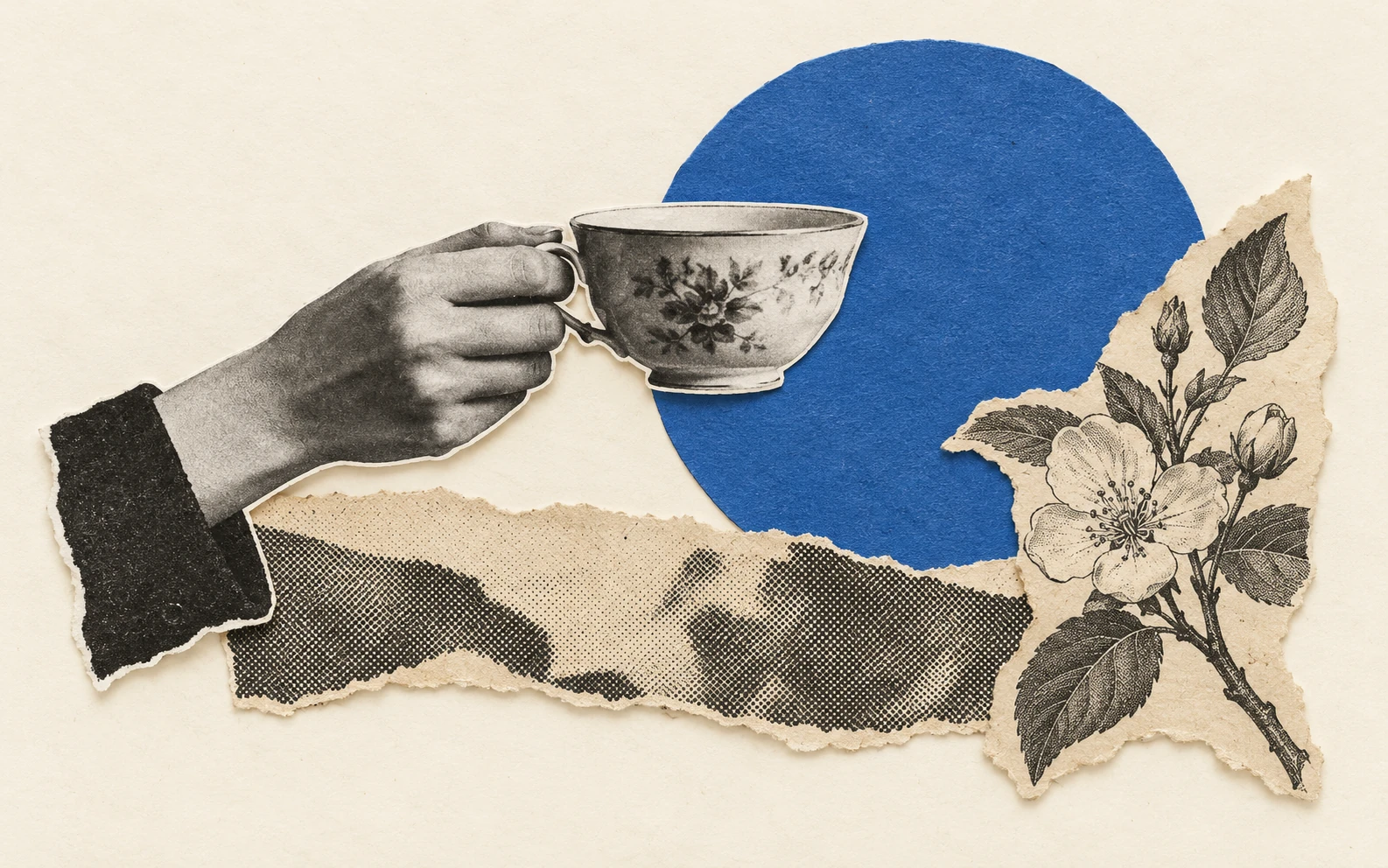
A collage on pale cream paper: a black-and-white cut-out photograph of a hand holding a teacup, a torn strip of old newspaper, a blue paper circle that is slightly too large, visible paper grain and soft shadows along the edges.
What to take from it today
- Choose fragments for what they carry, not only for how they look.
- Decide on one kind of edge, cut or torn, and use it consistently.
- Leave the seams visible; they are part of the language.
Take one old magazine. Cut out ten fragments in ten minutes without planning. Make three compositions using only five pieces each, and give every composition a title.