Seeing as a science
Leonardo was born in 1452 near the town of Vinci in Tuscany and trained in Florence in the workshop of Andrea del Verrocchio, where painters also learned sculpture, metalwork and engineering. In Verrocchio's Baptism of Christ, the angel he painted is said to have outshone his master's work.
He spent long years in Milan at the court of Ludovico Sforza, where he painted The Last Supper on a refectory wall in an experimental technique that began to flake within his lifetime. Back in Florence he began the portrait of Lisa Gherardini, the Mona Lisa, which he carried with him and kept working on for more than a decade. He died in France in 1519, in the service of King Francis I.
Fewer than twenty paintings are firmly his, and many were left unfinished. But more than seven thousand pages of his notebooks survive, written in mirror script: studies of water, flight, rock, light and shadow, plants, and dissections of the human body more accurate than anything before them. For Leonardo, painting was a way of knowing the world.
Visual anatomy of Leonardo da Vinci
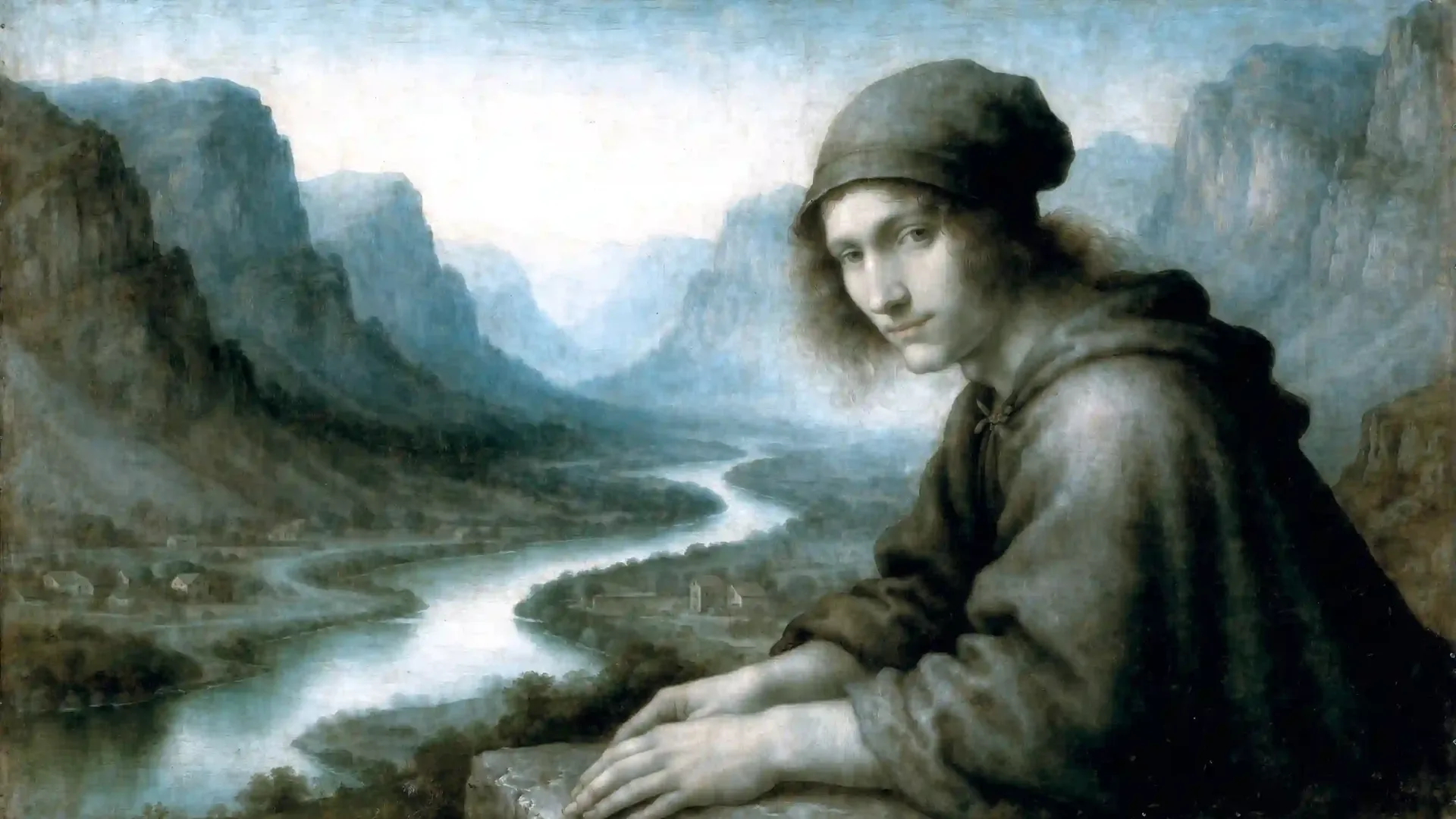
Edges dissolve 'like smoke' through layers of thin glaze, with no hard outlines, especially around eyes and mouth.
Soft, diffused light, as on an overcast day or at dusk, modelling forms gently from light to dark.
Aerial perspective: far mountains turn pale, blue and hazy.
Stable pyramids of figures; carefully studied gestures that show thought and feeling.
Ambiguous expressions, half-smiles, downcast eyes, a sense of an inner life.
Red chalk and pen studies with hatching that follows the form; left-handed strokes slanting from upper left.
Words around Leonardo
From Italian fumo, smoke: soft transitions between tones without lines or borders.
Showing depth by making distant things paler, bluer and less distinct.
A relaxed pose with weight on one leg, giving the body a gentle S-curve.
Leonardo's right-to-left script in his notebooks.
How to recognize Leonardo da Vinci's work
- Soft, smoky transitions with no hard outlines on faces.
- Hazy blue rocky landscapes in the background.
- Calm, pyramidal groups of figures.
- Subtle, ambiguous expressions and gentle hand gestures.
- Warm, muted, slightly darkened colour from aged varnish.
Where people get it wrong
'Sfumato' is often used for any blur or soft focus. It is a painted modelling of form through many thin, transparent layers, so that light turns into shadow without a visible edge while the form stays solid. Also, the Mona Lisa's dark, yellowish look is partly old varnish; originally the colours were brighter.
Words to describe Leonardo da Vinci
Words for what you see and feel in this work. They are for describing and understanding, not a recipe for copying an artist.
- sfumato
- smoky soft edges
- aerial perspective
- hazy blue mountains
- soft diffused light
- thin translucent glazes
- pyramidal composition
- enigmatic half-smile
- red chalk study
- Renaissance portrait
- contrapposto
- notebook sketches
A Renaissance portrait of a young woman in three-quarter view, her hands folded, painted in thin translucent oil glazes with sfumato: no hard edges around her eyes and mouth, a faint enigmatic half-smile, soft diffused evening light, and behind her a winding river and rocky mountains fading into pale blue haze.
What to learn from Leonardo da Vinci
- Ask for edges that melt into shadow, not a blurred image.
- Use aerial perspective: pale blue distance behind warm figures.
- Light the scene softly, as on an overcast evening.
- Give a face one ambiguous detail: a half-smile, a look away.
Questions about Leonardo da Vinci
What is sfumato in Leonardo's paintings?
A technique of building up many very thin, translucent layers of paint so that tones blend imperceptibly, 'without lines or borders, in the manner of smoke', as he wrote. It gives the Mona Lisa's eyes and mouth their soft, shifting expression.
How many paintings did Leonardo da Vinci finish?
Scholars generally attribute fewer than twenty surviving paintings to him, some of them unfinished or shared with his workshop. His notebooks and drawings, more than seven thousand pages, are a larger part of his legacy.
Why is the Mona Lisa so famous?
Its subtle sfumato, the ambiguous smile and the dreamlike landscape made it admired from the start. Its fame exploded after it was stolen from the Louvre in 1911 and recovered in 1913, and it has been reproduced endlessly since.
Look at the corners of the Mona Lisa's mouth and eyes. Describe exactly where light turns into shadow, without using the words 'blur' or 'soft'. Then describe the landscape behind her in three layers, near, middle and far, by colour alone.
Sources and further reading
- Musée du Louvre: Mona Lisa and Leonardo da Vinci, exhibition 2019–2020.
- Martin Kemp, Leonardo da Vinci: The Marvellous Works of Nature and Man, Oxford University Press, 2006.
- Royal Collection Trust: Leonardo da Vinci drawings at Windsor.
- Walter Isaacson, Leonardo da Vinci, Simon & Schuster, 2017.