Drawing to know
Scientific illustration exists to make knowledge visible. Andreas Vesalius's De humani corporis fabrica (1543) set a new standard for anatomical drawing. Maria Sibylla Merian's Metamorphosis insectorum Surinamensium (1705) showed insects, their life stages and host plants together, from her own observations in Suriname. John James Audubon's Birds of America (1827–38) and Ernst Haeckel's Kunstformen der Natur (1904) turned natural history into widely admired art.
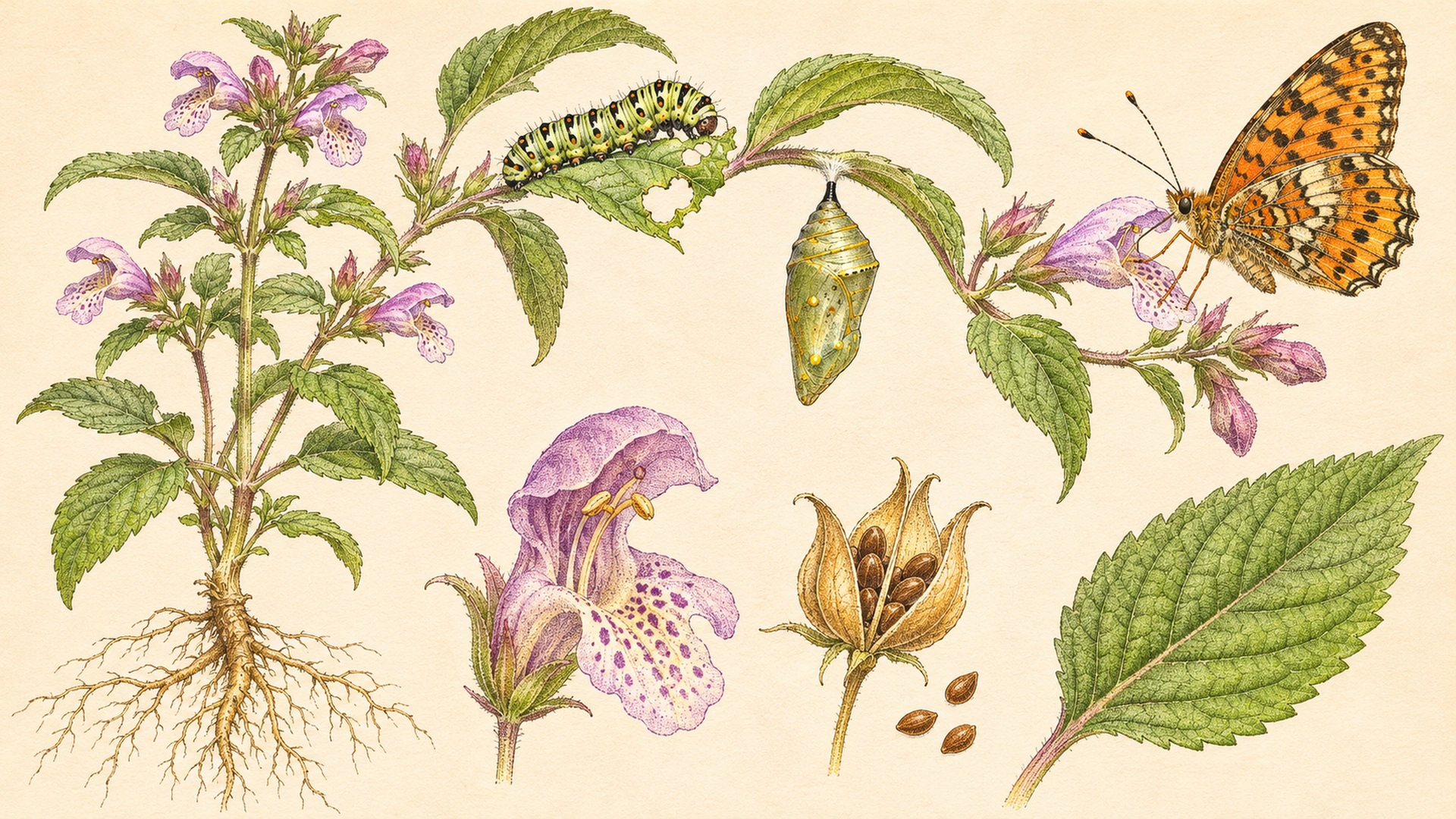
Unlike a photograph, an illustration can select, simplify and combine: show a flower, its seed and its root on one page, cut away a surface to show what lies beneath, or draw a typical specimen rather than one damaged individual. Today the field continues in medical, botanical and palaeontological illustration, in museum work and in a strong vintage aesthetic used in design and branding.
Visual anatomy of scientific illustration
Exact outlines, proportions and details drawn from observation.
Specimens arranged on a plain ground, often several views or life stages on one plate.
Fine pen or engraved lines, stippling, delicate watercolour washes.
Numbers, letters and scale bars linking to captions.
Sections and dissections showing internal structure.
Accurate, restrained colour, sometimes hand-coloured prints.
Key names
Anatomy; De humani corporis fabrica (1543).
Insects and plants in life cycles; Suriname plates (1705).
Life-size birds of North America (1827–38).
Radiolarians, jellyfish and symmetry; Kunstformen der Natur (1904).
How to recognize scientific illustration
- Precise specimens on a plain ground.
- Multiple views or stages on one plate.
- Fine lines, stippling and delicate colour.
Where people get it wrong
Scientific illustration is often imitated as 'vintage botanical poster' with decorative flowers. The real tradition is about accurate observation and clear explanation: correct structure, several views, life stages and labels. Decoration without accuracy is just ornament.
Words to describe scientific illustration
Precise words for the qualities above. Combine a few of them instead of naming the style or artist alone.
- scientific illustration
- botanical plate
- natural history engraving
- stippled pen and ink
- delicate watercolour wash
- multiple views on one plate
- life cycle stages
- anatomical cutaway
- specimen on white ground
- hand-coloured print
An original natural history plate: a single species of flowering plant shown with its flower, seed pod, leaf and root, plus a butterfly at three life stages (caterpillar, chrysalis, adult) feeding on it, arranged on a cream page, fine pen lines with stippling and delicate watercolour, small numbers beside each part. No words or readable text.
What to take from scientific illustration today
- Name the specimen precisely, to species if possible.
- Choose the views or stages to show.
- Describe the technique: pen and ink, stipple, watercolour, engraving.
Questions about scientific illustration
What is scientific illustration?
Drawing nature to be understood: botanical plates, insects and their life cycles, anatomical cutaways and specimen sheets, precise and often beautiful.
How do you recognize scientific illustration?
Precise specimens on a plain ground. Multiple views or stages on one plate. Fine lines, stippling and delicate colour.
How do you describe scientific illustration in words or a prompt?
Name the specimen precisely, to species if possible. Choose the views or stages to show. Describe the technique: pen and ink, stipple, watercolour, engraving.
Plan a scientific plate for a plant or insect near you: which views, which life stages, how they are arranged, which details are enlarged and what technique and colour you'd use.