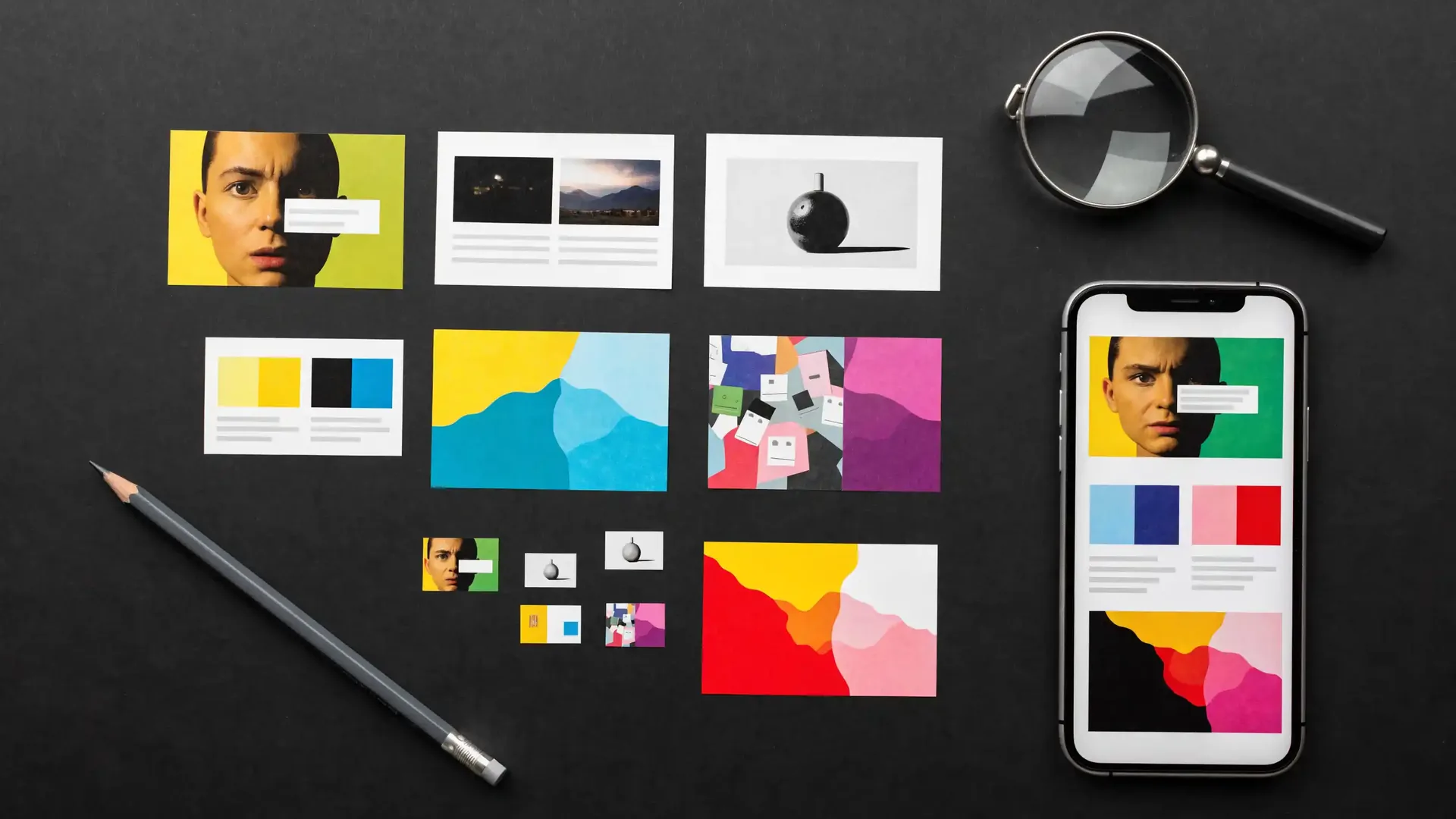
How YouTube's own test works
YouTube Studio's Test & Compare lets creators upload several thumbnails, and now titles, for a long-form video and shows them to different viewers at the same time. At the end, a thumbnail is marked a winner, preferred, or no clear result, based on watch-time share rather than click-through rate.
YouTube explains the choice: a thumbnail that wins more clicks but loses viewers quickly is not a better thumbnail. Third-party tools that rotate thumbnails one after another and measure CTR can pick a different winner, partly because traffic changes over time.
What to test first
Test the promise before the decoration. The biggest differences come from changing what the thumbnail says, not how it is styled. Variants that are too similar usually end with no clear result.
- Outcome or obstacle: the finished result, or the problem in the way.
- Face or evidence: a human reaction, or the thing itself.
- Wide scene or close-up object.
- Known subject or unexplained mystery.
- Text or no text.
- Before and after, or only the after.
Only once you know which kind of promise works for a topic is it worth testing crop, colour, expression or type.
A thumbnail workflow
- Research the feed, not single thumbnails: search the topic, look at Home and Suggested, note what everyone else promises and where there is room to look different.
- Write the click reason in one sentence: 'The viewer clicks because they need to know ___.' If you cannot finish it, the problem is the idea, not the design.
- Divide the work with the title: the title carries the specific context, the thumbnail carries proof, emotion, stakes, scale or contrast.
- Sketch eight to fifteen rough concepts that differ in story, not in styling, then choose about three real directions.
- Check every option at real feed size, on a phone; kill what stops reading.
- Plan the thumbnail before filming when it needs a specific shot, prop or moment.
- Test the strongest two or three directions, then read the result with retention.
Reading the result
Give the test time: it often takes days and can take up to two weeks, depending on traffic. A 'no clear result' outcome is information too: the variants may not have been different enough, or the packaging may not be the problem.
Look at what the winner changed. If the close-up object beat the face, that is a lesson about your audience and topic, not just about one video.
Keep an experiment log
For every test write down: the hypothesis, the variants, the title each was paired with, the main traffic source, the test length, the result, and what happened to CTR and retention. After twenty or thirty videos, this record is worth more than any general rule, because it describes your audience.
Drafts, not iterations
In prompt composition we prefer the word draft to iteration. An iteration changes a setting; a draft changes what is being said. The same distinction makes a thumbnail test useful.
Before testing, write each variant as one sentence of meaning: 'A says it was worth it.' 'B says it nearly failed.' 'C says it changed someone.' If two variants have the same sentence, they are one draft in two colours, and the test will probably tell you nothing.
Integrity applies here too: test different honest promises, not an honest one against a misleading one. A misleading variant can win a test and still lose the audience.
Questions about Thumbnail A/B Testing
How does YouTube pick the winning thumbnail?
By watch-time share: the thumbnail whose viewers produce the larger share of total watch time during the test wins. A result can also be 'preferred', a likely but not certain winner, or no clear result.
How long should a thumbnail test run?
Usually several days and up to about two weeks, depending on how many impressions the video gets. Smaller channels need longer tests to collect enough data.
What should I A/B test in a thumbnail?
Meaningfully different ideas: outcome versus obstacle, face versus object, text versus none, wide versus close. Small changes like text colour rarely produce a clear winner.
Choose one of your videos and write its click reason in one sentence. Then describe three thumbnail concepts that each tell a different story: one showing the result, one the obstacle, one a human reaction. Which would you test first, and why?
Sources and further reading
- YouTube Help: Test & compare thumbnails (support.google.com/youtube/answer/13861714).
- YouTube Help: A/B test titles & thumbnails (support.google.com/youtube/answer/16391400).
- YouTube Help: Impressions & click-through-rate FAQs (support.google.com/youtube/answer/7628154).
- YouTube, How YouTube Works: Recommendations (youtube.com/howyoutubeworks).
Words to describe Thumbnail A/B Testing
Precise words for the qualities above. Combine a few of them instead of naming the style or artist alone.
- A/B test
- Test & Compare
- watch-time share
- variant
- hypothesis
- click reason
- conceptual difference
- feed size check
- preferred result
- no clear result
- experiment log
- packaging
Three variants for a video about restoring an old bicycle: A, the gleaming finished bike against a plain wall; B, a rusted frame with one wheel missing; C, a person's tired face next to the half-restored bike. Same title, tested together, judged by watch-time share.