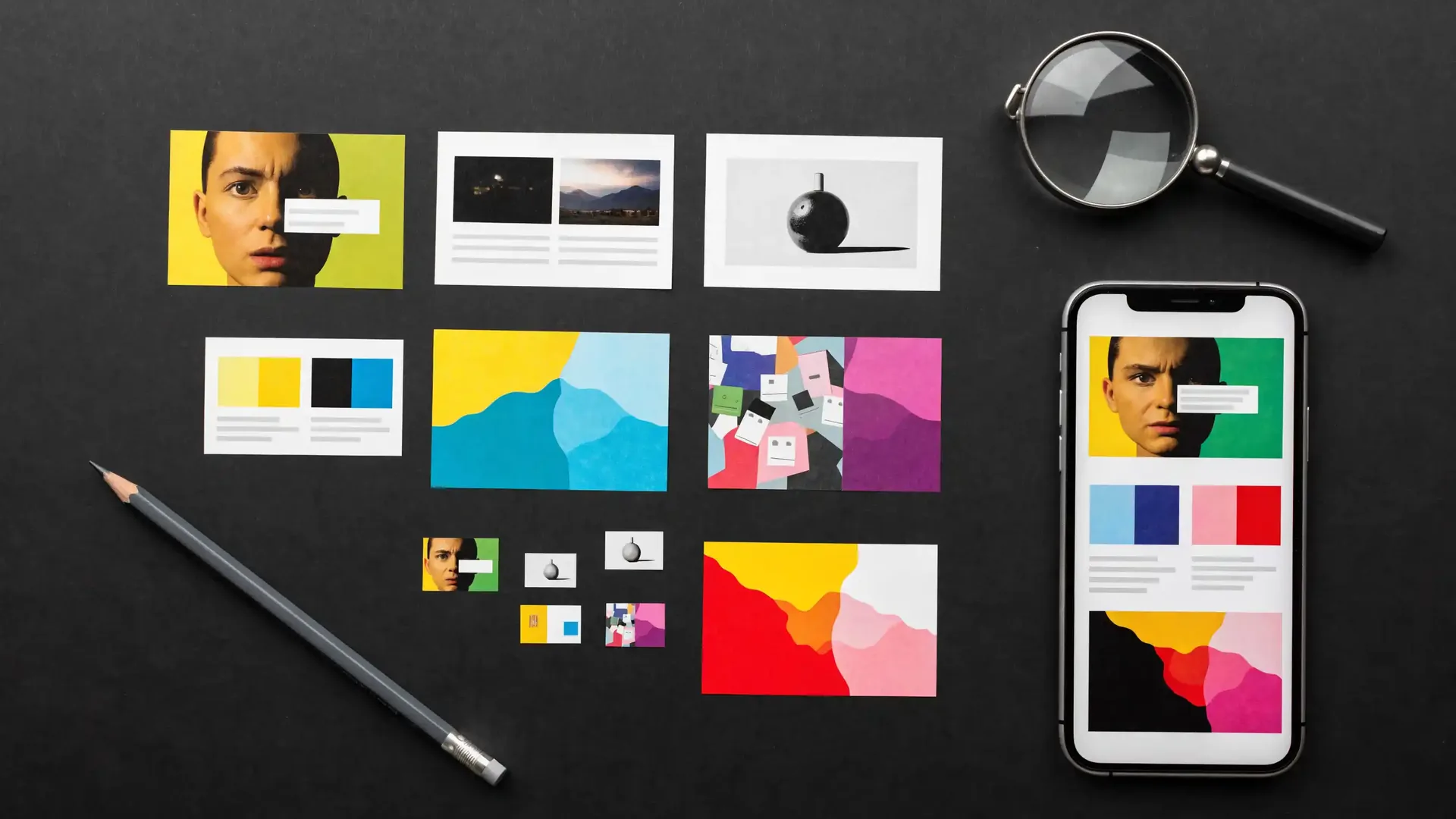
Two lines of one sentence
Viewers read a title and a thumbnail together, in one glance. The pair works like a two-line joke or a short poem: the second line changes the meaning of the first. If both say the same thing, the viewer learns it once and the second line is wasted space.
A useful division: the title carries specificity, context and cause, the words. The thumbnail carries what words do badly at speed: proof, emotion, stakes, scale, identity, contrast.
Rules for the pair
- Do not repeat the title's words in the thumbnail text; if the thumbnail needs words, let them add a new piece.
- Make the image support the title's story, so the two clearly belong together.
- Let the title name what the image cannot show: a number, a place, a reason, a person.
- Let the image show what the title cannot prove: a result, a reaction, an object, a change.
- Read the pair aloud as one sentence; if it does not make a small story, rewrite one side.
Eight example pairs
Image: a tired day-one face beside an alert day-thirty face, no text.
Image: a calm face holding a visibly broken object, with two words: 'I know.'
Image: one highlighted line in an otherwise clean financial document.
Image: a grid of tiny thumbnails with one circled exception.
Image: a simple chart, impressions rising sharply while CTR falls.
Image: an elaborate desk setup crossed out beside one plain notebook.
Image: the ugly original beside a blurred, partly hidden final version.
Image: an empty social profile next to a human silhouette.
Common mistakes
- The same phrase in title and thumbnail.
- A clever title with an unrelated pretty image.
- A thumbnail that explains everything, so the title has nothing to add.
- A title that promises one thing and an image that promises another.
- Text in the thumbnail long enough to be a second title.
A literary way to think about it
Writers know this structure from the epigraph and the first line, or the caption and the photograph: meaning sits in the gap between two pieces, not inside either one. A good title–thumbnail pair leaves a small, precise gap and trusts the viewer to cross it. That gap is where curiosity lives.
Ekphrasis in reverse
Ekphrasis is writing that describes an image so vividly that the reader sees it. A title–thumbnail pair runs that in both directions at once: the words make the image mean something specific, and the image makes the words feel true.
That is why the honest pair is also the strongest one. When the title and the picture tell the same story from two sides, the viewer arrives already oriented, and the video's first seconds confirm instead of correct.
Questions about title and thumbnail
Should the thumbnail text repeat the title?
Usually not. Repeating spends the viewer's few seconds on the same information. Thumbnail text works better when it adds something new, a reaction, a number, a twist, or when there is no text at all.
Which comes first, the title or the thumbnail?
Many creators start from the idea and the one-sentence click reason, then develop title and thumbnail together. Writing the title first helps you see what the image must not repeat.
Can I test titles as well as thumbnails?
Yes. YouTube's Test & Compare now supports testing titles too, and the winner is chosen by watch-time share.
Take a title you like and write three thumbnail concepts that each add a different missing piece: proof, emotion, contrast. Then do the reverse: describe one strong thumbnail and write three titles that each change what it means.
Sources and further reading
- YouTube Help: A/B test titles & thumbnails (support.google.com/youtube/answer/16391400).
- YouTube Help: Test & compare thumbnails (support.google.com/youtube/answer/13861714).
- George Loewenstein, 'The psychology of curiosity: A review and reinterpretation', Psychological Bulletin 116(1), 1994.
- Veritasium, 'Clickbait is Unreasonably Effective', YouTube, 2021.
Words to describe title and thumbnail
Precise words for the qualities above. Combine a few of them instead of naming the style or artist alone.
- packaging
- title–thumbnail pair
- division of labour
- proposition
- visual proof
- tension
- missing piece
- redundancy
- complementary text
- small precise gap
- click reason
- two-line structure
Title: 'The Room My Grandmother Never Opened'. Thumbnail: a closed wooden door in a sunlit hallway, a thin line of cold blue light under it, no text.