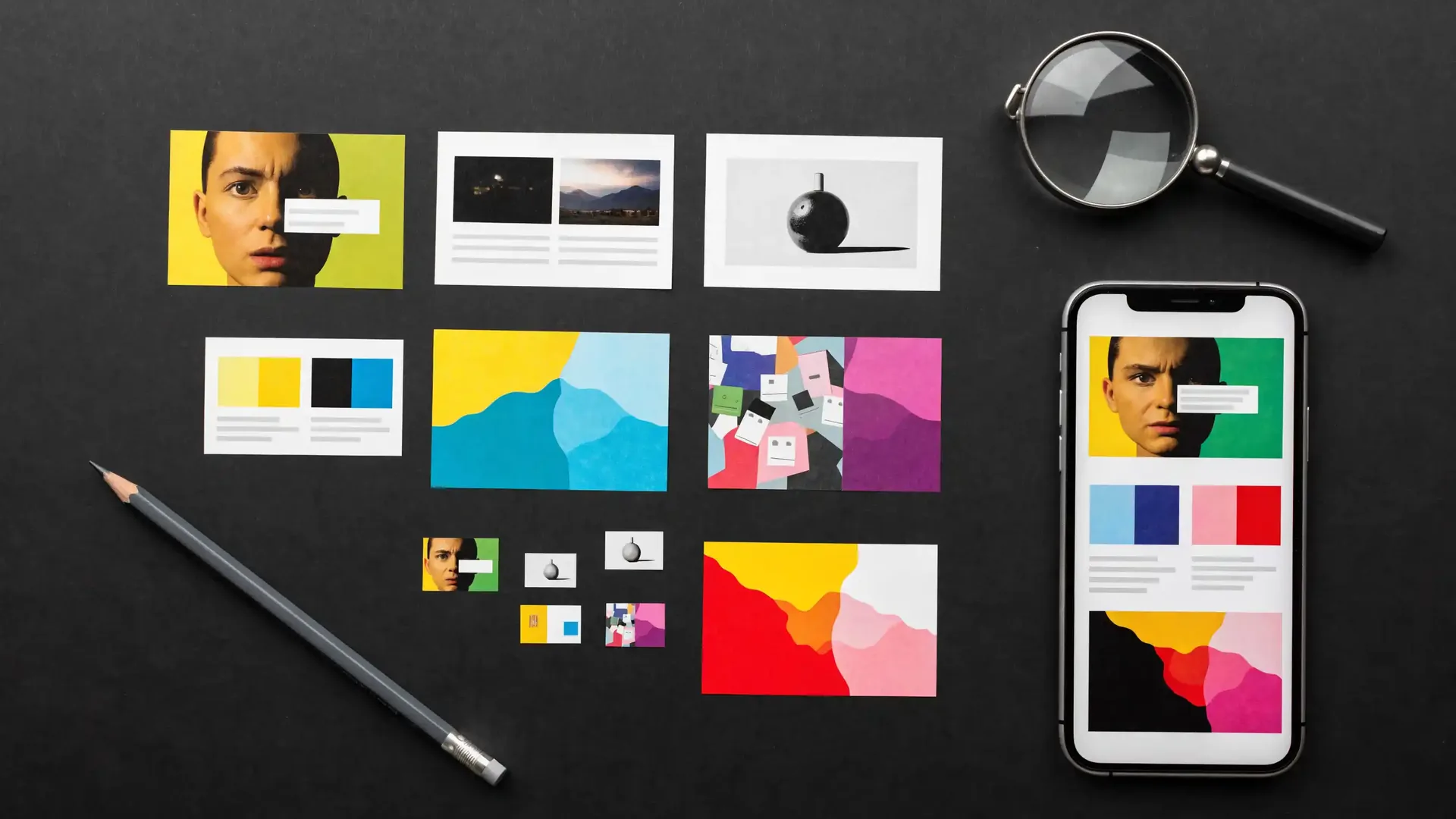
A decision, not a poster
In a feed, a viewer is scanning many competing promises at once: topics, faces, stories, identities, moods. The thumbnail's job is not to hold the most information. It is fast understanding plus something still unresolved: I understand enough to care, and I still need the video.
That is why it helps to think of a thumbnail as a decision interface rather than a small poster. A poster can reward a long look. A thumbnail is judged in a glance, at the size of a fingertip, next to its rivals.
Eight mechanisms behind a click
Getting noticed among competitors. Mistake: shouting louder than everyone instead of being different from them.
Being understood quickly; images that are easy to process feel more pleasant and trustworthy. Mistake: adding decorative detail.
Signalling 'this is for me'. Mistake: optimising for intrigue while the topic stays unclear.
Making the stakes felt. Mistake: fake reaction faces that read as performance.
Leaving one valuable question open. Mistake: hiding the whole premise, so there is nothing to be curious about.
Showing evidence the promise is real. Mistake: replacing evidence with hype.
Signalling a tribe, an expertise or an aspiration. Mistake: confusing your branding with the viewer's interest.
Making change or conflict visible. Mistake: adding arrows and circles instead of designing the contrast into the image.
What we know about faces
Faces attract the eye. Eye-tracking research has shown for years that people look at faces in an image quickly and often, ahead of many other features. That much is well supported.
Whether faces increase clicks is less certain. Some studies of YouTube find faces correlate with more views, with effects that differ by category; other large analyses find little difference. Correlation is also tangled with topic: personality channels use faces and also have loyal audiences.
The defensible rule: use a face when it carries information, a reaction, a relationship, a status, a fear, a pride, and leave it out when it is only there because thumbnails are supposed to have faces.
Qualified curiosity
Curiosity grows from a gap between what we know and what we want to know, an idea the psychologist George Loewenstein called the information gap. A gap pulls only when the viewer already understands enough to see it.
So the best curiosity gap does not hide information. It creates a question whose answer is still worth having after the click. Call it qualified curiosity: qualified, because the right viewer understands the subject and promise; curiosity, because something valuable remains open.
Curiosity that produces only the click is weak. Curiosity that survives into watching is the kind platforms reward, because it shows up as watch time and satisfaction.
Emotion and arousal
Emotion is not only positive or negative. Research on video selection has found that thumbnails with high arousal, intensity, can draw selection even when their valence is low, unpleasant or tense. That fits the long popularity of conflict, danger and mystery.
But the effect is entangled with topic: crime, disasters and failures naturally contain both tense images and high interest. There is no good evidence for telling every creator to exaggerate fear or shock. Match the emotion to what the video really contains.
Curiosity with a conscience
Narrative therapy starts from a simple observation: the stories told about people shape how they see themselves. Thumbnails tell viewers small stories about themselves too. 'You are doing it wrong.' 'Your body is the problem.' 'Everyone else already knows.'
Those stories work, in the narrow sense that they get clicks, because they recruit a viewer's fear or shame. They also leave a residue. A thumbnail can create curiosity without casting the viewer as a failure: invite them into a question rather than accuse them of an ignorance.
- Prefer 'what happens if' to 'what is wrong with you'.
- Let the tension belong to the subject, not to the viewer's worth.
- If an image would embarrass the person in it, or the person watching, find another one.
Questions about thumbnail psychology
Why do people click on thumbnails?
Usually because the thumbnail is noticed, understood quickly, feels relevant, and leaves one worthwhile question open. Emotion, proof and identity add weight. A thumbnail that is only loud gets noticed but not chosen.
Do faces in thumbnails really increase clicks?
Faces reliably attract attention, but evidence that they increase clicks is mixed and depends on the category and audience. Use a face when the expression or the person adds meaning; otherwise an object, a scene or a contrast can work as well.
What is a curiosity gap in a thumbnail?
A visible question the viewer wants answered: something partly shown, an unexpected result, a contradiction. It works when the subject is clear and the answer is valuable, and turns into clickbait when the payoff is weak.
Pick three thumbnails from your own feed. For each, name which two of the eight mechanisms it relies on most. Then redesign one of them in words, swapping one mechanism for another, for example replacing a reaction face with visible proof.
Sources and further reading
- George Loewenstein, 'The psychology of curiosity: A review and reinterpretation', Psychological Bulletin 116(1), 1994.
- Rolf Reber, Norbert Schwarz and Piotr Winkielman, 'Processing fluency and aesthetic pleasure', Personality and Social Psychology Review 8(4), 2004.
- Moran Cerf, Jonathan Harel, Wolfgang Einhäuser and Christof Koch, 'Predicting human gaze using low-level saliency combined with face detection', NeurIPS, 2008.
- Yoon and Kim, study of thumbnail valence and arousal in video selection, Electronic Commerce Research 19(3), 2019.
- Byungwan Koh and Fuquan Cui, 'An exploration of the relation between the visual attributes of thumbnails and the view-through of videos: The case of branded video content', Decision Support Systems 160, 2022.
- YouTube, How YouTube Works: Recommendations (youtube.com/howyoutubeworks).
Words to describe thumbnail psychology
Precise words for the qualities above. Combine a few of them instead of naming the style or artist alone.
- salience
- processing fluency
- relevance
- emotional stakes
- curiosity gap
- qualified curiosity
- visual proof
- identity signal
- designed contrast
- high arousal
- decision interface
- one open question
A thumbnail built on proof and curiosity: a close-up of a hand holding a cracked, old smartphone that still lights up, a soft dark background, the screen glowing, no face and no text, so the image raises the question the title will name.