No colour means one thing
Colour meanings feel natural, but most are learned. A bride in white is a 19th-century Western habit popularised by Queen Victoria's wedding in 1840; in China and India brides traditionally wear red. In much of East and South Asia white has been a colour of mourning, while in Iran and the West mourning is black.
For image-makers this matters in two ways: a colour can mean the opposite of what you intend for another audience, and AI models tend to default to the meanings most common in their training data. Naming the culture and the context is part of describing a colour.
Colours and meanings
Purity and weddings in the West; mourning in parts of East and South Asia.
Mourning in Iran and the West, and in Muharram; elegance and formality in fashion.
Luck and weddings in China and India; danger, love and passion in many places.
Associated with Islam and paradise; nature and renewal; in China a green hat is a sign of being cheated on.
Protection in the blue evil-eye amulets of Iran, Turkey and Greece; the Virgin Mary's robe in European art.
Imperial colour in China; in Persian poetry a yellow face means illness or love-sickness.
Royalty and power in Rome and Byzantium, because Tyrian purple was so costly.
The divine and the eternal in icons and illumination; wealth almost everywhere.
Colour in Persian rituals
Jumping over fire singing 'zardi-ye man az to, sorkhi-ye to az man': my yellow (paleness) to you, your red (health) to me.
Green sprouts grown for Nowruz and thrown into running water on Sizdah Bedar.
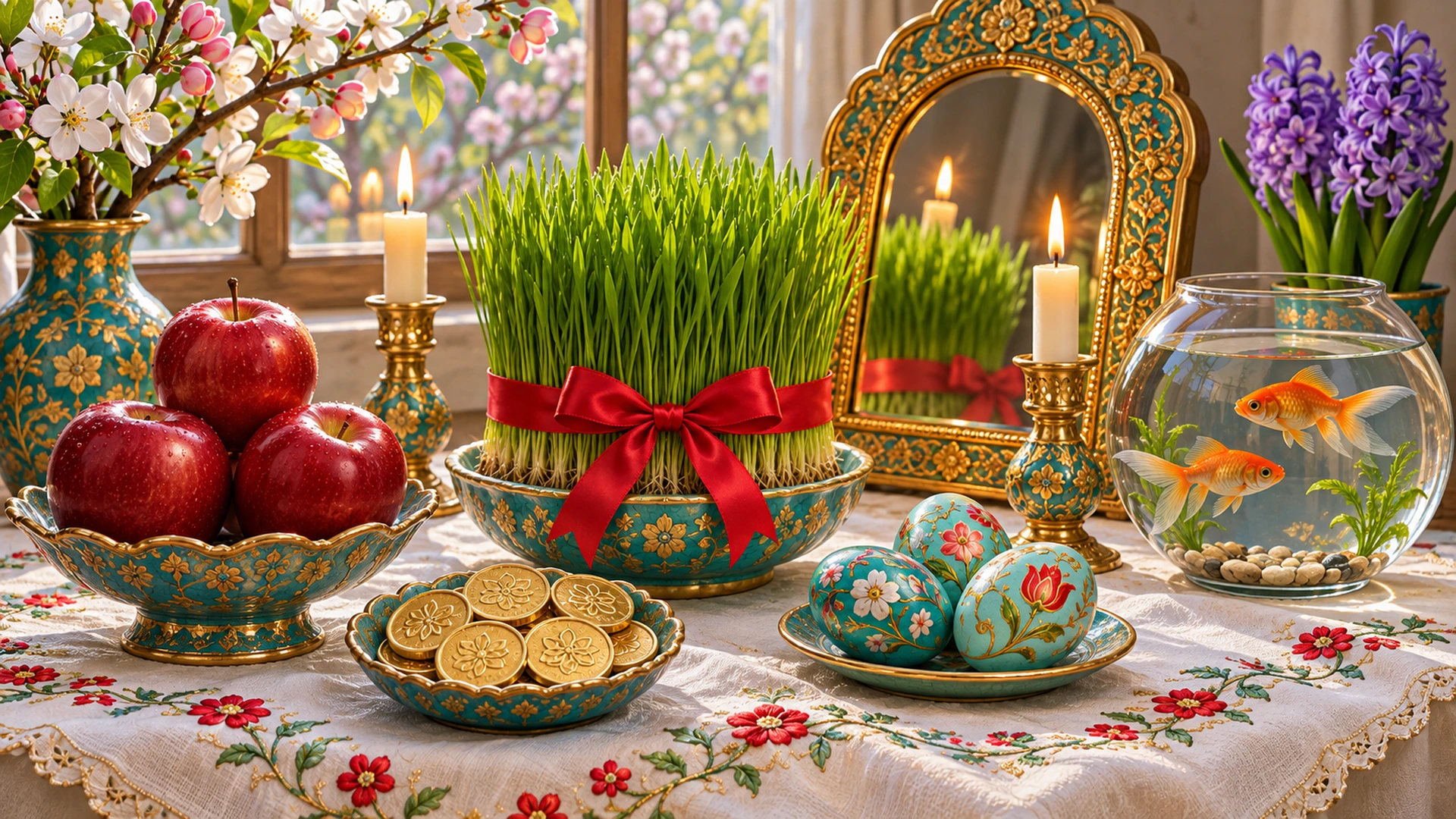
A table of seven symbolic things, full of greens, reds and the gold of coins.
Black clothing and banners for mourning, with green and red in religious symbols.
White, gold, mirrors and candles: light and reflection as blessing.
Using colour across cultures
Ask what a colour means to the people who will see it.
The same red feels festive on a lantern and alarming on a sign.
Not every Persian image needs turquoise, nor every Chinese image red.
The words to describe it
Precise words for the qualities above. Combine a few of them instead of naming the style or artist alone.
- white wedding dress
- red bridal clothes
- black mourning clothes
- green Nowruz sprouts
- blue evil-eye amulet
- imperial yellow
- Tyrian royal purple
- gold for the sacred
- Chaharshanbe Suri firelight
- culturally specific colour
'A Nowruz table at morning: green wheat sprouts in a ceramic bowl, red apples, gold coins, a mirror reflecting candlelight, painted eggs in turquoise and saffron, a white cloth.'
How to put it into words
- Say which culture and context you are describing a colour for.
- Name the ritual or object that carries the meaning.
- Check whether your audience reads the colour the same way.
Where we usually get it wrong
Colour psychology charts often present one meaning per colour as if it were universal. Most meanings are cultural and change over time; even in one country, a colour can mean opposite things in a wedding and on a warning sign.
Choose one colour and write down five meanings it has in your own life, in rituals, clothes, sayings and places. Then ask someone from another culture for theirs and compare.
Sources and further reading
- Michel Pastoureau, books on the history of colours: Blue (2001), Black (2008), Green (2013), Red (2016), Yellow (2019).
- Kassia St Clair, The Secret Lives of Colour (2016).