Glitches that come from culture
Visual artifacts are the obvious errors of AI images: extra fingers, melted text. Cultural-linguistic artifacts are subtler: images that are technically fine but carry the assumptions of the data they came from. Ask for 'a Persian woman' or 'an Iranian home' and you may get a mix of carpets, domes, heavy eyeliner and a desert, a souvenir version of a culture rather than any real place.
These artifacts come from the captions and images the model saw: who took the photos, who wrote the captions, which cultures were photographed often and which were described from outside. Naming them precisely is the first step to describing past them.
Kinds of artifacts
A culture reduced to a few tourist symbols: domes, carpets, camels, lanterns.
Contemporary places shown as if from another century.
Generic nouns like 'a doctor' or 'a family' default to one gender, age or ethnicity.
'Wedding', 'breakfast', 'funeral' shown in the most common culture in the data.
Persian, Arab, Turkish and Indian elements blended into one 'Middle Eastern' look.
Persian and Arabic letters disconnected, reversed or meaningless.
Why they happen
Some cultures are photographed and captioned far more than others.
Images described by tourists or stock sites use outsider vocabulary.
Concepts named mostly in Persian are rarely learned well.
Models drift toward the average of what they saw, which erases specific detail.
How to describe past them
'A 1970s apartment in Tehran's Yousefabad' rather than 'an Iranian home'.
Samovar, kilim, terrazzo floor, ceramic tile, Arcopal plates.
Age, clothing, gesture and activity instead of ethnicity as a style.
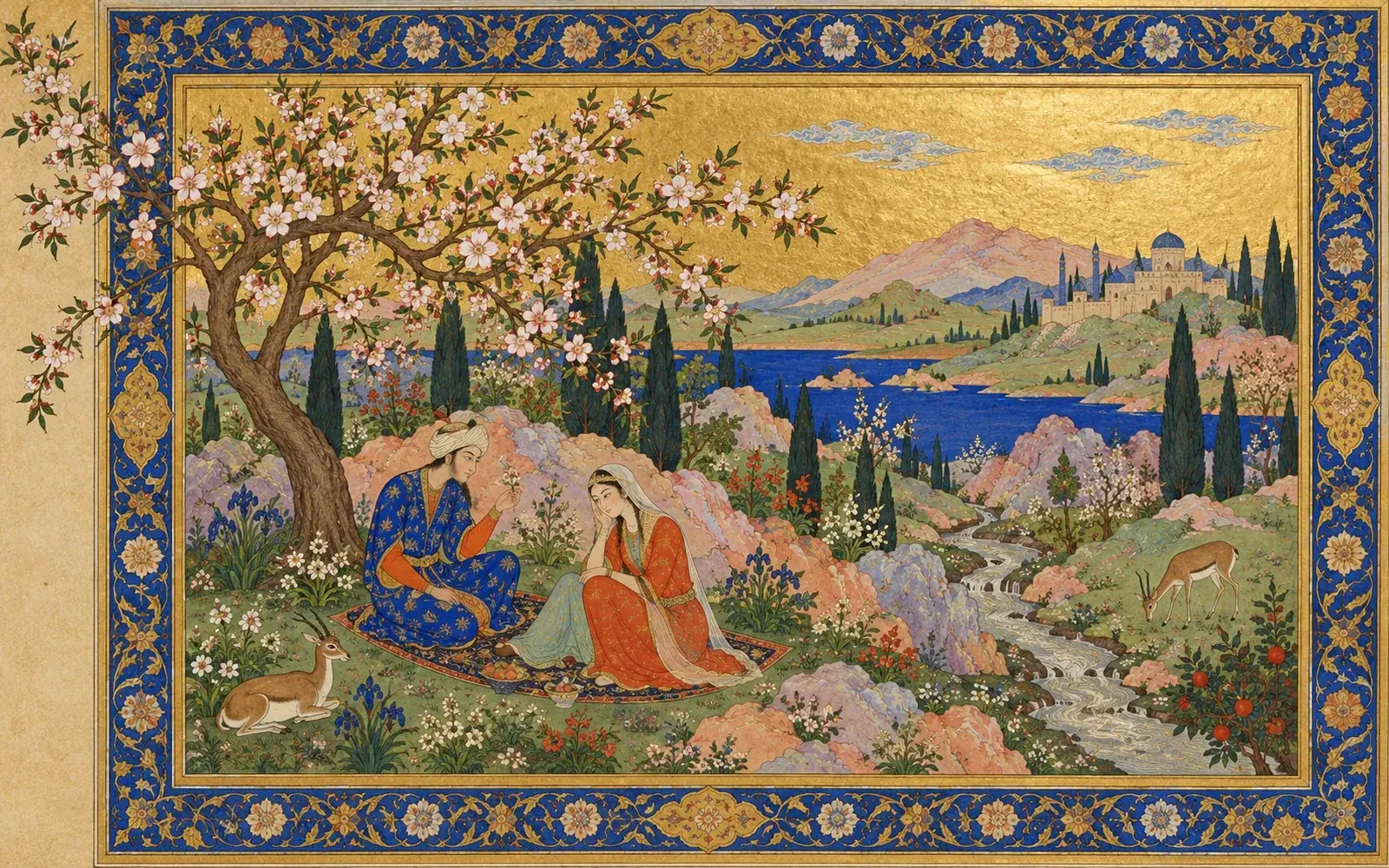
Name the real tradition: Safavid tilework, Qajar portrait, Isfahan school drawing.
Add text afterwards in design software; models often break the script.
They notice false details you won't.
The words to describe it
Precise words for the qualities above. Combine a few of them instead of naming the style or artist alone.
- cultural default
- exotic cliché
- outsider caption
- time collapse
- generic 'Middle Eastern' blend
- broken Persian script
- specific place and decade
- real materials and objects
- people as individuals
- review by insiders
Instead of 'an Iranian home', try: 'A small 1970s Tehran apartment living room in the afternoon: a worn red kilim on a terrazzo floor, a glass-fronted cabinet with Arcopal plates, a samovar on a side table, sheer curtains and a balcony with geranium pots, soft dusty sunlight.'
How to put it into words
- List what the model assumed, then replace each assumption with a real detail.
- Use the vocabulary of the culture itself, explained visually.
- Check the result against real photographs and real people.
Where we usually get it wrong
One response to cultural artifacts is to add more 'authentic' symbols, which often makes the cliché stronger. The better answer is fewer symbols and more ordinary, specific life: a real kitchen, a real street, a real person doing something everyday.
Generate 'an Iranian family having breakfast' with no other details. List every cliché you see. Then rewrite the prompt with specific, ordinary details from a breakfast you know, and compare.
Sources and further reading
- Edward Said, Orientalism (1978).
- Research on social bias in text-to-image models, for example Bianchi et al., 'Easily Accessible Text-to-Image Generation Amplifies Demographic Stereotypes at Large Scale' (2023).