The city as a stage
Street photography records ordinary life in public places, usually without staging and often without the subject noticing. It grew with smaller, faster cameras: Eugène Atget photographed the streets of Paris around 1900, and the compact Leica of the 1920s let photographers move through crowds unseen.
Henri Cartier-Bresson's book Images à la sauvette (1952), published in English as The Decisive Moment, gave the field its most famous idea: the instant when form, gesture and meaning line up. Helen Levitt, Garry Winogrand, Saul Leiter, Vivian Maier and Daido Moriyama each pushed it somewhere else, from playful children on New York sidewalks to rain-soaked colour and rough, grainy black and white.
Visual anatomy of street photography
A gesture, a glance or a coincidence caught at its peak.
Foreground, middle ground and background each holding something, so the eye travels in depth.
Two unrelated things in one frame that make a third meaning: a poster and a passer-by, a shadow and a shape.
Available light only: hard sun and long shadows, shop windows, neon, rain reflections.
Usually wide or normal (28mm, 35mm, 50mm), close to the subject, rarely a long telephoto.
Close and involved, the photographer inside the scene, not watching from far away.
Grain, motion blur and imperfect focus are accepted, sometimes chosen.
Words photographers use
Cartier-Bresson's idea: the split second when everything in the frame falls into place.
Pre-setting the focus distance so you can shoot instantly without looking through the lens.
Finding a good background or light and waiting for the right person to walk into it.
Taking pictures without raising the camera to the eye.
Japanese for 'rough, blurred, out of focus': the gritty style of Moriyama and the Provoke magazine (1968–69).
Street photography built on colour relationships, as in Saul Leiter's or Joel Meyerowitz's work.
How to recognize street photography
- Unposed people in public space.
- A sense of timing: something is happening right now.
- Real, available light and imperfect conditions.
Where people get it wrong
Street photography is not just any photo of a street, and it is not photographing strangers from behind with a telephoto lens. Its subject is a moment of human life. It also raises real questions of privacy and consent, and laws about photographing people in public differ from country to country.
Words to describe street photography
Precise words for the qualities above. Combine a few of them instead of naming the style or artist alone.
- candid street moment
- decisive moment
- layered composition
- juxtaposition
- 28mm wide angle up close
- hard sun and long shadows
- reflections in shop windows
- rain and neon at night
- grainy black and white
- motion blur of passers-by
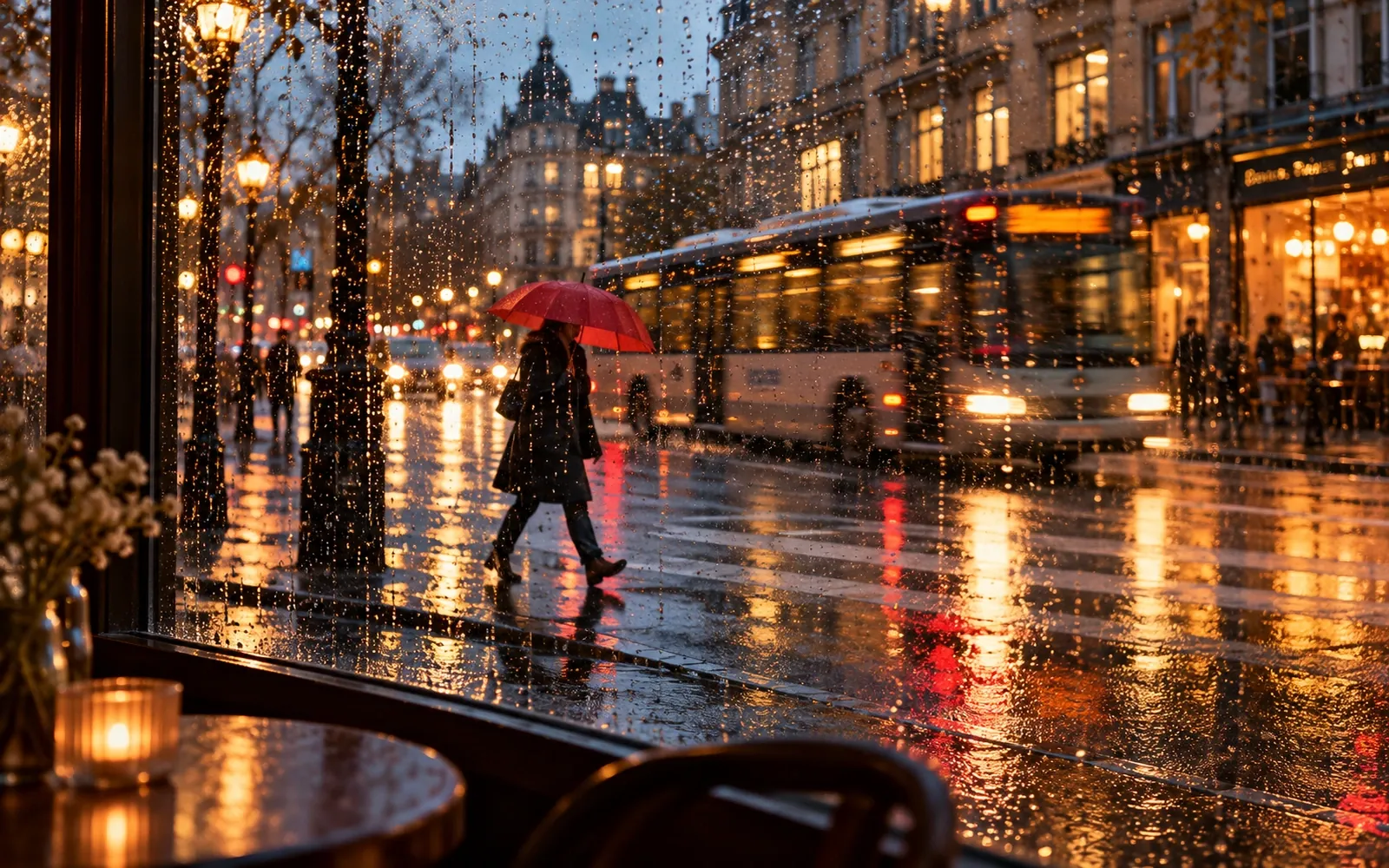
A rainy city street at dusk seen through a café window covered in droplets: a red umbrella crossing in the middle ground, a blurred bus behind, warm shop light reflected on wet asphalt, shot close with a 35mm lens, soft grain.
What to take from street photography today
- Describe the moment, not only the place: what is about to happen?
- Name the layers: what is in front, in the middle, at the back.
- Say where the light comes from and what it does to the people.
Questions about street photography
What is street photography?
Photographs of ordinary public life, taken as it happens: the decisive moment, layered scenes, light and chance in the city.
How do you recognize street photography?
Unposed people in public space. A sense of timing: something is happening right now. Real, available light and imperfect conditions.
How do you describe street photography in words or a prompt?
Describe the moment, not only the place: what is about to happen? Name the layers: what is in front, in the middle, at the back. Say where the light comes from and what it does to the people.
Stand in one spot on a busy street for twenty minutes. Without taking a photo, write down three moments you would have caught: who, where in the frame, what light, and why that instant.