From limited animation to a world language
Japanese animation goes back to the 1910s, but the style now called anime took shape in the 1960s with Osamu Tezuka's Astro Boy (1963). Working for television on tiny budgets, Tezuka's studio used limited animation: fewer drawings, held frames, moving mouths on still faces, camera pans across a single image. Those constraints became an aesthetic, and the large expressive eyes he borrowed partly from Disney and Fleischer cartoons became a signature.
The 1970s and 1980s brought space operas and giant robots, then a wave of ambitious films: Miyazaki and Takahata at Studio Ghibli, Akira (1988) with its dense hand-drawn cityscapes, and Ghost in the Shell (1995). The 1990s look, with hand-painted cels, soft grain and pastel sunsets, is now an aesthetic of its own.
Today anime is drawn and coloured digitally but keeps its grammar: clean line art, two-tone cel shading, carefully painted background art, and visual shorthand for emotion such as sweat drops, blush lines and speed lines. Directors like Satoshi Kon, Mamoru Hosoda and Makoto Shinkai have each pushed it in different directions, from psychological thriller to luminous skies.
Visual anatomy of Anime Style
Large, detailed eyes with highlights and reflections carry most of the emotion.
Clean, even line art with tapered ends; hair drawn as sharp clumps.
Cel shading: one flat shadow tone and sometimes one highlight, with crisp edges.
Richly painted, almost photographic skies, streets and rooms behind flat-coloured characters.
Limited animation: held poses, sliding pans, sudden smears and speed lines at moments of action.
Visual codes for feeling: sweat drop, blush lines, chibi exaggeration, sparkles, a vein for anger.
Words around anime
Flat blocks of shadow with hard edges, from the era of painted celluloid sheets.
Fans' word for scenes of especially fine, fluid animation.
A small, big-headed exaggerated version of a character, for comedy.
Painted settings, often the most detailed part of the frame.
How to recognize Anime Style
- Characters with large, glossy, expressive eyes.
- Clean line art and flat cel shading with hard-edged shadows.
- Detailed painted backgrounds behind simple flat characters.
- Visual shorthand: blush lines, sweat drops, speed lines.
- Dramatic light: lens flares, sunsets, glowing skies.
Where people get it wrong
'Anime style' is not one style. Ghibli's soft painted worlds, the sharp lines of 1990s action shows, the pastel moe look, Satoshi Kon's realism and Makoto Shinkai's hyper-luminous skies are very different. 'Big eyes' is only one convention, and many anime use realistic proportions. When describing, name the decade, the genre or the studio feel rather than just 'anime'.
Words to describe Anime Style
Precise words for the qualities above. Combine a few of them instead of naming the style or artist alone.
- cel shading
- clean line art
- large expressive eyes
- painted background art
- 90s anime aesthetic
- film grain
- pastel sunset
- speed lines
- blush lines
- limited animation
- lens flare
- slice of life
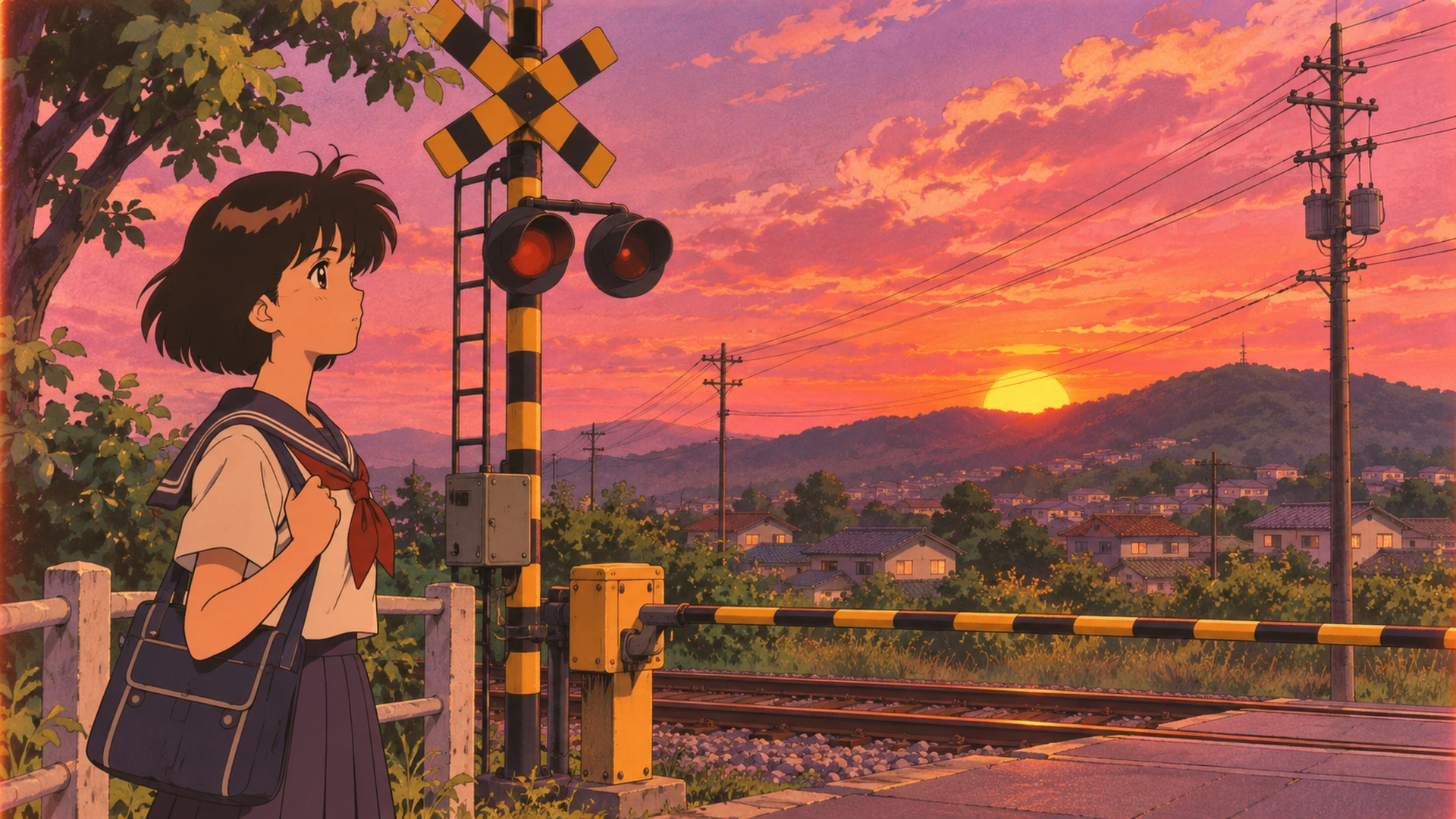
A 1990s anime frame on hand-painted cels: a girl with short dark hair and large glossy eyes stands at a railway crossing, clean thick line art, flat two-tone cel shading, behind her a detailed painted sky of pink and orange sunset clouds, power lines, soft film grain and slightly warm colour bleed.
What to take from Anime Style today
- Name the era: 1980s cel, 1990s hand-painted, or modern digital.
- Separate character and background: flat cel-shaded figures over painted settings.
- Describe the light; anime skies carry mood.
- Use one piece of visual shorthand on purpose, not all of them.
Questions about Anime Style
What is the difference between anime and manga?
Manga are Japanese comics, printed and usually black and white. Anime is Japanese animation. Many anime are adapted from manga, so they share character design conventions, but anime adds colour, motion, sound and painted backgrounds.
What makes the 90s anime aesthetic?
Hand-painted cels photographed on film: slightly soft colour, visible grain, warm or pastel palettes, thick outlines, chromatic bleed and VHS-era imperfection. Films and series like Sailor Moon, Cowboy Bebop and Neon Genesis Evangelion are typical references.
Is Studio Ghibli anime?
Yes. Ghibli films are Japanese animation, though their look is distinctive: softer line, watercolour-like painted backgrounds, natural movement and less use of exaggerated shorthand.
Pause one frame from any anime. Describe the character in one line and the background in three. Notice how much more detail sits behind the figure. Then describe the light only: where it comes from, what colour, what it says.
Sources and further reading
- Jonathan Clements, Anime: A History, BFI, 2013.
- Thomas Lamarre, The Anime Machine: A Media Theory of Animation, University of Minnesota Press, 2009.
- Studio Ghibli Museum, Mitaka.
- Helen McCarthy, The Art of Osamu Tezuka, Abrams, 2009.