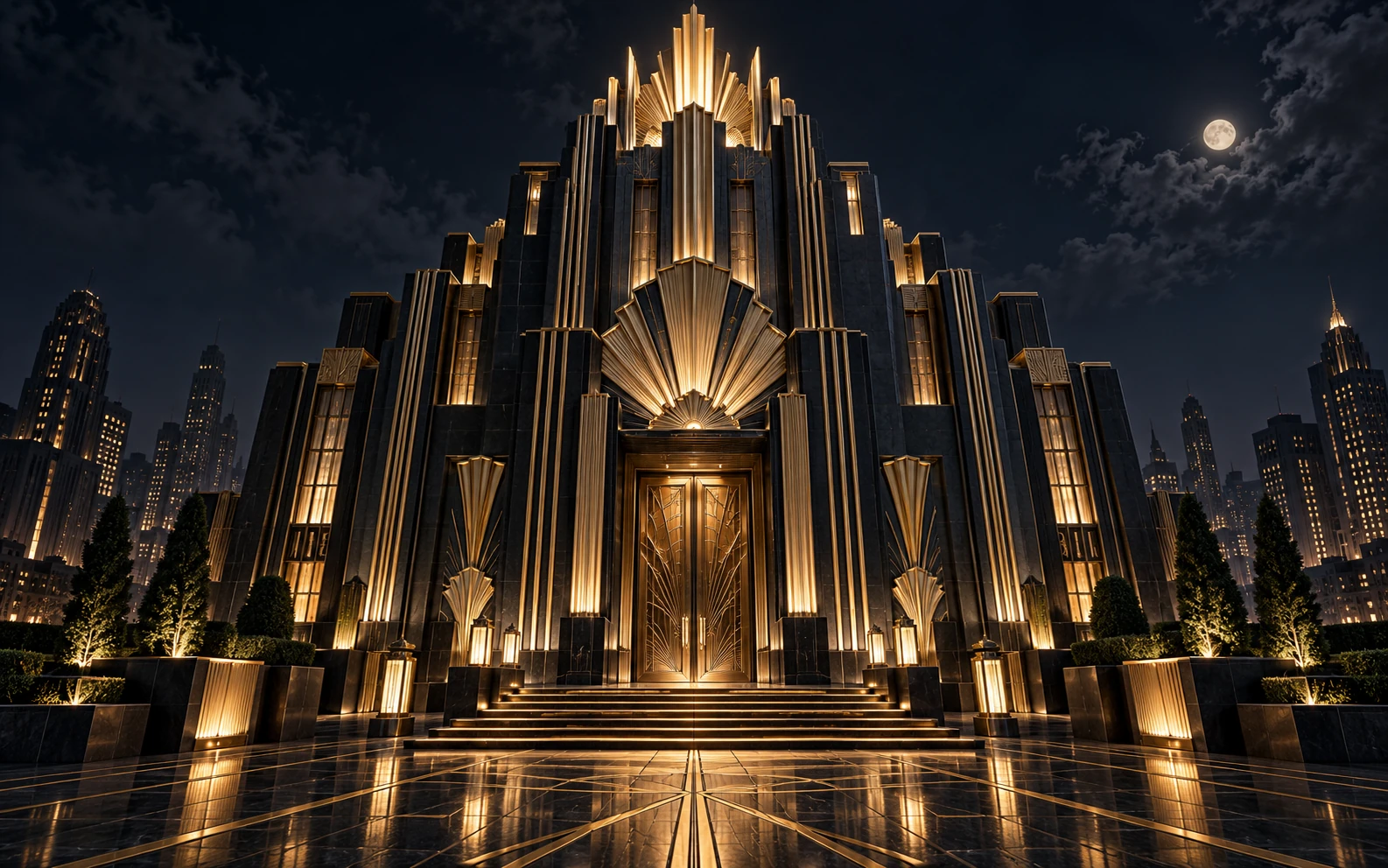
Modern, but dressed for the evening
Art Deco takes its name from the 1925 Paris exhibition of decorative and industrial arts, though the label itself was coined decades later. Through the 1920s and 1930s it shaped skyscrapers, ocean liners, cinemas, posters, jewelry and fashion.
It borrowed freely: the geometry of Cubism, the speed of Futurism, motifs from ancient Egypt after Tutankhamun's tomb was opened in 1922, and the streamlined shapes of trains and planes. Unlike the Bauhaus, it was not trying to strip ornament away; it made ornament modern and luxurious.
Visual anatomy
Strong symmetry and central axes. Elements are stacked, stepped or radiating from a center.
Zigzags, chevrons, sunbursts, fans and stepped ziggurat forms replace the curves of Art Nouveau.
Thin parallel lines, often in threes, suggest speed and elegance.
High contrast: black and gold, jade, ivory, silver, deep red, or soft pastels in later streamline work.
Chrome, lacquer, glass, marble, exotic woods, bakelite and inlay; surfaces are polished and reflective.
Tall, geometric display letters with dramatic thick–thin contrast.
How to recognize it
- Symmetry and verticality give a sense of ceremony.
- Ornament is geometric and repeats in bands.
- Surfaces shine: metal, lacquer, glass.
Where people get it wrong
Art Deco is not Art Nouveau with straighter lines; it belongs to a different, faster world. It is also wider than the 'Gatsby look': the later Streamline Moderne of the 1930s is smoother, more horizontal and less ornamental.
The words to describe it
Precise words for the qualities above. Combine a few of them instead of naming the style or artist alone.
- sunburst motif
- stepped setbacks
- chevron and zigzag
- strict symmetry
- triple parallel lines
- black and gold
- polished chrome
- lacquer and inlay
- geometric display type
- streamline curves
A tall symmetrical facade at night: stepped setbacks rising to a sunburst crown, thin gold lines on black stone, a central doorway framed by fan shapes, soft uplight reflecting on polished metal.
What to take from it today
- Use symmetry when a design needs authority and calm.
- Build ornament from simple geometry: a fan, a step, three lines.
- Let material and finish carry the luxury, not the amount of detail.
Design a building entrance using only three shapes: a rectangle, a fan and a stepped outline. Make one version in black and gold, and one in two pastel colors. Compare which feels more like an evening.