The eye as the medium
Op Art, short for optical art, became widely known in the mid-1960s, especially after the exhibition 'The Responsive Eye' at the Museum of Modern Art in New York in 1965. Victor Vasarely had explored optical effects since the 1930s; Bridget Riley, Jesús Rafael Soto and Carlos Cruz-Diez, among others, pushed them further.
Its works use precise patterns of lines, dots, squares and color to trigger reactions in the eye: shimmer, afterimages, illusions of depth and movement. The effect happens in the viewer's perception, so the same image can feel different from moment to moment. It was quickly absorbed into fashion and advertising.
Visual anatomy of Op Art
Repeated lines, stripes, dots or checks with gradual changes in size or spacing.
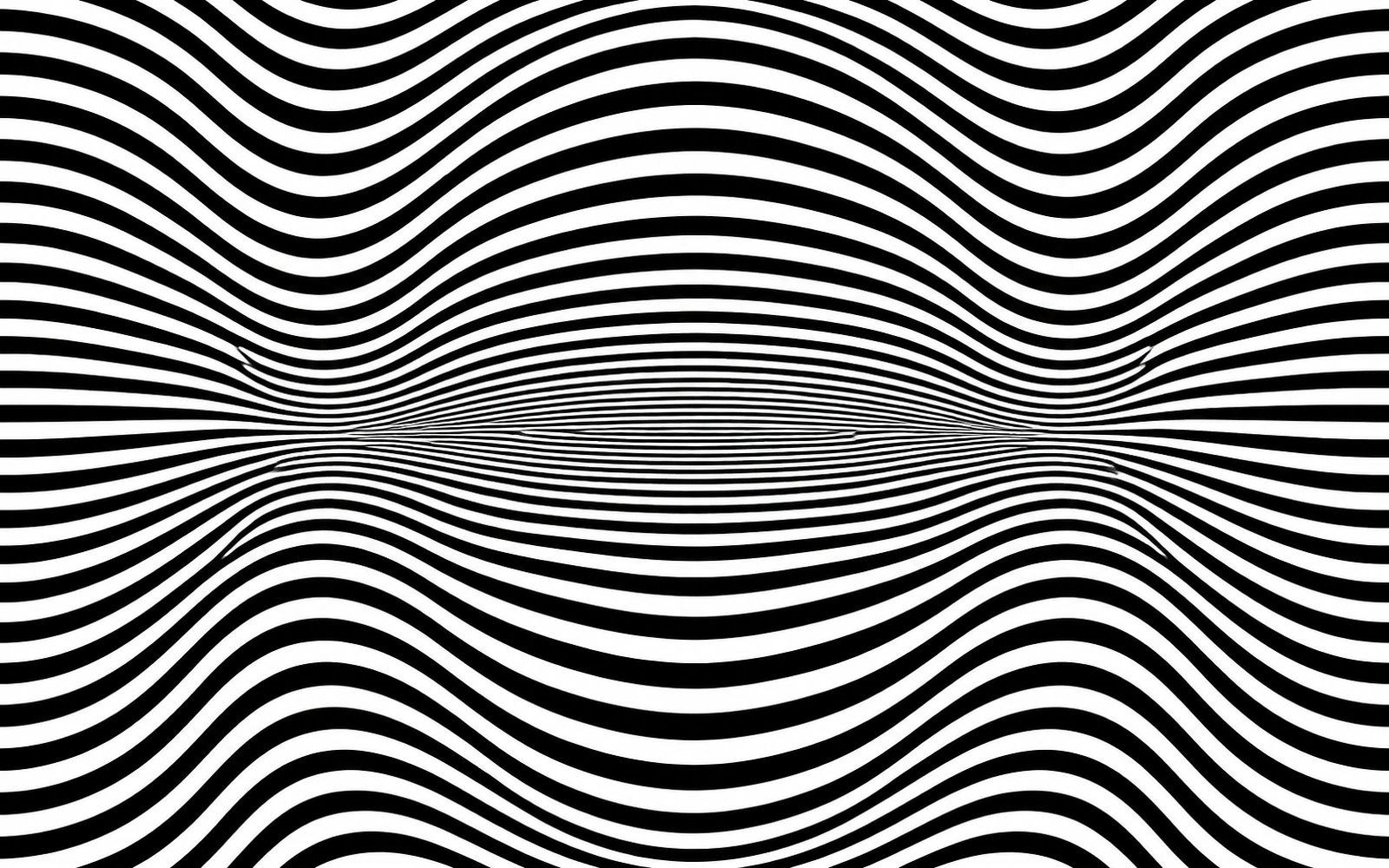
Often black and white for maximum contrast; color works add vibrating complementary pairs.
Surfaces seem to bulge, sink, ripple or rotate.
Hard edges and exact geometry; no visible brushwork.
The image appears to move as the eye moves across it.
The work is completed by perception; distance and time change it.
How to recognize Op Art
- Hard-edged repeated patterns.
- The surface seems to move or vibrate.
- Strong contrast, often black and white.
Where people get it wrong
Op Art is not just a 'psychedelic' pattern. Its effects come from careful, almost scientific control of spacing and contrast, and it is related to research on perception, such as Josef Albers's color studies.
Words to describe Op Art
Precise words for the qualities above. Combine a few of them instead of naming the style or artist alone.
- optical illusion
- black and white stripes
- moiré pattern
- vibrating complementary colors
- hard-edge geometry
- rippling surface
- gradual spacing change
- kinetic effect
- high contrast
- afterimage
A field of black and white wavy stripes whose spacing narrows toward the center, so the surface seems to bulge outward and ripple, hard edges, perfectly flat finish, no figure or background.
What to take from Op Art today
- Change one variable gradually across a pattern: width, spacing or angle.
- Use contrast to create movement without any figure.
- Test the image at different distances.
Questions about Op Art
What is Op Art?
Abstract art that works directly on the eye: patterns that seem to vibrate, swell, flicker or move while standing still.
How do you recognize Op Art?
Hard-edged repeated patterns. The surface seems to move or vibrate. Strong contrast, often black and white.
How do you describe Op Art in words or a prompt?
Change one variable gradually across a pattern: width, spacing or angle. Use contrast to create movement without any figure. Test the image at different distances.
Draw twenty parallel lines, then redraw them making the spacing gradually narrower toward the middle. Describe at what distance the page starts to feel like it bends.