Painting the photograph
Photorealism appeared in the United States in the late 1960s, as a reaction to Abstract Expressionism and Minimalism and a cousin of Pop Art. The painters did not paint reality; they painted photographs of reality, and used projectors, grids and airbrushes to transfer every detail, including the camera's own look: depth of field, lens distortion and glare.
Richard Estes painted New York shop windows full of overlapping reflections; Ralph Goings painted diners and pickup trucks; Audrey Flack made glossy still lifes; Chuck Close painted giant, pore-by-pore faces from passport-style photos. The later hyperrealists pushed further, into sculpture with Ron Mueck's uncanny giant figures. Today the same skill shows up in pencil drawings that go viral online, and the question it asks, what does a camera add to seeing?, matters even more in the age of generated images.
Visual anatomy of Photorealism
A photograph, not the scene itself, often the artist's own snapshot.
Every reflection, chrome edge, label and pore rendered precisely.
Smooth, almost brushless paint; airbrush and fine sable brushes.
Ordinary American life: diners, storefronts, cars, motorbikes, candy, faces.
Depth of field, lens distortion, glare and flat light borrowed from the photo.
Often huge canvases, so the detail becomes overwhelming.
Key names
City storefronts and layered reflections in glass.
Diners, ketchup bottles and pickup trucks in flat California light.
Monumental faces painted from grids of photographs.
Glossy, crowded still lifes of lipstick, fruit and jewellery.
Hyperreal sculptures of people at strange scales.
How to recognize Photorealism
- It looks like a photograph until you see the scale or the paint.
- Gleaming reflections, chrome and glass.
- Everyday, unglamorous American subjects.
Where people get it wrong
Photorealism is not just 'very realistic painting'. Old masters painted reality; photorealists paint the photograph, so they keep the camera's flaws: blur, flare and flattened perspective. Without that camera look, it is realism, not photorealism.
Words to describe Photorealism
Precise words for the qualities above. Combine a few of them instead of naming the style or artist alone.
- photorealist painting
- chrome reflections
- layered shop window reflections
- airbrush smoothness
- diner booth and counter
- glossy still life
- shallow depth of field
- lens glare
- monumental close-up face
- flat midday light
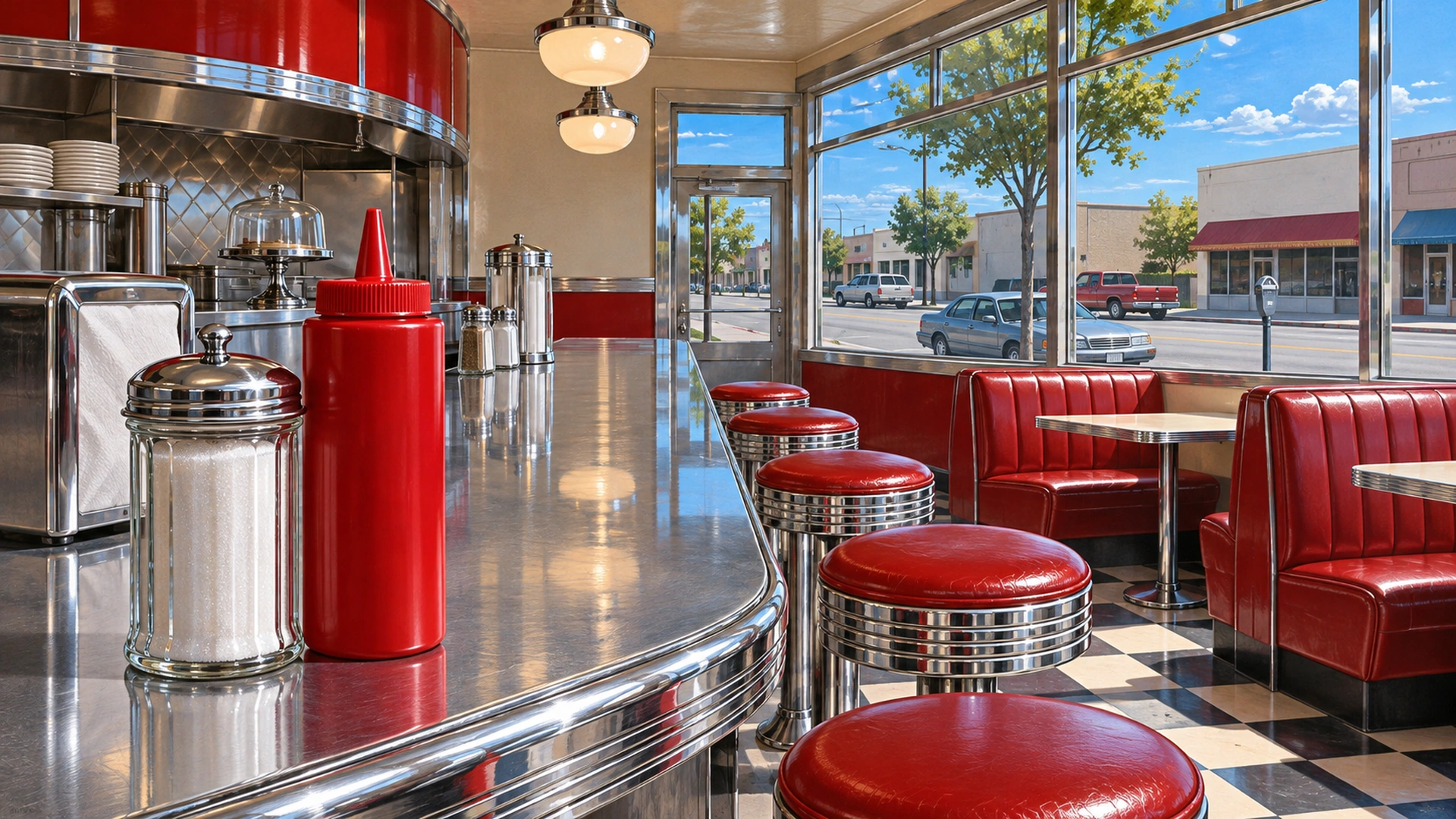
An original photorealist painting study: the chrome counter and red vinyl stools of an empty roadside diner, a glass sugar jar and a ketchup bottle in the foreground, the street, parked cars and blue sky reflected in the big front window, flat midday light, extremely sharp detail, smooth airbrushed surface. Not a copy of any existing painting.
What to take from Photorealism today
- Describe the reflections: what is mirrored in what.
- Name the camera traits that were copied: focus, flare, lens.
- Say what ordinary subject is given monumental attention.
Questions about Photorealism
What is Photorealism?
American painters of the late 1960s who copied photographs so precisely, reflections, chrome and all, that the paintings look like photos.
How do you recognize Photorealism?
It looks like a photograph until you see the scale or the paint. Gleaming reflections, chrome and glass. Everyday, unglamorous American subjects.
How do you describe Photorealism in words or a prompt?
Describe the reflections: what is mirrored in what. Name the camera traits that were copied: focus, flare, lens. Say what ordinary subject is given monumental attention.
Take a photo of a shop window or a café table on your phone. Describe it as if you had to paint it at two metres wide: every reflection, label and highlight you would have to copy.