Photographing the dark
In 1840 John William Draper made a daguerreotype of the Moon, one of the first astronomical photographs. Photography soon became essential to astronomy: plates recorded stars too faint for the eye, and long exposures revealed nebulae and galaxies. Space telescopes like Hubble and James Webb later produced images that shaped how the public imagines space.
Today astrophotography has two main forms. Wide-field 'nightscapes' show the Milky Way or star trails above a landscape, taken with a camera on a tripod or tracking mount far from city lights. Deep-sky imaging uses telescopes and stacks hours of exposures to reveal faint nebulae. Many famous space images use false or mapped colour, assigning colours to wavelengths the eye cannot see.
Visual anatomy of astrophotography
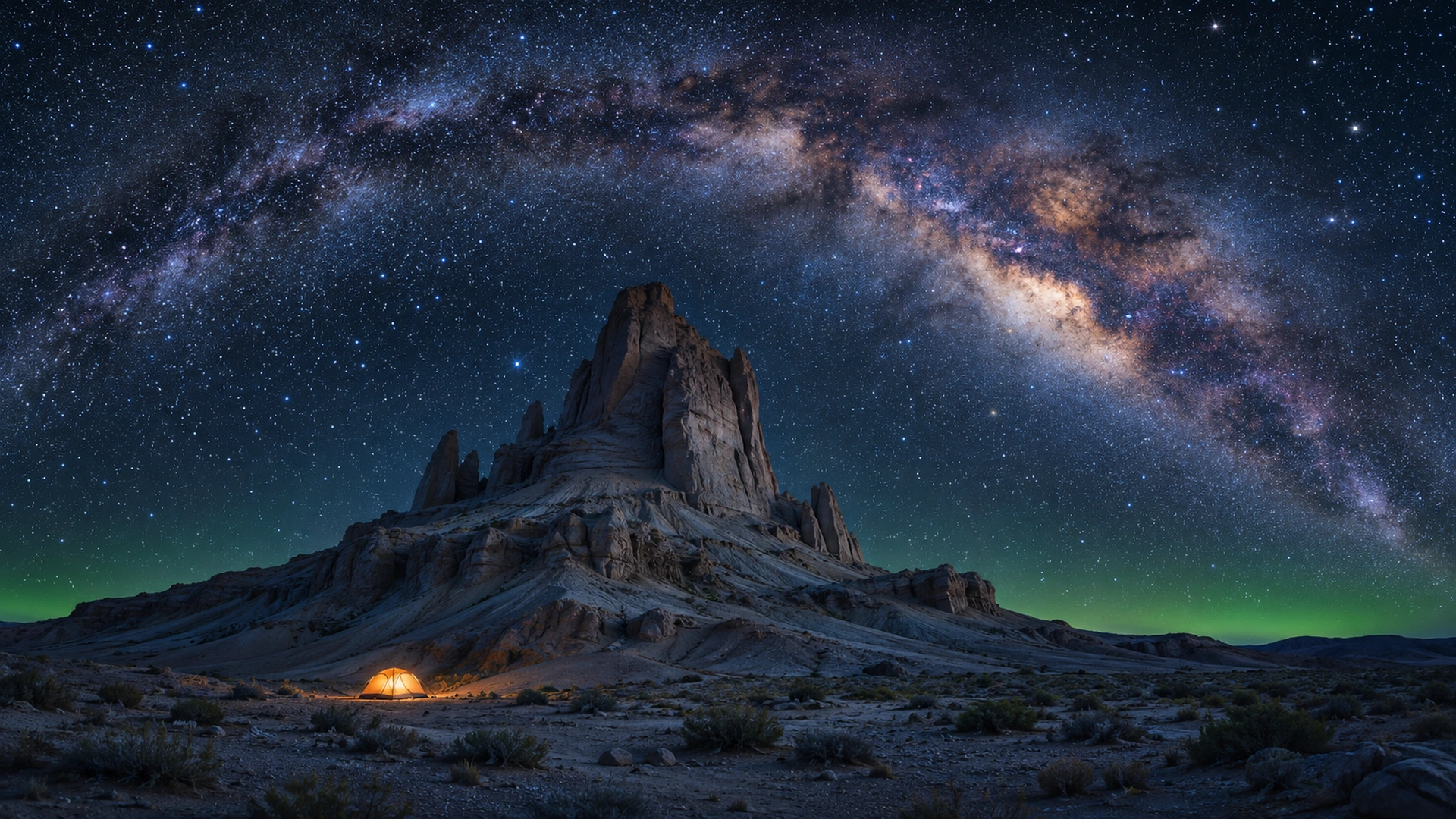
The Milky Way's bright core, dust lanes and countless stars.
A dark silhouette or softly lit landscape anchors the scale.
Cool blue night tones, warm airglow near the horizon, colourful nebulae.
Stars as points with tracking, or arcs and circles in star trails.
Many frames combined to reduce noise and reveal faint detail.
Orange glow from cities on the horizon, avoided or used as contrast.
Key terms in astrophotography
Wide-field image of the night sky with a landscape.
A motorised mount that follows the sky's rotation.
Combining many exposures to improve signal and reduce noise.
Assigning visible colours to specific wavelengths, as in many space telescope images.
How to recognize astrophotography
- Countless stars and a visible Milky Way.
- A dark foreground silhouette for scale.
- Cool night colours, sometimes vivid nebula colours.
Where people get it wrong
Astrophotography is often imitated with an impossibly dense, colourful sky over a sunlit landscape. Real nightscapes have a dark or faintly lit foreground, a believable Milky Way position and subtle colour. Overdone skies read as fantasy wallpaper, not photographs.
Words to describe astrophotography
Precise words for the qualities above. Combine a few of them instead of naming the style or artist alone.
- astrophotography
- milky way core
- nightscape
- star trails
- dark foreground silhouette
- tracking mount
- stacked exposures
- nebula in mapped colour
- airglow on the horizon
- light pollution glow
An original astrophotography nightscape: the Milky Way's bright core arching over a lone desert rock formation, the rock softly lit by faint starlight, countless stars, a thin green airglow near the horizon, cool blue tones, a small tent glowing warm at the base for scale. No text.
What to take from astrophotography today
- Say nightscape, star trails or deep-sky.
- Describe the foreground and how it is lit.
- Keep colour believable unless you want mapped colour.
Questions about astrophotography
What is astrophotography?
Photographing the night sky: the Milky Way arching over mountains, star trails, the Moon's craters and colourful nebulae built from long exposures and many stacked frames.
How do you recognize astrophotography?
Countless stars and a visible Milky Way. A dark foreground silhouette for scale. Cool night colours, sometimes vivid nebula colours.
How do you describe astrophotography in words or a prompt?
Say nightscape, star trails or deep-sky. Describe the foreground and how it is lit. Keep colour believable unless you want mapped colour.
Describe a nightscape from a place you'd love to visit: where the Milky Way stands in the sky, what silhouette is in the foreground, what faint light falls on it and what colour the horizon is.