From cyanotype to CAD
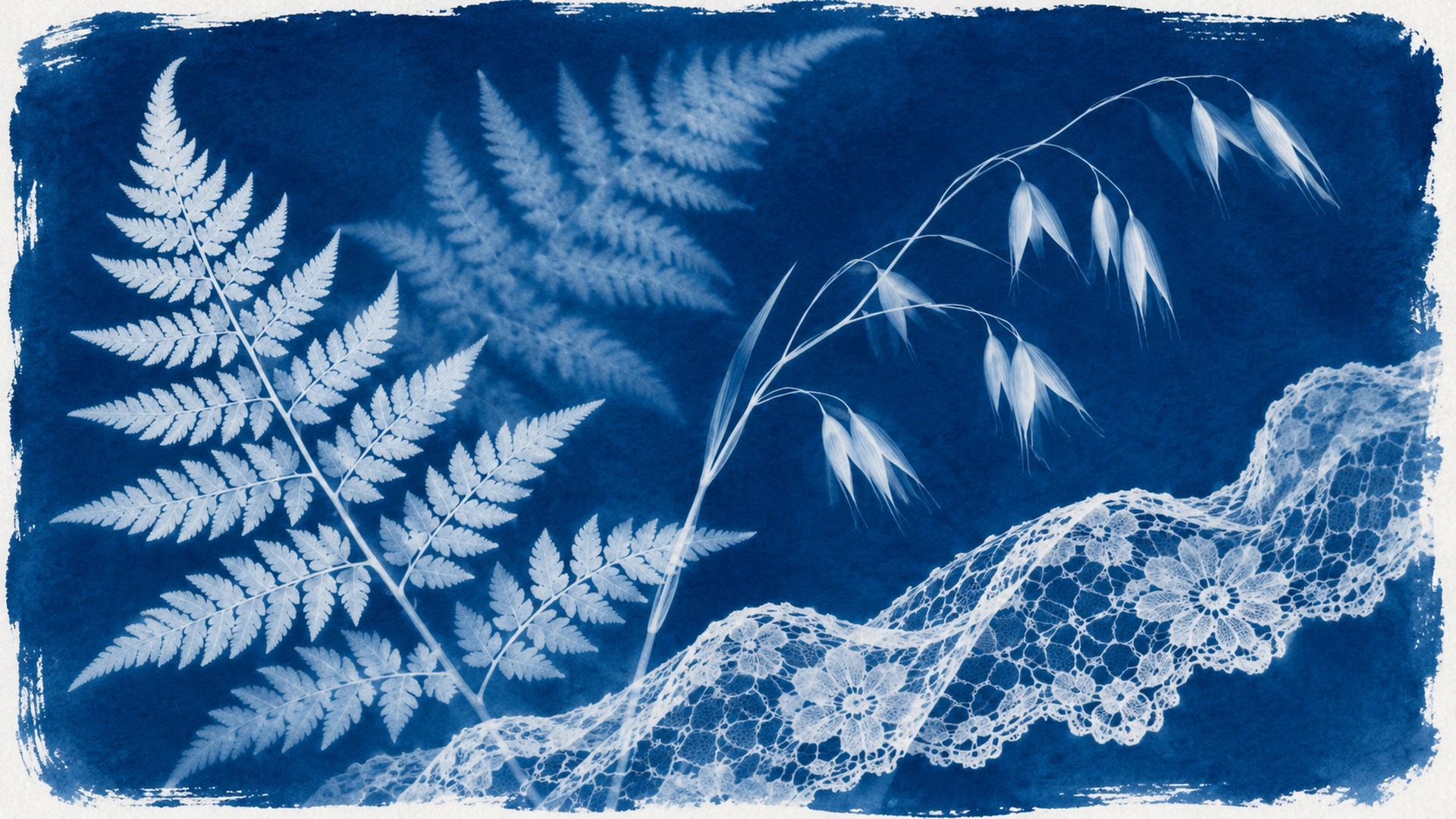
The blueprint began as a chemical process. In 1842 the scientist John Herschel invented the cyanotype, which turns paper Prussian blue where light hits it. From the 1870s, architects and engineers used it to copy drawings cheaply: a drawing on translucent paper laid over treated paper gave white lines on a blue ground. These were the original blueprints.
By the mid-twentieth century, diazo 'whiteprints' with dark lines on white replaced them, and later photocopiers and computer-aided design (CAD). The word blueprint survived as a general term for a plan, and the white-on-blue look survived as a style, alongside other conventions of technical drawing: orthographic views, sections, exploded views and the clean line work of patent drawings.
Visual anatomy
White or pale lines on Prussian blue, or dark lines on white for technical drawing.
Thin, even, ruled; dashed lines for hidden edges, dot-dash for centre lines.
Front, side and top views side by side; isometric or exploded views.
Dimension lines, arrows, callouts, title blocks.
A cut through the object, with hatching on the cut surfaces.
Rational, careful, explanatory, quietly beautiful.
Words around technical drawing
Showing an object as flat views from the front, side and top.
Parts pulled apart along their axes to show how they fit.
A view of an object cut through to show its inside.
A label or number linked to a part by a leader line.
How to recognize it
- White lines on deep blue, or crisp black on white.
- Several views of one object.
- Dimension arrows and leader lines.
- Hatching on cut surfaces.
Where people get it wrong
Many 'blueprint style' images are just a blue filter over a picture. Real technical drawing has rules: consistent line weights, aligned views, hidden lines dashed. Following a few of those conventions is what makes the style convincing. Annotation can be suggested with lines and arrows; it does not need readable numbers.
The words to describe it
Precise words for the qualities above. Combine a few of them instead of naming the style or artist alone.
- blueprint
- Prussian blue
- orthographic
- isometric
- exploded view
- cross-section
- hatching
- dimension line
- callout
- title block
A blueprint-style drawing: a vintage camera shown in front, side and exploded views, thin white ruled lines on deep Prussian blue paper, dashed hidden lines, dimension arrows and leader lines with no readable numbers or words.
What to take from it today
- Choose the view: orthographic, isometric, exploded, section.
- Say the colours: Prussian blue and white, or black on white.
- Keep line weights thin and consistent.
- Add arrows and leader lines, not fake text.
A drawing that argues
A technical drawing is a piece of persuasive prose with no adjectives: every line is a claim that the thing can be built. Its beauty comes from being exact, and from what it chooses not to show.
Questions people ask
Why are blueprints blue?
Because they were made with the cyanotype process, invented by John Herschel in 1842, which produces Prussian blue where light reaches the paper and leaves the drawn lines white.
What is an exploded view drawing?
A technical drawing that shows the parts of an object slightly separated, in order, so you can see how they fit together.
Are blueprints still used?
The chemical process is mostly obsolete; plans are now printed or viewed digitally from CAD files. The word and the white-on-blue look remain.
Choose a simple object, a pencil sharpener or a teapot, and describe it as a technical drawing: which views you need, what the section would reveal, and which part you would explode out.
Sources and further reading
- Wikipedia: Blueprint and Technical drawing.
- Science Museum Group: cyanotype and blueprint collections.
- Victoria and Albert Museum: architectural drawings collection.