Most image models think in English
Most text-to-image models learned from image-caption pairs that were overwhelmingly in English. Some tools quietly translate your prompt before generating; others read other languages directly but with much less to go on. Either way, a Persian prompt usually reaches the image through a thinner or translated layer of meaning.
That doesn't mean you should give up your language. It means deciding, word by word, what English carries well and what only your language can say, then describing the second kind so the model can see it.
What happens to a non-English prompt
The model saw far fewer Persian captions, so Persian words are linked to fewer and vaguer images.
Persian script often breaks into many more pieces than an English word, which spends the prompt's length faster.
Some tools translate first; the image then follows the translation, including its mistakes.
Words like 'Persian garden' or 'Iranian woman' pull in the most common clichés from the data, whatever language you use.
When to use which language
Light, lens, framing, material and colour words have the strongest training in English: 'soft window light', 'shallow depth of field'.
Write the idea in Persian to find what you actually mean, then decide how to carry it.
Run the same idea in Persian and in English with the same seed, and compare what each language gives you.
If a tool translates silently, read or ask for its English version so you know what the model received.
Words worth keeping
Words like gorg-o-mish or delbaz have no single English equivalent; translating them flattens them.
Keep the word and add what it looks like: 'gorg-o-mish, the dim grey-blue light just before dawn when shapes are unclear'.
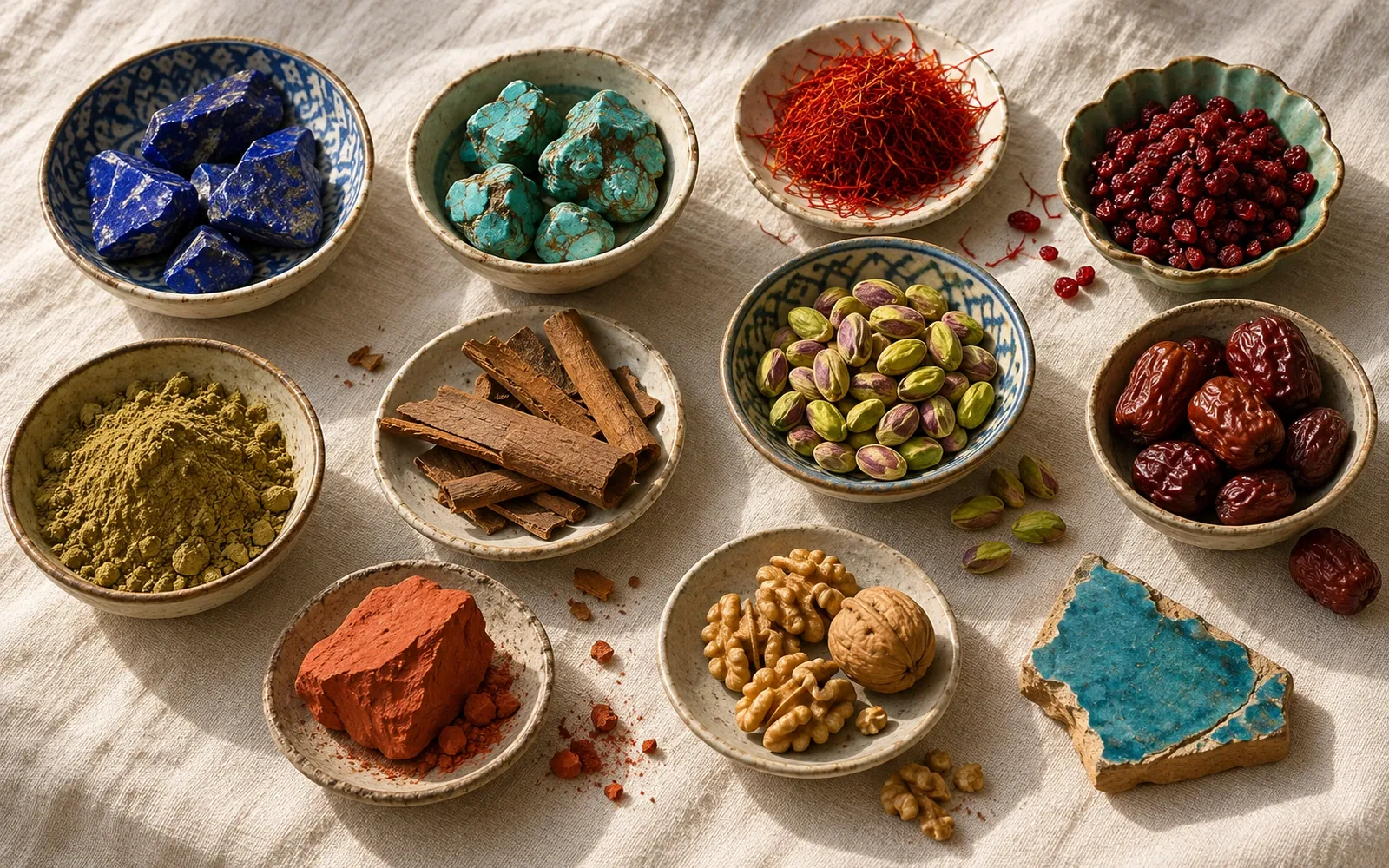
Instead of 'Persian pattern': 'a Safavid-era girih pattern of ten-pointed stars in turquoise and cobalt tile'.
Kashi tiles, Yazd windcatchers, a korsi table: concrete nouns with a short description work better than adjectives of origin.
Persian letters in the image
Most models still break Persian and Arabic letters: wrong joins, mirrored shapes, invented characters.
Say 'no letters or writing' when script is not essential, as models add fake text to signs and books.
Place real Persian typography in a design tool, where you control font, joining and direction.
Calligraphy-like ornaments can look like another script entirely; check before publishing.
The words to describe it
Precise words for the qualities above. Combine a few of them instead of naming the style or artist alone.
- visual mechanics in English
- concept in the mother tongue
- bilingual prompt
- keep and unfold the word
- named specific object
- no letters or writing
- add typography afterwards
- same seed comparison
- check what the tool translated
- cultural specificity over clichés
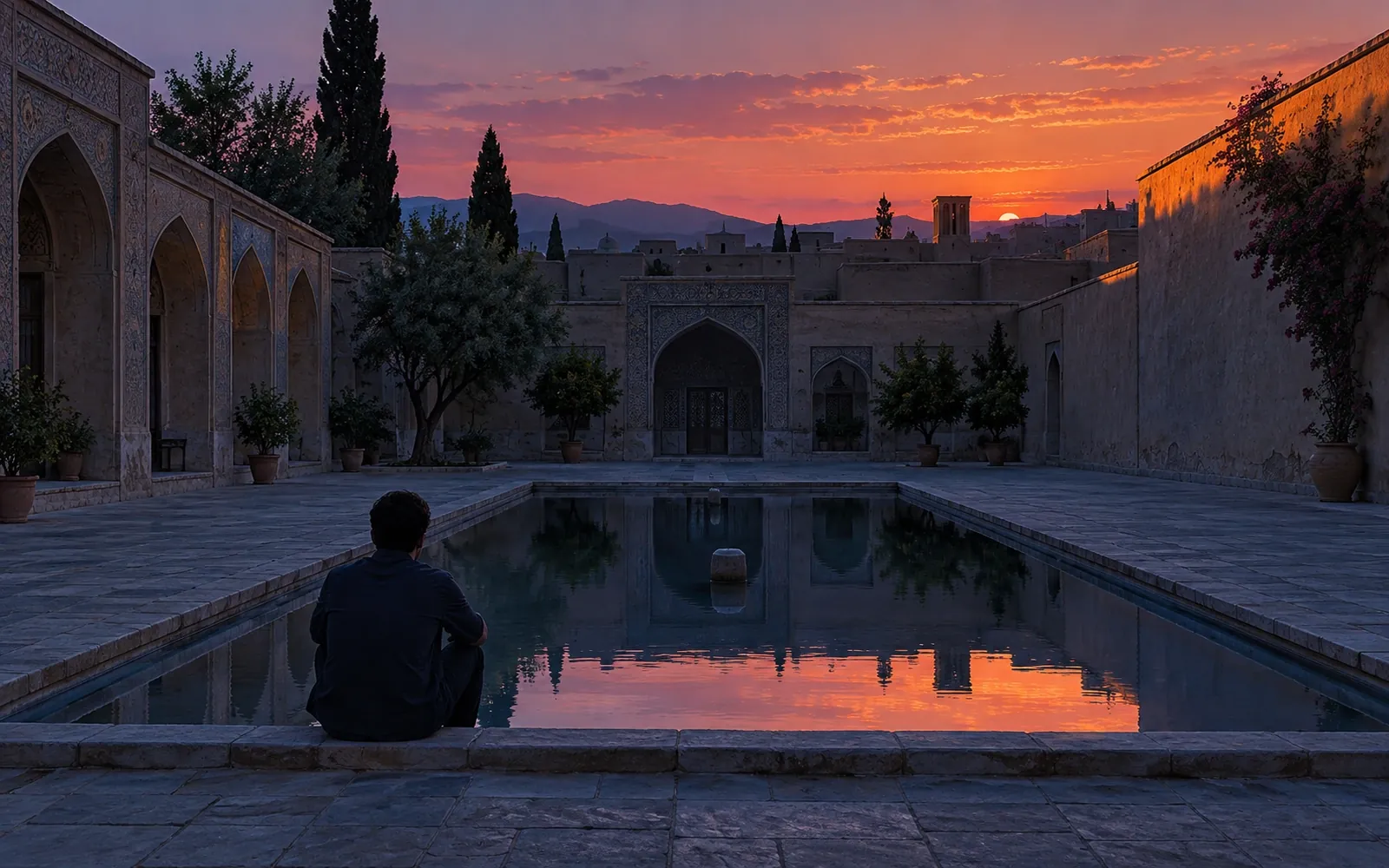
A bilingual prompt: 'A walled garden at gorg-o-mish (the dim grey-blue light before dawn, when outlines dissolve), a long narrow pool reflecting a row of cypresses, wet stone paving, a single lit window in a brick pavilion, no people, no text.'
How to put it into words
- Write the idea in Persian, then translate only the visual mechanics.
- Keep untranslatable words and add a short visual unfolding.
- Replace adjectives of origin with specific, named things.
Where we usually get it wrong
The common mistake is translating a Persian concept word for word and trusting the result. 'Dreamy Persian garden at dusk' gives a generic postcard; 'a walled Persian garden at gorg-o-mish, a long pool reflecting a cypress row, the light grey-blue and shapeless' gives the moment you meant.
Choose one Persian word for a time, place or feeling that you love. Write two prompts: one with an English translation, one keeping the word and unfolding it into what you would see. Generate both with the same seed and compare.
Sources and further reading
- Research on multilingual text-to-image generation, for example Saxon and Wang, 'Multilingual Conceptual Coverage in Text-to-Image Models' (ACL 2023).
- Saxon et al., 'Lost in Translation? Translation Errors and Challenges for Fair Assessment of Text-to-Image Models on Multilingual Concepts' (NAACL 2024).