Describing it in its own words
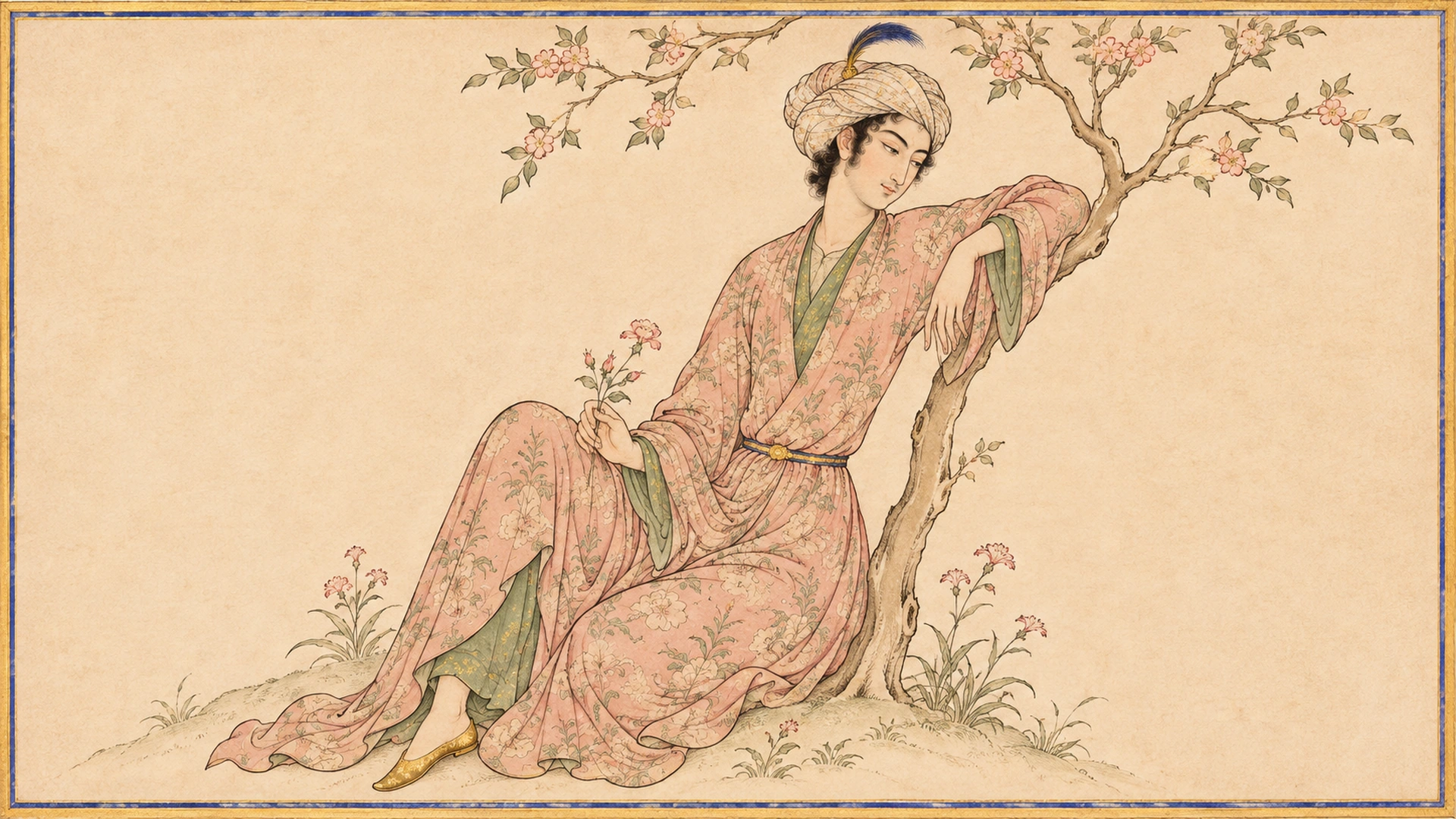
In English this tradition is usually called Persian miniature, a European label for small paintings in books. In Persian it is negargari, and the craft has a precise vocabulary of its own: separate words for drawing the outline, laying the colour, building tone with tiny strokes, ruling the frame and painting in gold.
These words are worth learning because 'Persian miniature style' alone produces a generic mix of gold, carpets and domes. Naming the parts, such as a high horizon, flat colour fields, a toranj medallion or an eslimi border, describes how these paintings are actually built. As everywhere in this library, the aim is to describe and understand the tradition, not to copy a particular painting.
Making the image
The Persian word for this painting tradition; preferred over 'miniature'.
The first drawing, the underlying design of the composition.
The fine, even contour line drawn with a very thin brush around every form.
Filling forms with flat, opaque, carefully separated fields of colour.
Building tone and softness with countless tiny dots and strokes, especially on faces and skin.
Gold ground into a powder with glue and painted with a brush; used for skies, haloes and ornament.
Drawing the thin coloured and gold frame lines around the text and the painting.
Illumination and ornament
Gold and colour ornament on a manuscript page, usually with lapis blue.
Light drawings of animals, birds and plants, often in gold or pale colour, in the page margins.
Spiralling, split-leaf vegetal scrolls; the arabesque of Persian ornament.
Blossom and flower motifs, palmettes and peonies; the name points to China (Khata).
A central oval or lobed medallion, used on pages, book covers and carpets.
A medallion with matching quarter pieces in the corners; a classic layout for covers and carpets.
A round rosette with rays, usually on an opening page.
The illuminated panel at the start of a text.
Space and composition
The horizon sits near the top, so the ground becomes a tall vertical field for the story.
Distance is shown by placing things higher, not smaller; several views at once.
A tree, a rock or a figure grows beyond the ruled border into the margin.
Curling ribbon-like clouds, borrowed from Chinese painting.
Pastel, coral-like rocks, sometimes hiding faces and animals in their contours.
An album of collected paintings and calligraphy, often with decorated borders.
Schools
15th century, around Behzad: crowded, lively compositions and natural, individual figures.
Early 16th century: rich colour, dense detail, large court manuscripts.
17th century, around Reza Abbasi: single-page figures, elegant calligraphic line, light colour.
The words to describe it
Precise words for the qualities above. Combine a few of them instead of naming the style or artist alone.
- negargari flat colour fields
- ghalam-giri fine outline
- pardaz stippled tone
- tala-hal shell gold
- high horizon stacked space
- eslimi arabesque border
- khatai blossom motif
- toranj central medallion
- shamseh sunburst rosette
- tash'ir gold margin drawings
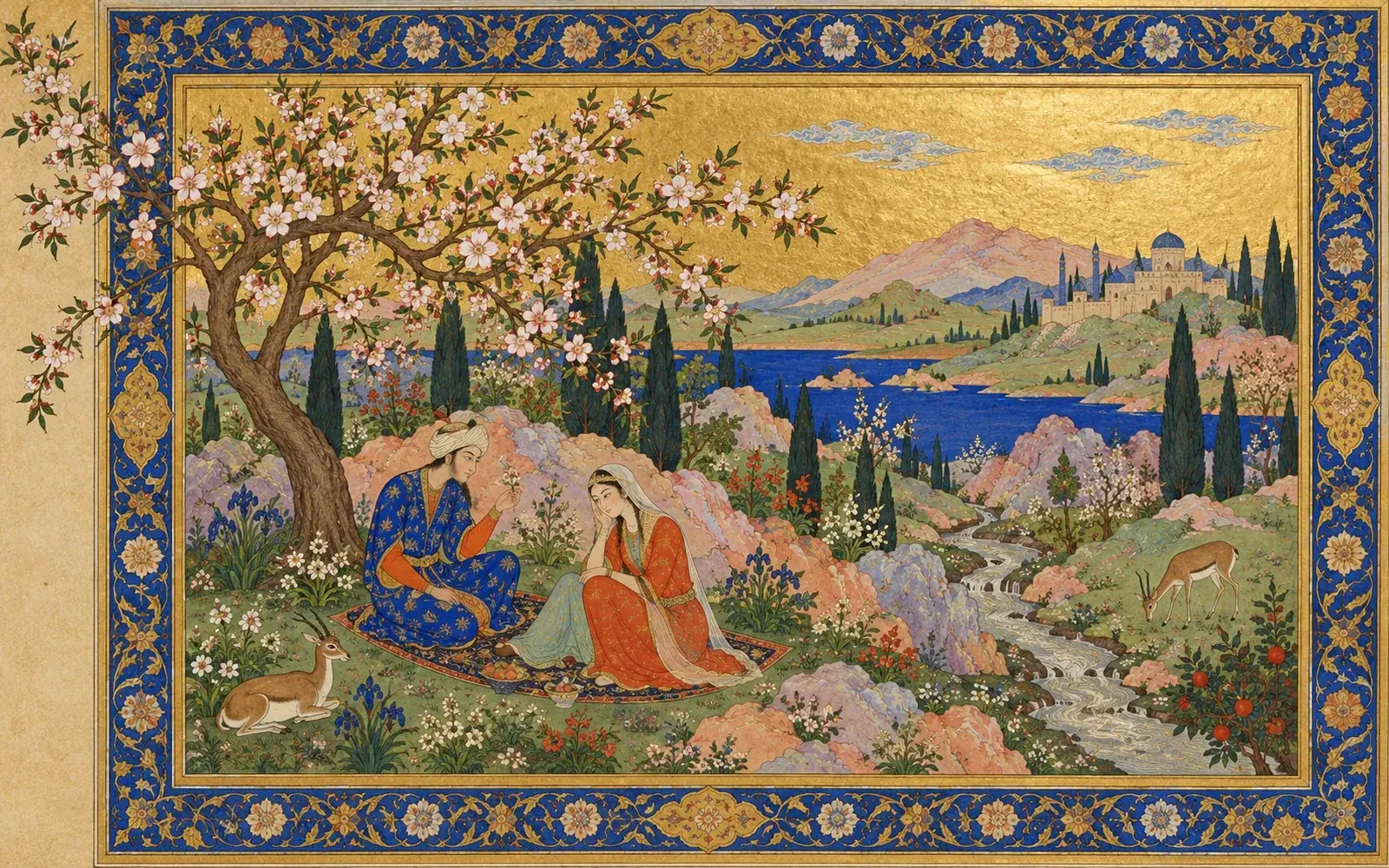
An original page in the language of Persian painting: a garden scene with a high horizon and a shell-gold sky, two figures under a blossoming tree drawn with a fine ghalam-giri outline, flat lapis, vermilion and pistachio colour fields, a stream in silver, an eslimi border and the branch of the tree breaking out of the frame into the margin.
How to put it into words
- Name the parts: border, medallion, horizon, outline, gold.
- Describe the space: a high horizon and stacked layers instead of perspective.
- Name the surface: opaque flat colour, shell gold and burnished paper.
Where we usually get it wrong
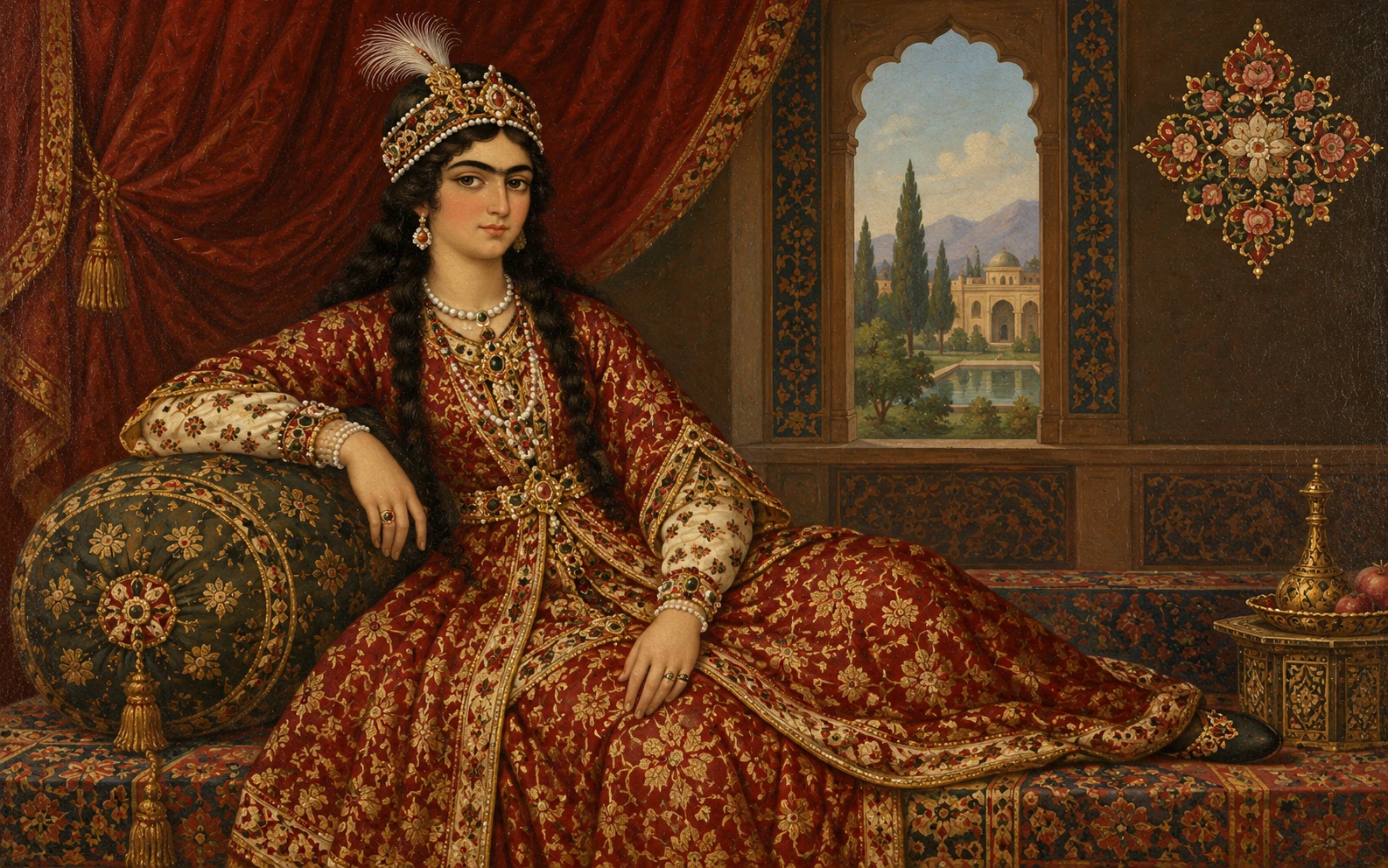
'Persian miniature' alone usually brings back a souvenir cliché: gold everywhere, random domes and carpets. The real tradition is mostly about clear colour, precise outline and layered storytelling space. And mixing up Persian, Mughal and Ottoman painting loses the details that make each one recognisable.
Look at one page of a Persian manuscript in a museum's online collection. Describe it with five terms from this page: one for the line, one for the colour, one for the ornament, one for the space and one for the frame.