A story in one frame
A story unfolds in time. An image stands still. In 1766 Gotthold Ephraim Lessing argued that painting, which can show only one instant, should choose the 'pregnant moment': the instant from which the viewer can best imagine what came before and what will follow. Two centuries later narratology, the study of how stories are built, gave us a fuller toolkit: the difference between the story and its telling, who narrates and who sees, what is shown and what is left for the reader to fill.
A prompt can use all of it. Most prompts describe a scene; a narrative prompt describes a moment in a story. The difference is visible. A scene is 'a woman at a window'. A moment is 'a woman at a window with car keys in her hand, a packed suitcase by the door and two cups on the table, one of them untouched'. The second image has a past and a future, and the viewer starts telling it to themselves.
This page translates the main ideas of narratology into decisions you can write: which moment to freeze, whose eyes we see through, which traces of the past to leave and which signs of the future to plant, and what to keep outside the frame.
The story and its telling
The Russian formalists split fabula, what happened in order, from syuzhet, how it is told. One image is a single slice of the telling; the prompt chooses which.
Lessing's instant just before the climax, rich with what came before and what will come. Usually stronger than the climax itself.
Exposition, rising action, climax, falling action, resolution. Each point makes a different image of the same story.
Starting in the middle of things. An image that drops the viewer into an action already underway asks them to reconstruct the beginning.
Seymour Chatman's terms (after Barthes): kernels are the events the story depends on, satellites are the texture around them. Put a kernel in the image, then add satellites.
A story starts when someone wants something and something stands in the way. Show both, and the image moves.
Who tells, who sees
Gérard Genette separated who speaks from who sees. In an image, the camera position decides whose perception we share.
The all-seeing view: a high wide shot that shows more than any character knows.
We see through a character: point-of-view shot, over the shoulder, their hands in the frame.
We watch from outside and know only what is visible: a distant, neutral camera, faces turned away.
Close and intimate or far and observational. Lens and framing are the narrator's distance.
An image can mislead on purpose: a reflection that contradicts the scene, a crop that hides the key fact.
Before and after the frame
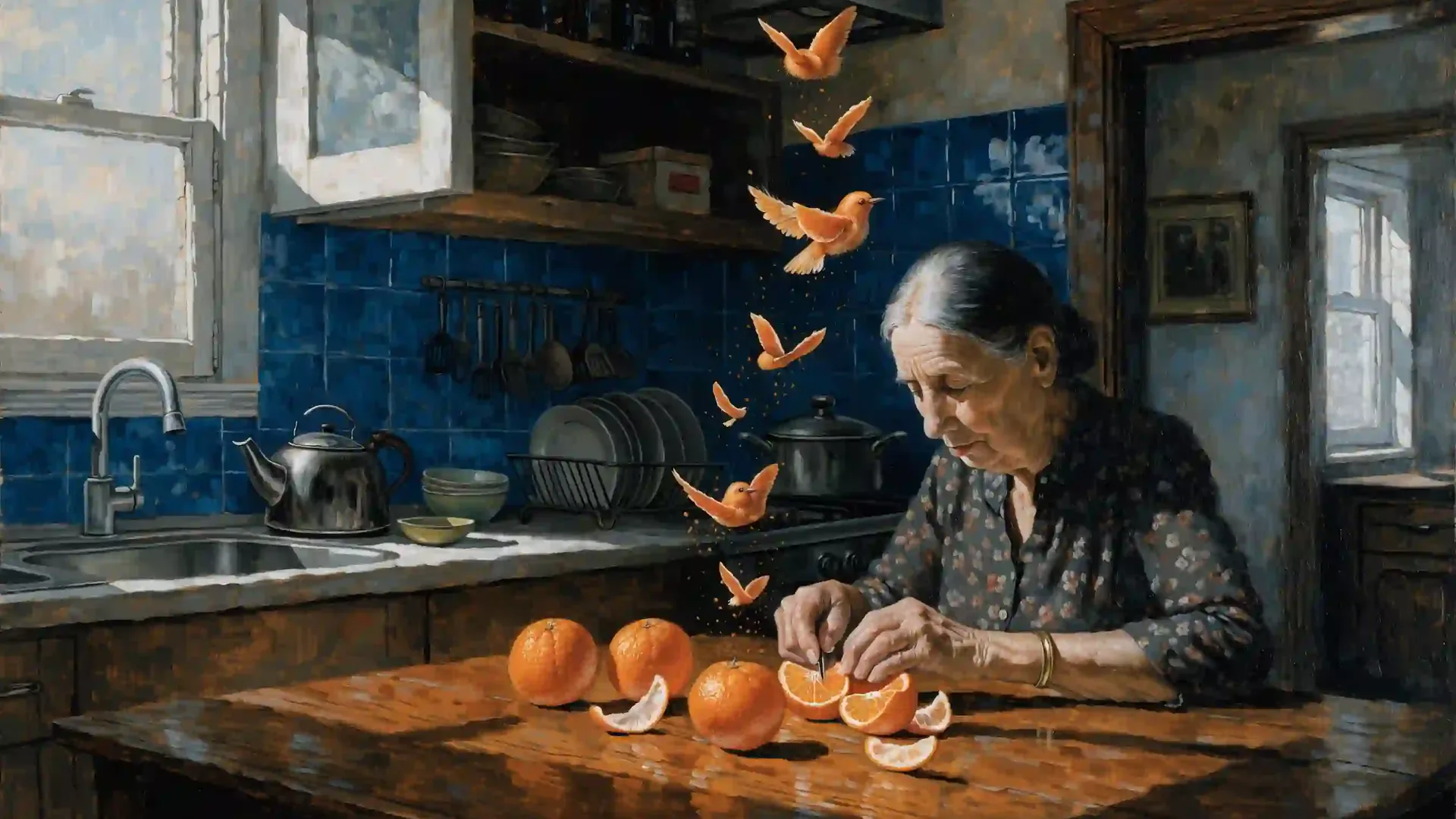
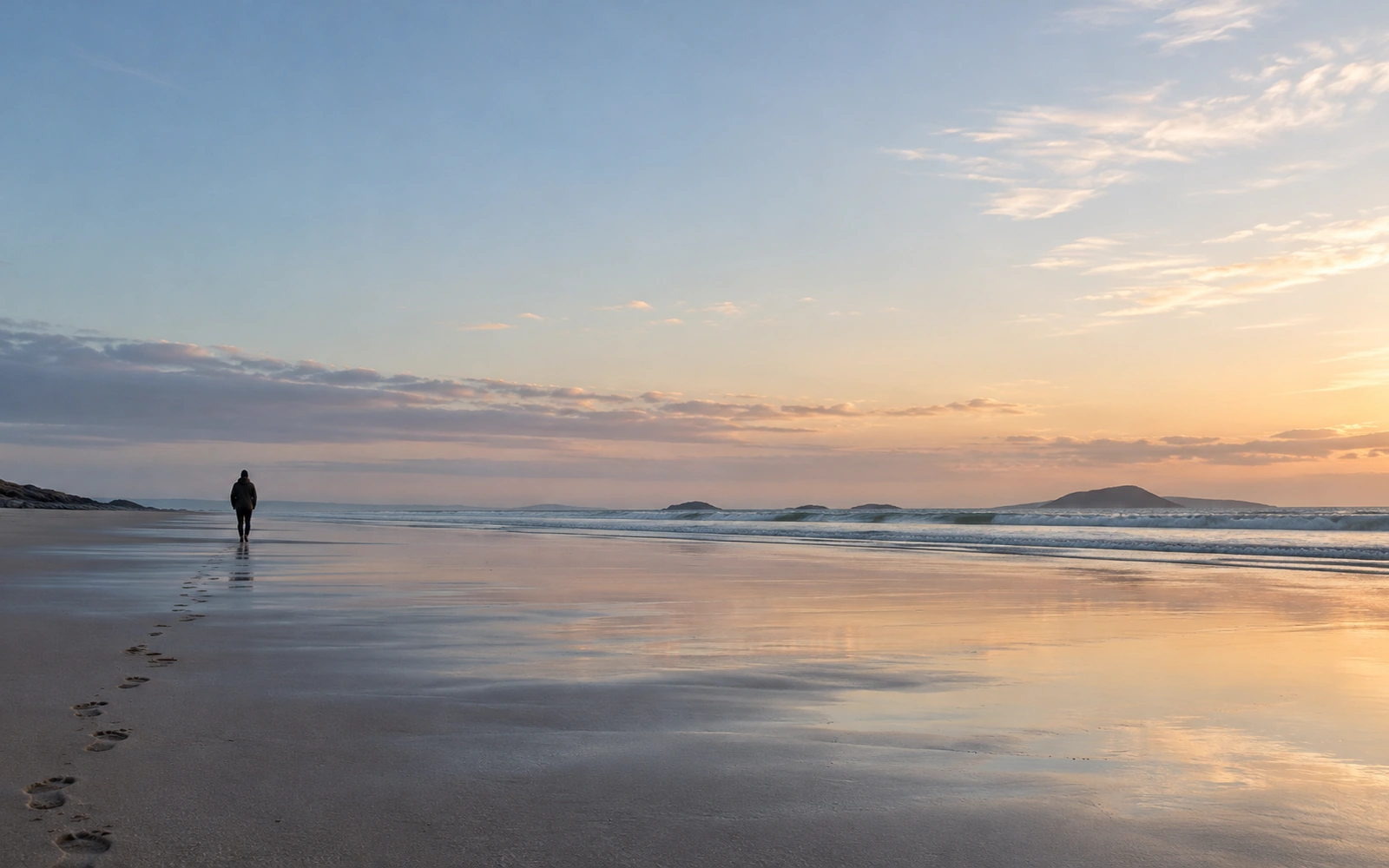
Evidence of what just happened: wet footprints, a fallen chair, a half-eaten meal, smoke from a candle just blown out.
Signs of what is about to happen: a raised hand, a packed bag, a gathering storm, a phone lighting up face down.
Noël Burch described the space beyond the edges of the frame. A glance or a shadow from outside makes the unseen part of the story.
Wolfgang Iser argued that readers make meaning by filling the gaps a text leaves. Leave a gap the viewer can't resist filling.
Scott McCloud's word for how we infer what happens between comic panels. A single image invites closure with an imagined next panel.
Ways one image tells a story
One moment, one place: the most common form, and the one the pregnant moment serves.
The same character appears several times in one picture at different stages, as in many medieval and early Renaissance paintings.
Only the consequences are shown, and the event is reconstructed from them.
Only the waiting is shown, and the event is imagined ahead of it.
The words to describe it
Precise words for the qualities above. Combine a few of them instead of naming the style or artist alone.
- narratology
- fabula and syuzhet
- story and discourse
- pregnant moment
- Freytag's pyramid
- in medias res
- kernel and satellite
- focalisation
- narrative distance
- unreliable narrator
- off-screen space
- gap
- closure
- trace and setup
- continuous narrative
'A small kitchen at dawn seen from the dark hallway through a half-open door: a woman in a coat stands at the window with car keys in her hand, a packed suitcase waits by the table, two coffee cups sit on the counter, one untouched, a wedding photograph lies face down. Cold blue window light against warm shadow.'
How to put it into words
- Write the whole story in one sentence before writing the prompt.
- Choose the moment: usually just before the turn.
- Choose the focaliser and write the camera position to match.
- Add one trace of the past and one setup for the future.
- Decide what stays outside the frame, and hint at it.
Where we usually get it wrong
Describing a situation instead of a moment. 'A detective in a rainy city at night' is a genre, not a story: nothing has happened and nothing is about to. Add one thing that has just changed and one thing that is about to, and the same detective becomes a scene from a plot.
Write a three-sentence story. Generate three images from it, frozen at three points: rising action, the pregnant moment, the aftermath. Then take the strongest moment and generate it three more times with different focalisation: through a character's eyes, from a distant neutral camera, from high above. Notice how the same events become different stories.
Sources and further reading
- Gotthold Ephraim Lessing, Laocoön (1766).
- Gustav Freytag, Technique of the Drama (1863).
- Roland Barthes, 'Introduction to the Structural Analysis of Narratives' (1966).
- Gérard Genette, Narrative Discourse (1972).
- Seymour Chatman, Story and Discourse (1978).
- Wolfgang Iser, The Act of Reading (1976).
- Noël Burch, Theory of Film Practice (1969).
- Scott McCloud, Understanding Comics (1993).
- Mieke Bal, Narratology: Introduction to the Theory of Narrative (1985).