A painter's word that writers made famous
The German critic Franz Roh coined 'Magischer Realismus' in 1925 for painters who turned away from Expressionism towards sharp, still, strangely heightened pictures of everyday things. In 1943 the Museum of Modern Art in New York showed 'American Realists and Magic Realists', and painters in the Netherlands, Italy and the United States worked in related ways.
From the 1940s the idea moved into literature, above all in Latin America: Alejo Carpentier wrote of 'lo real maravilloso' in 1949, and Gabriel García Márquez's One Hundred Years of Solitude (1967), where a girl rises to heaven while folding sheets, became its most famous example. In both art and writing, the key is tone: the marvellous is reported in the same calm voice as the ordinary.
Visual anatomy of Magic Realism
A recognisable, everyday world: kitchens, streets, fields, families.
One impossible element: levitation, rain of flowers, a door in a tree.
Calm and matter-of-fact; no one in the image reacts.
Precise, clear rendering, often sharp and still.
Even, clear and slightly heightened, like an afternoon that has lasted too long.
Wonder, melancholy, quiet strangeness.
Words around magic realism
Franz Roh's 1925 term for post-Expressionist painting.
Alejo Carpentier's 'marvellous real', rooted in Latin American history and landscape.
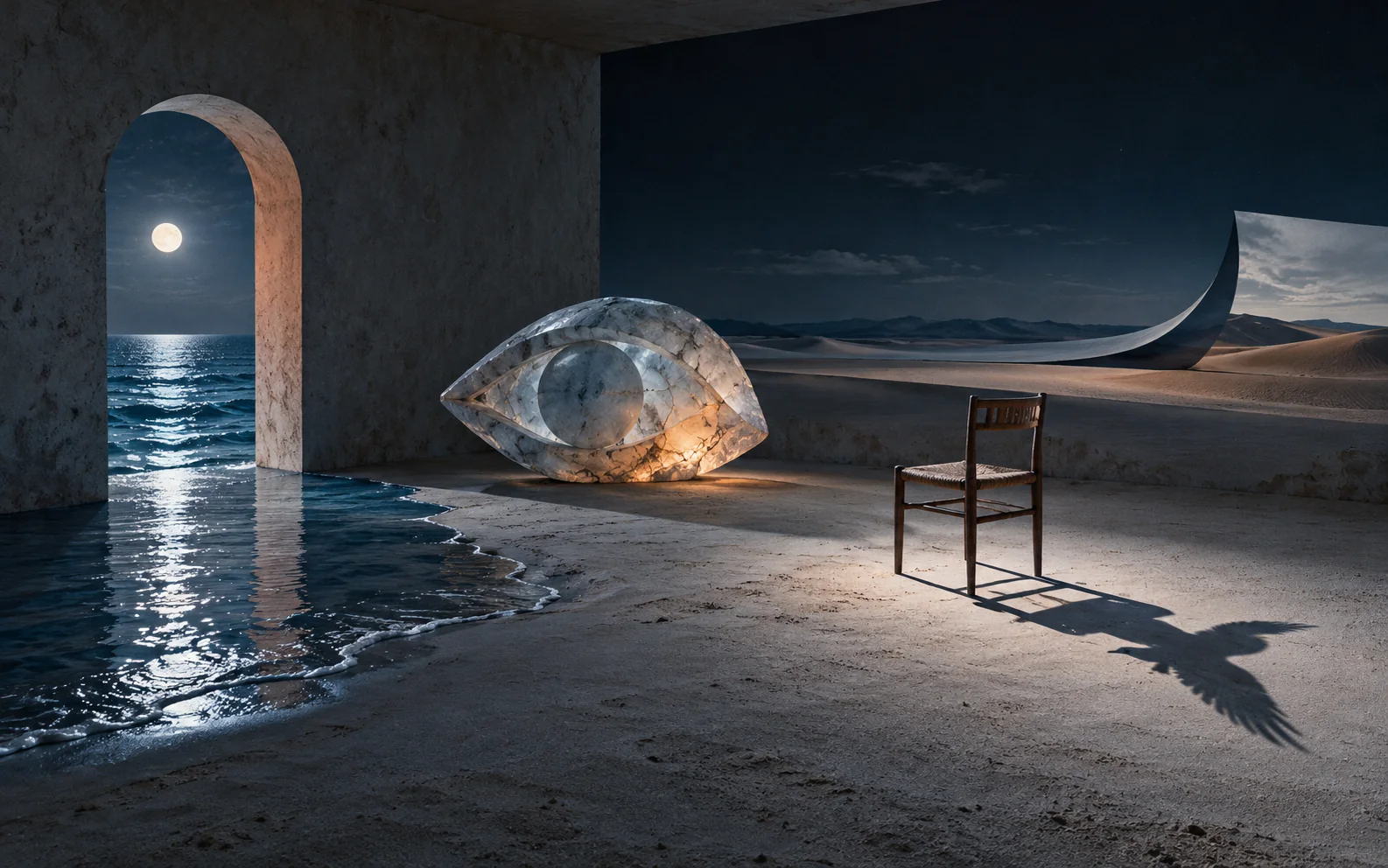
A related but different idea, built on dreams and the unconscious rather than calm everyday reality.
How to recognize Magic Realism
- An ordinary scene painted or told precisely.
- One impossible detail.
- No one reacts to it.
- A quiet, matter-of-fact tone.
Where people get it wrong
Magic realism is often confused with Surrealism or fantasy. Surrealism builds dream logic from the unconscious, and fantasy builds a separate world; magic realism stays in this world and lets one marvel in. Overloading an image with impossible things turns it into fantasy and loses the effect.
Words to describe Magic Realism
Precise words for the qualities above. Combine a few of them instead of naming the style or artist alone.
- magic realism
- magical realism
- the marvellous real
- matter-of-fact tone
- levitation
- precision
- intrusion
- stillness
- Franz Roh
- García Márquez
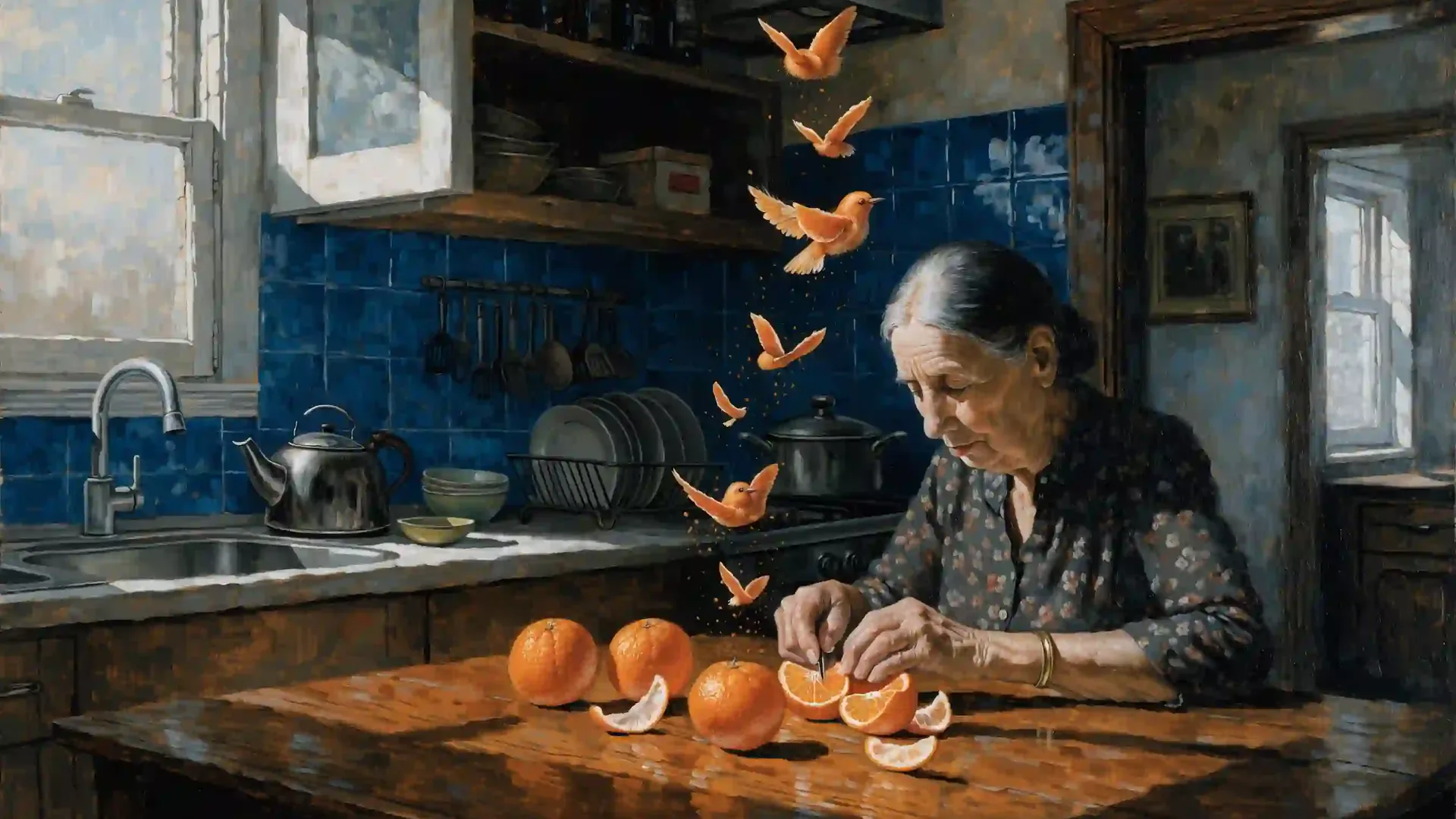
A magic realist study: a sunlit kitchen with blue tiles and a wooden table, a grandmother peeling oranges, the peels rising slowly into the air like small orange birds, nobody looking up, clear afternoon light.
What to take from Magic Realism today
- Describe the ordinary scene first, in detail.
- Add one impossible element only.
- Say that nobody reacts.
- Keep the light clear and the tone calm.
The tone is the technique
In literature, magic realism lives in the narrator's voice: the miracle is told as if it were the weather. The same holds for images and prompts. The calm sentence 'a woman hangs laundry while the sheets drift up into the clouds' does more than a list of fantastic adjectives. The punctum is the impossible detail; the art is in not underlining it.
Questions about Magic Realism
What is magic realism?
A style in art and literature that shows the ordinary world realistically and includes magical or impossible elements as if they were normal, without explanation or surprise.
What is the difference between magic realism and surrealism?
Surrealism creates dreamlike, irrational worlds from the unconscious. Magic realism keeps the real world and its everyday logic, with one or two marvellous elements accepted calmly.
Who coined the term magic realism?
The German critic Franz Roh, in 1925, for a group of post-Expressionist painters. Later it was used widely for Latin American literature.
Write four sentences about your morning exactly as it happened. Then change one detail into something impossible, and rewrite only that sentence, in the same calm tone.
Sources and further reading
- Franz Roh, Nach-Expressionismus. Magischer Realismus, Klinkhardt & Biermann, 1925.
- Museum of Modern Art, American Realists and Magic Realists, exhibition catalogue, 1943.
- Lois Parkinson Zamora and Wendy B. Faris (eds), Magical Realism: Theory, History, Community, Duke University Press, 1995.
- Alejo Carpentier, prologue to The Kingdom of This World, 1949.