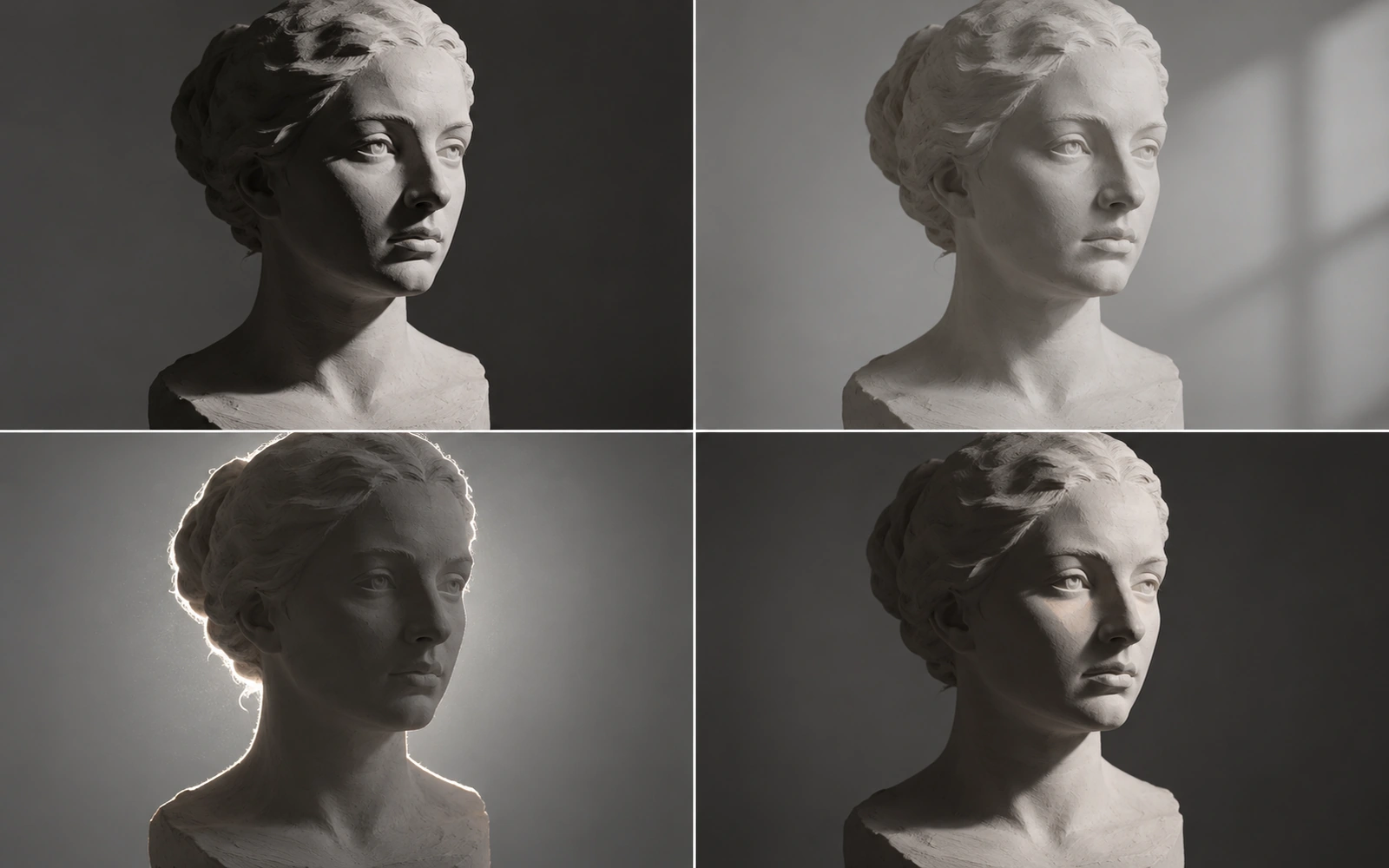
Guiding the eye
Composition is the arrangement of everything inside the frame. It decides what the viewer sees first, how the eye travels and whether an image feels calm, tense, intimate or vast.
The common 'rules' come from painting, photography and design. They are not laws, but a shared vocabulary: knowing them lets you describe an image precisely and break them on purpose.
Placement and balance
The frame divided into a 3×3 grid; subjects placed on the lines or their crossings feel natural and dynamic.
The subject in the middle; strong, iconic, confrontational.
Mirrored halves; order, calm, formality.
Unequal elements that still feel balanced through size, color or position.
A proportion of about 1:1.618 used to place subjects along a spiral path.
How strongly an element pulls the eye: size, contrast, color, faces.
Lines and shapes
Roads, rails or edges that lead the eye toward the subject.
Strong diagonals that create movement and energy.
Three points forming a stable, connected group.
Repeated elements that create rhythm, often broken by one exception.
Space and depth
Empty area around the subject that gives it room and focus.
A doorway, window or arch that frames the subject inside the image.
Objects in the foreground that add depth and place the viewer inside the scene.
The relationship between a shape and its background; clarity or ambiguity.
Space left in front of a subject that is looking or moving.
The space above a person's head; too much or too little changes the feeling.
Words to describe composition
Precise words for the qualities above. Combine a few of them instead of naming the style or artist alone.
- rule of thirds
- centered symmetrical composition
- leading lines
- strong diagonal
- generous negative space
- frame within a frame
- layered foreground
- asymmetric balance
- repeating pattern with one exception
- low horizon
A small figure in a red coat stands on the lower left third of a vast snowy field, a line of fence posts leading the eye toward her, a low horizon and generous empty white sky above.
How to describe composition in words
- Say where the subject sits: center, left third, low in the frame.
- Name what leads the eye there.
- Describe the empty space and the depth.
Where people get it wrong
The rule of thirds is not a guarantee of a good image, and centered subjects are not a mistake. The question is always what the arrangement does to the meaning.
Questions about composition
What is composition?
How elements are arranged inside a frame so the eye knows where to go: balance, lines, space, depth and the 'rules' worth knowing and breaking.
How do you describe composition in words or a prompt?
Say where the subject sits: center, left third, low in the frame. Name what leads the eye there. Describe the empty space and the depth.
Photograph the same object three ways: centered, on the left third with space in front, and small in a large empty frame. Describe in one sentence how each changes the feeling.