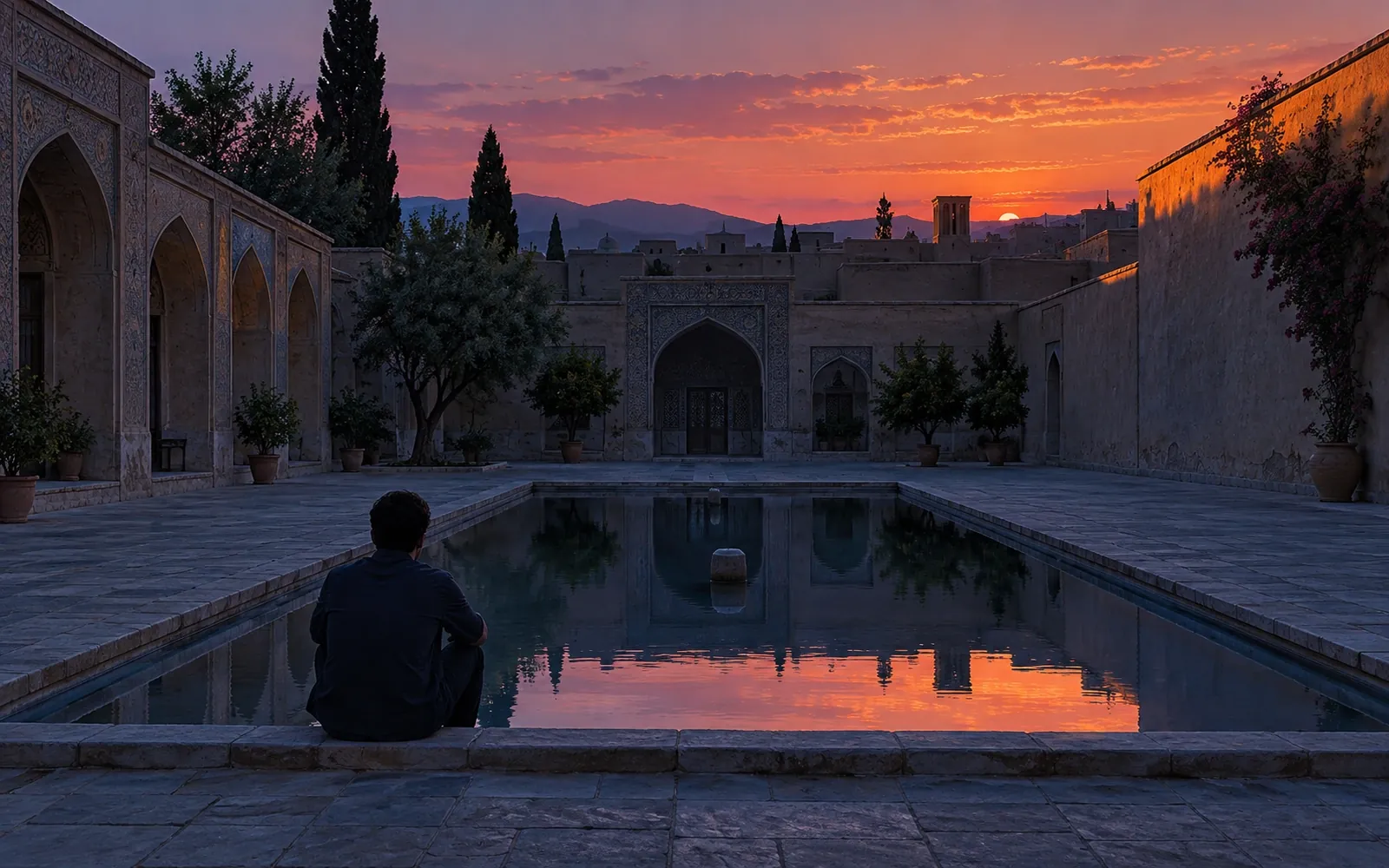
A word that holds a whole scene
Some words are compressed descriptions. Gorg-o-mish, Persian for twilight, literally means 'wolf-and-ewe': the hour when the light is too low to tell a wolf from a sheep. The word does not just name a time, it hands you a picture, a level of light and a small danger, all at once.
That is why these words matter for anyone who makes or describes images. An untranslatable word is a thin label that is secretly thick: a whole scene folded into one sound. Our job is to unfold it again, into light, colour, distance, surface and time. So every word on this page comes with a second line: what you would actually see.
Most lists of untranslatable words online repeat the same dozen favourites, often with invented or stretched meanings. This one starts from Persian, which has an unusually rich vocabulary for looking, then moves to the painting words of East Asia and a few carefully chosen words from elsewhere.
Persian ways of looking
English mostly gets by with see, look, watch and stare. Persian splits looking into many verbs, each with its own distance, duration and intention. For an image-maker, each one is a camera decision: where the eyes go, how long they stay, and who knows they are being watched.
Looking for pleasure, at leisure, as if at a show; going out 'to tamasha' a garden or a street. English borrowed it through Hindi as 'tamasha', a spectacle or a fuss.
In the image Wide, open framing, a crowd or a landscape, people turned toward the same view, unhurried time.
Quiet, contemplative watching from a distance, without taking part.
In the image A figure seen from behind, looking out over a view; long lens, stillness, soft even light.
In Hafez and Persian mystical poetry, the 'play of the gaze': looking at beauty as a way of approaching the divine.
In the image Two gazes meeting across a space, reflections, mirrors, a face lit as if it were the source of light.
To stare fixedly, often dazzled or lost; the word also means dazzling light itself.
In the image A frozen face, wide eyes, strong light on the face, everything else falling out of focus.
To stare boldly, insistently, sometimes rudely.
In the image Direct eye contact with the camera, centred, symmetrical, no escape.
Looking from the corner of the eye, secretly, while pretending not to.
In the image Head turned one way and eyes another, a three-quarter view, a glance aimed out of the frame.
A half-glance; a look that is barely given.
In the image A face caught mid-turn, slight motion blur, a cropped profile.
Watching someone or something without being seen.
In the image Shot through a gap: a half-open door, leaves, curtains, a foreground that hides the watcher.
Stretching your neck to peek around a corner or over a wall.
In the image A head entering the frame from the edge, an unusual angle, a wall cutting the image in two.
Looking someone up and down to size them up.
In the image A vertical pan or a tall full-length frame; the eye travels from shoes to face.
Literally 'to sew your eyes' to something: fixing your gaze in waiting or longing.
In the image A figure at a window or a door, the eyeline leading out of the frame to an empty road.
The Persian clock of light
Persian divides the edges of the day very finely, and many of these words are, at heart, descriptions of light. Together they work like a lighting chart.
The last part of the night before dawn; the hour of prayer and of poetry.
In the image Deep blue darkness, no shadows yet, one lamp or one window lit.
The first whiteness on the horizon.
In the image A pale band of light low on the horizon, the rest still blue-black, silhouettes without detail.
The redness that appears in the sky at daybreak.
In the image Rose and orange in the lowest sky, cool blue above, long faint shadows.
'Wolf and ewe': the light in which you can no longer tell them apart, at dawn or dusk.
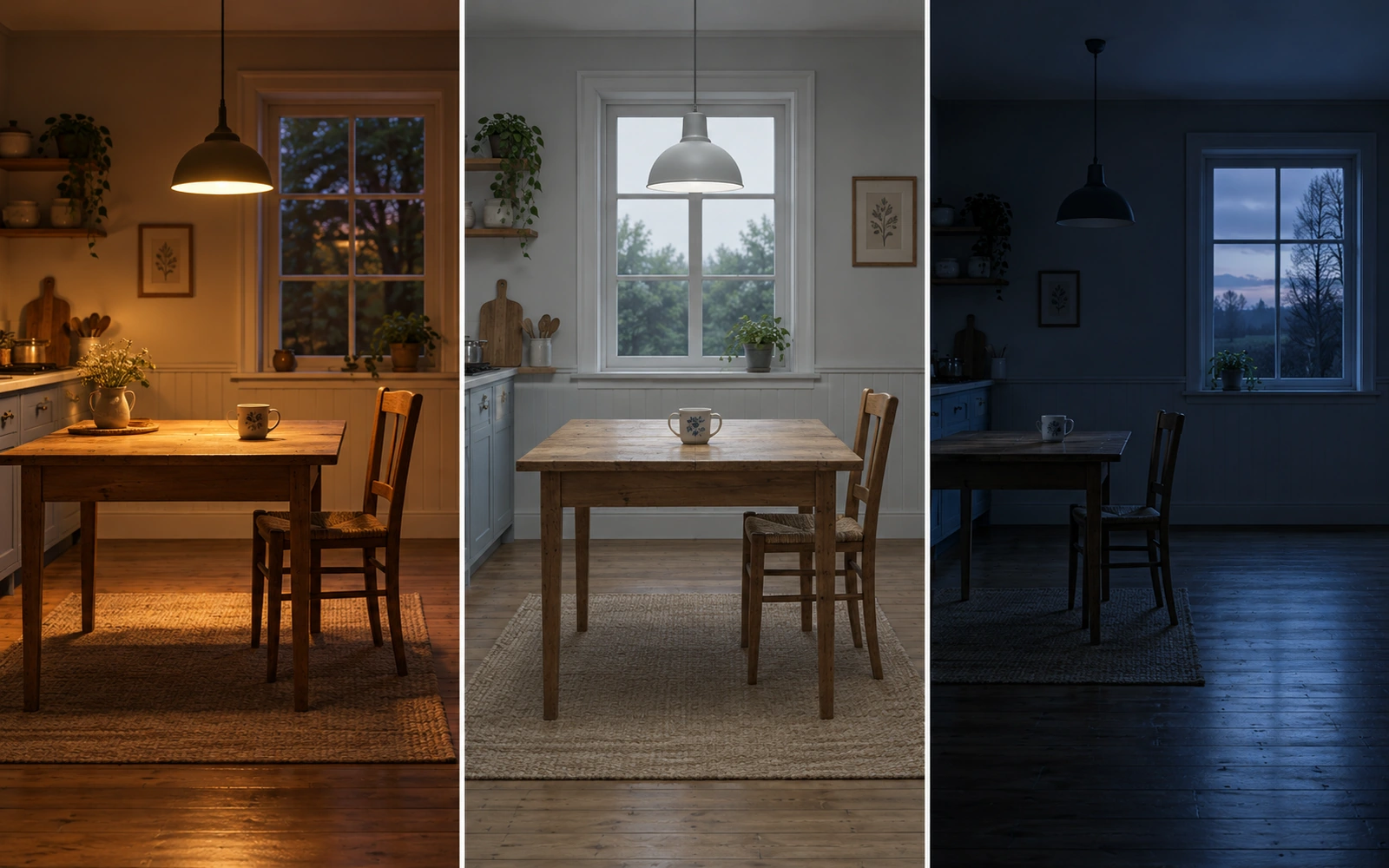
In the image Low contrast, colours collapsing into grey-blue, edges dissolving, shapes recognisable only by outline.
The red glow that stays in the sky after sunset.
In the image A red-orange band above a dark horizon, the land already in shadow, warm light only on the highest things.
'Sun on the edge of the roof': the very last sunlight; also an image for old age.
In the image Light only on the top edge of walls and roofs, everything below in cool shade.
The sunny slope and the shaded slope of a mountain or a valley.
In the image One side warm and bright, the other cool and blue, a strong diagonal border of light.
The wave of heat rising from hot ground or a fire.
In the image Shimmering air, distorted distance, bleached colour, a hot white sky.
A faint, far light, almost lost; also a last glimmer of hope.
In the image One tiny warm point of light in a large dark frame.
Moonlit; also an open roof terrace, and also the white fluorescent tube light.
In the image Cold, flat, bluish-white light, with or without the moon.
Rooms, spaces and states
Many Persian words for places are built on del, the heart. A room is 'heart-open' or 'heart-catching'. These words describe space by its effect on the body, which is exactly what an interior or a location photograph needs to capture.
'Heart-open': a space that is airy, bright and spacious, that lets you breathe.
In the image High ceilings, big windows, light walls, empty floor, a view out.
'Heart-catching': a place, hour or light that weighs on the heart.
In the image Flat overcast light around five in the afternoon, closed curtains, dull colours, an empty street; think of a cloudy Friday dusk.
A tucked-away, quiet, cosy corner that feels like it belongs to you.
In the image A small corner seen from close, a lamp, a cushion, a wall at your back, darker space around it.
Small, neat and lovable, said of a house, a room or a shop.
In the image A compact space with everything in place, warm materials, the whole room in one frame.
The fresh, pure pleasantness of a place, often with water, greenery and company.
In the image A courtyard pool, trees, morning light, clean air, people sitting on the ground.
Both solitude and an empty, quiet place; 'the street is khalvat' means nobody is there.
In the image An empty street or room, one figure or none, generous negative space.
The feeling of being a stranger far from home; also the far place itself.
In the image Unfamiliar light and signs, a figure slightly out of place, distance between the figure and everything else.
Your state in this moment, but also the whole atmosphere of a moment, as in 'this place has hal'.
In the image Hard to fake: the right light, the right time, the right sound implied; describe it through the other words.
Empty space: words from East Asian painting
Chinese and Japanese aesthetics have precise words for things European art theory talks around: empty space, the mood a painting leaves behind, the balance of dark and light. Designers quote some of them every day.
The interval between things, in space or time, felt as something meaningful rather than missing.
In the image Wide gaps between few objects, pauses in an edit, a silence before a cut.
'Leaving white': the empty, unpainted part of a painting, which can be mist, water, sky or nothing.
In the image A large blank area of paper or sky that the eye fills in itself.
The 'realm' of feeling and meaning a poem or painting opens up beyond what it shows.
In the image Not one element but the total mood; describe the scene and the feeling it should leave together.
'Spirit resonance', the first of Xie He's six principles of painting (6th century): the sense that the work is alive.
In the image Loose, confident brushwork, movement in still things, nothing stiff.
The balance of dark and light as flat shapes, before any detail.
In the image Squint at the image: two or three clear masses of dark and light.
A deep, mysterious grace, felt rather than seen.
In the image Mist hiding a mountain, a figure disappearing, what is out of sight matters more than what is shown.
The beauty of imperfect, impermanent, worn things.
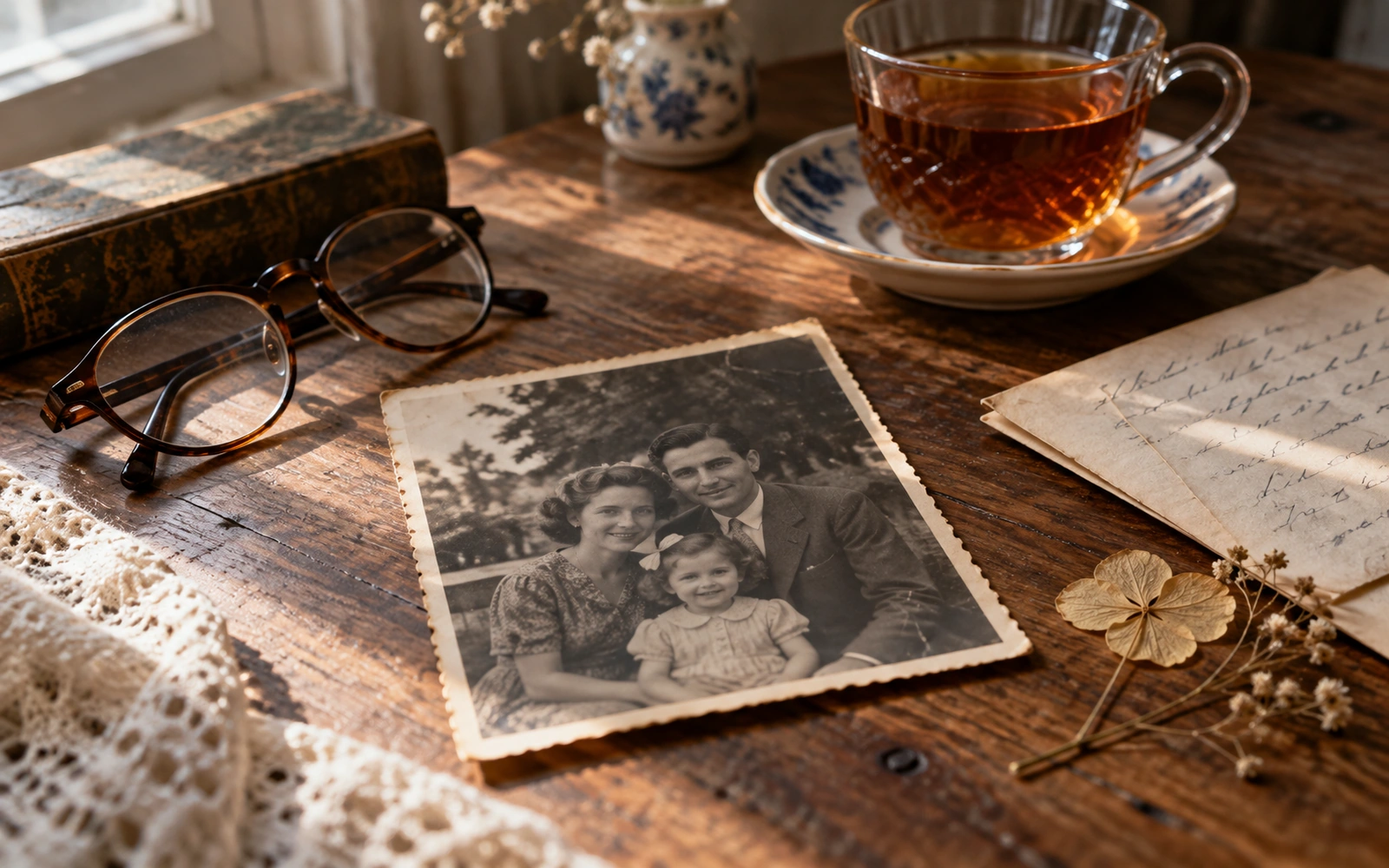
In the image Cracks, patina, faded wood, uneven glaze, muted earthy colour, soft side light.
Quiet, understated beauty that reveals itself slowly.
In the image A restrained palette, one small accent colour, fine texture, nothing shouting.
Sunlight leaking through the leaves of trees.
In the image Moving spots of light on the ground and on faces, green-gold glow, dappled shadow.
From elsewhere
A few more, chosen because they point at something you can actually see, not only at a feeling.
The road-like reflection of the moon on water.
In the image A narrow glittering path of light from the horizon to the viewer, dark water on both sides.
The polar night, the weeks when the sun does not rise.
In the image A day-long blue twilight, snow glowing faintly, lit windows at noon.
The blue hour, between sunset and night.
In the image Deep blue sky, warm artificial lights just switched on, balanced brightness between sky and city.
The disorientation of being somewhere foreign.
In the image Unfamiliar signs, unusual colours of light, a slightly tilted or off-centre frame.
A person who strolls the city just to watch it.
In the image Street-level photographs, passers-by, reflections in shop windows, a walking pace.
The feeling of being alone in a forest.
In the image Tall trunks, filtered green light, one small figure, deep silence.
A moment, literally 'an eye-glance'.
In the image A decisive instant frozen: a gesture, a glance, a fall.
In Lorca's sense, the dark, raw intensity that makes art shake you.
In the image Hard light, deep shadows, a body or a face under strain, nothing polished.
The 'flavour' or emotional essence an artwork lets the audience taste.
In the image Choose one dominant feeling and make every element serve it.
Words English stopped translating
Sometimes a language does not translate a word, it simply adopts it. These Italian and French words were once untranslatable too; now they are part of the vocabulary of art.
From fumo, smoke: soft transitions with no hard lines.
In the image Edges melting into shadow, hazy gradients, faces without outlines.
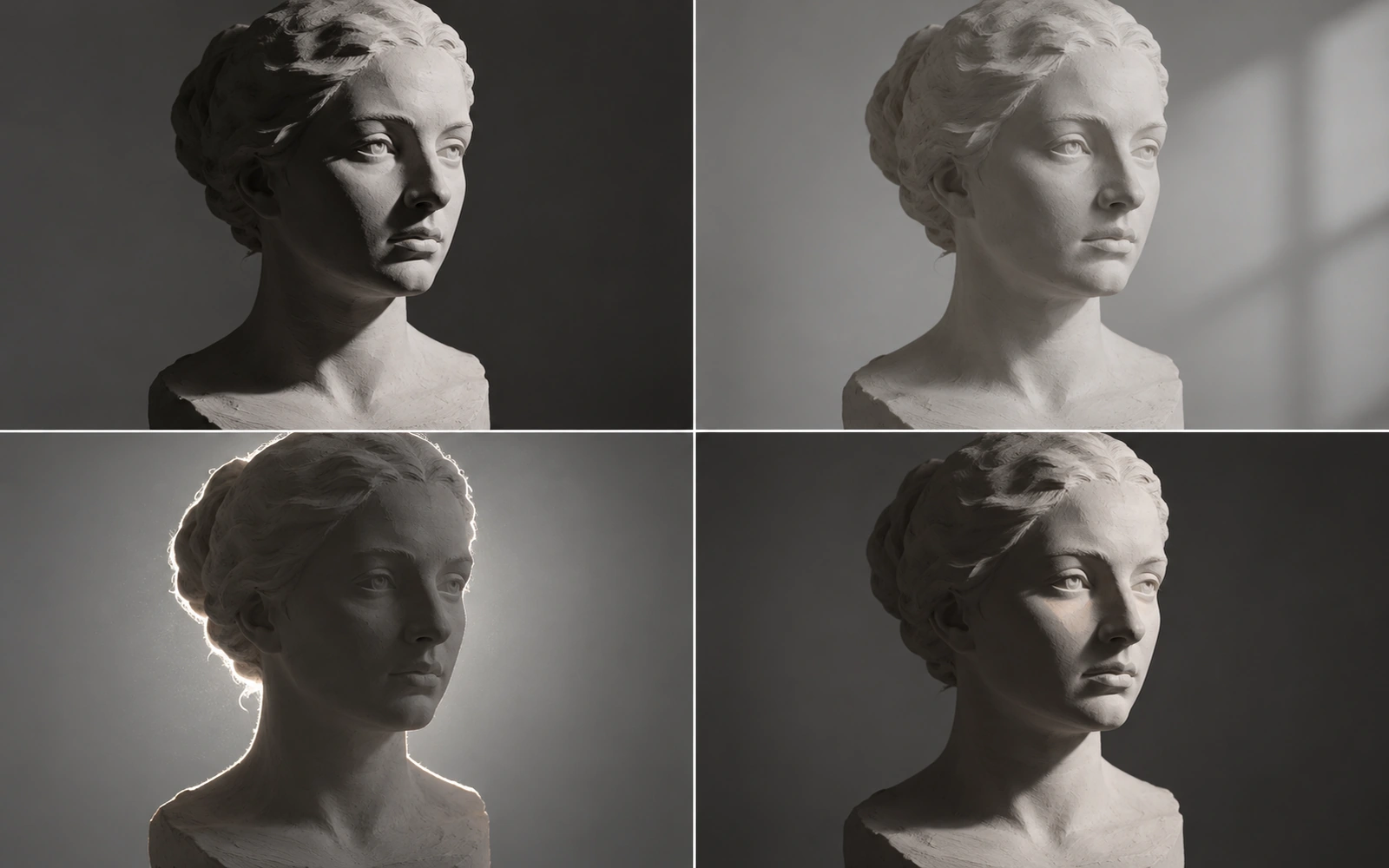
'Light-dark': strong contrast that pulls form out of shadow.
In the image One directional light source, deep black background, sculpted faces.
'Repentance': a trace of an earlier painting showing through.
In the image Ghost lines, a second faint version under the first, visible corrections.
The softness and delicacy of painted skin.
In the image Warm gentle light, smooth tonal transitions, soft focus on skin.
Studied carelessness: effort hidden behind ease.
In the image A loose sketch-like finish, slightly off-centre, imperfect in a deliberate way.
'Pretty-ugly': a beauty that comes from irregularity.
In the image Unconventional faces or objects lit and framed with total seriousness.
The words to describe it
Precise words for the qualities above. Combine a few of them instead of naming the style or artist alone.
- gorg-o-mish twilight, wolf-and-ewe light
- shafagh afterglow
- aftab lab-e bam last light on the rooftops
- horm heat shimmer
- delbaz airy bright room
- delgir overcast afternoon
- zir-e cheshmi sidelong glance
- ma, meaningful empty interval
- liubai blank space
- mångata moon road on water
A courtyard at shafagh: the land already in cool shadow, the last red glow above the rooftops, warm light only on the top edge of a wall, a still pool reflecting the sky, one woman seen from behind doing nazareh over the garden, wide empty space around her like liubai.
Unfold a word into an image
An untranslatable word on its own is a thin description: it points, but it does not show. To use one, unfold it, the same way narrative therapy turns a thin label into a thick story.
Delgir
Thin: a delgir afternoon. Thick: a Friday at about five, overcast, flat light with no shadows, a living room with the curtains half closed, the TV off, a cup of tea gone cold on the table, the street outside empty, colours of beige and dull green, the camera still and a little too far away.
Ma
Thin: a composition with ma. Thick: three small objects on a long low table, wide intervals between them, nothing on the wall, light from one side, the interval as important as the objects, nothing added to fill the space.
Where we usually get it wrong
Untranslatable does not mean unthinkable. English speakers can see twilight perfectly well; Persian just packed it into one word with a picture inside. The most famous example of this mistake is the claim that Eskimo languages have hundreds of words for snow, a story that grew with every retelling. Many online lists also invent meanings or flatten them, and some words, like hygge, have been turned into marketing. Check a word with a native speaker or a good dictionary before you build a project on it.
Persian makes new words easily by joining two: del + baz, nur + gir (a skylight, 'light-catcher'), shab + tab (a firefly, 'night-shiner'). Find something you have seen many times that has no name, such as the light on a wall from a passing car or the silence after a door closes, and make a compound word for it. Then write its second line: what it looks like in an image.
Sources and further reading
- Barbara Cassin (ed.), Dictionary of Untranslatables: A Philosophical Lexicon (2014; French edition 2004).
- Geoffrey K. Pullum, The Great Eskimo Vocabulary Hoax (1991).
- Tim Lomas, The Happiness Dictionary (2018), and his research on untranslatable words for feelings.
- Susan Bush and Hsio-yen Shih, Early Chinese Texts on Painting (1985), for Xie He's six principles.
- Arthur Wesley Dow, Composition (1899), which brought notan into Western art teaching.
- Kenya Hara, White (2010), on emptiness in Japanese design.
- Jun'ichirō Tanizaki, In Praise of Shadows (1933).
- Leonard Koren, Wabi-Sabi for Artists, Designers, Poets and Philosophers (1994).
- Federico García Lorca, 'Theory and Play of the Duende' (1933).
- The Divan of Hafez, for nazar-bazi.