Art that looks like a product
Andy Warhol was born in Pittsburgh in 1928 to a working-class family from present-day Slovakia. In the 1950s he was one of New York's most successful commercial illustrators, drawing shoes and ads in a delicate blotted-line style, before turning to painting.
In 1962 he showed 32 Campbell's Soup Cans, one for each flavour, and began making silkscreen paintings from photographs: Marilyn Monroe after her death, Elvis, Liz Taylor, Coca-Cola bottles, dollar bills, electric chairs and car crashes. His studio, The Factory, produced paintings, films, the Velvet Underground's banana album cover (1967) and Interview magazine. He died in 1987, but his idea that art can look like mass production, and that everyone will be 'world-famous for 15 minutes', feels more current every year.
Visual anatomy of Andy Warhol
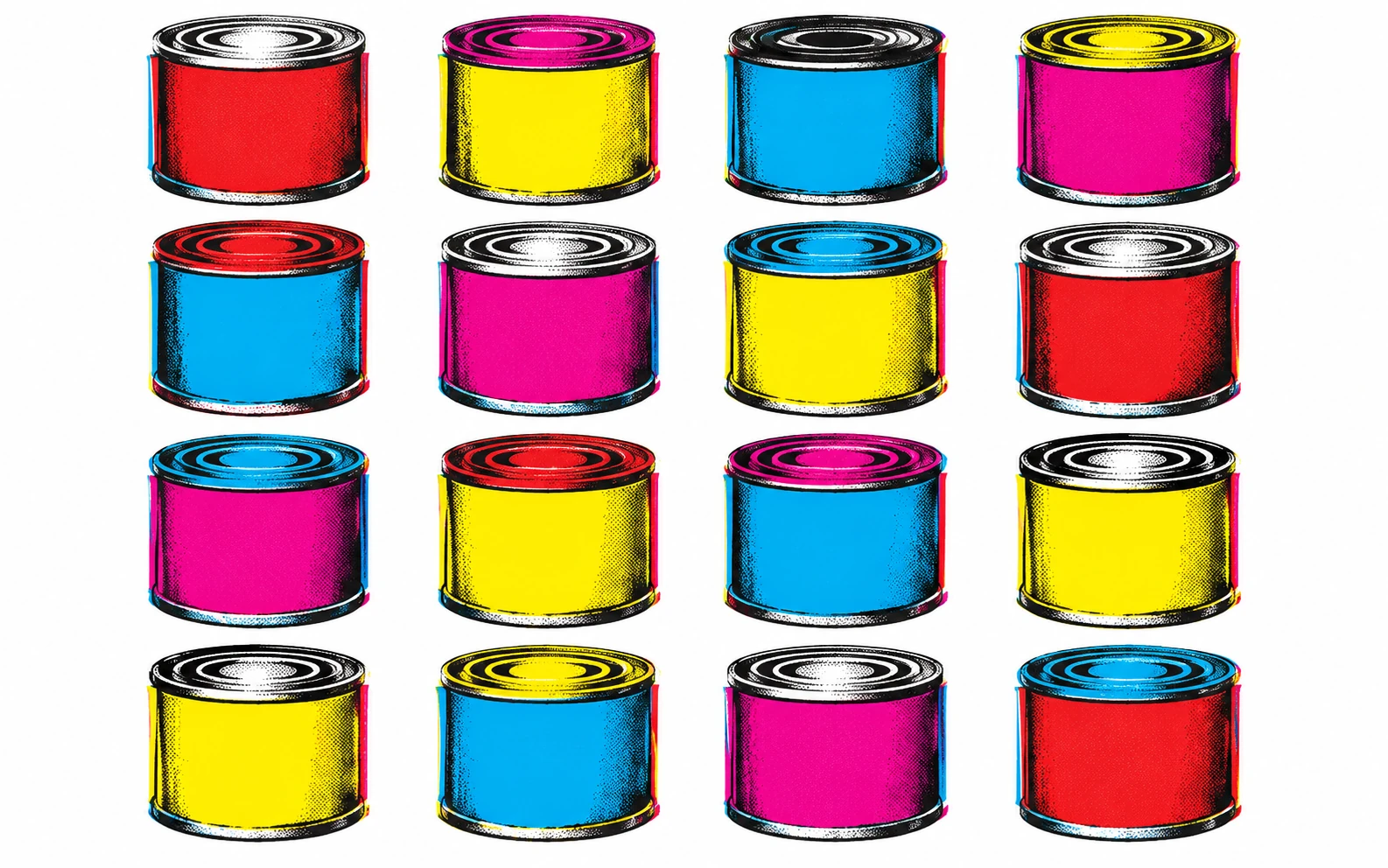
The same image repeated in grids, as on a supermarket shelf.
Photographic screens printed onto canvas, with slips, smears and misregistration.
Flat, arbitrary, high-key colour: hot pink faces, turquoise hair, acid yellow.
Brands, money, celebrities, and also death: car crashes, electric chairs.
Press photos, publicity stills and packaging, used almost unchanged.
Cool, blank, deadpan; no visible emotion or brushwork.
How to recognize Andy Warhol's work
- Grids of the same image, in shifting colours.
- Silkscreened photos with flat, unreal colour.
- Celebrities, brands and everyday products.
Where people get it wrong
'Warhol style' is often reduced to four colourful copies of a face. His real subject is what repetition does: a face repeated fifty times becomes a product, and a car crash repeated becomes wallpaper. Without that idea, it is only a filter.
Words to describe Andy Warhol
Words for what you see and feel in this work. They are for describing and understanding, not a recipe for copying an artist.
- silkscreen print
- repeated grid of portraits
- flat high-key colour
- misregistered ink
- pop art celebrity
- consumer product as icon
- deadpan repetition
- hot pink and turquoise
- press photo source
- factory-made look
An original description inspired by the approach, not a copy: a grid of nine identical silkscreened photographs of a plain glass water bottle, each in a different flat colour combination, acid yellow on violet, turquoise on hot pink, with slightly misaligned ink and smudges.
What to learn from Andy Warhol
- Repeat one image and change only the colour.
- Use a flat, found photograph instead of a drawing.
- Choose an everyday object or a famous face and treat it like a product.
Questions about Andy Warhol
Who was Andy Warhol?
American Pop artist who turned soup cans, celebrities and car crashes into silkscreened grids of repeated images, and made fame itself his subject.
How do you recognize Andy Warhol's work?
Grids of the same image, in shifting colours. Silkscreened photos with flat, unreal colour. Celebrities, brands and everyday products.
How do you describe Andy Warhol in words or a prompt?
Repeat one image and change only the colour. Use a flat, found photograph instead of a drawing. Choose an everyday object or a famous face and treat it like a product.
Pick an everyday object you use daily, a phone, a bottle, a snack, and describe a Warhol-like series of it: how many repetitions, which colour shifts, which flaws in the printing.