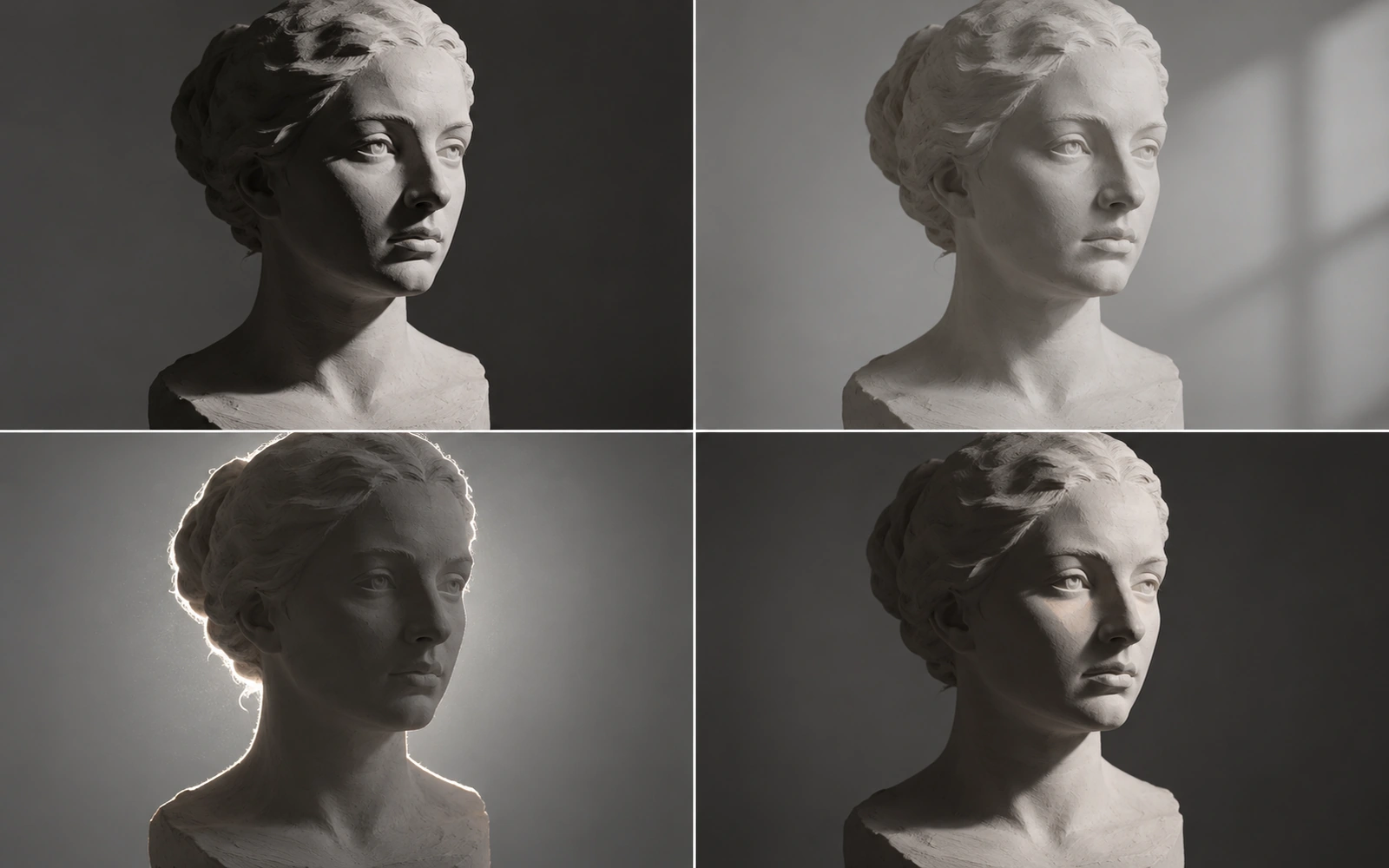
Light that seems to come from the world
Roger Deakins was born in Torquay, England, in 1949. He studied graphic design and still photography, then went to the National Film School and began with documentaries, which taught him to work with available light and to watch rather than impose. His long collaborations with the Coen brothers, from Barton Fink (1991) and Fargo (1996) to No Country for Old Men (2007), with Sam Mendes and with Denis Villeneuve defined much of modern cinematography.
He shot The Shawshank Redemption (1994), Skyfall (2012), with its silhouetted fight against Shanghai neon, Sicario (2015) and Blade Runner 2049 (2017), and won Oscars for Blade Runner 2049 and for 1917 (2019), designed to look like one continuous shot. With his wife and collaborator James Deakins he shares his knowledge openly through a podcast and online forum, and 'Deakins lighting' has become shorthand for clarity and restraint.
Visual anatomy of Roger Deakins
Light seems to come from a real source: a window, a lamp, the sky, a fire.
Few lights, often one large soft source; nothing that draws attention.
Strong dark shapes against bright windows, skies or neon.
Restrained, coherent colour for each film: cold blue, amber dust, sodium orange.
Clean, graphic compositions; wide frames that show people in their world.
Calm, purposeful movement; the camera moves only when the story does.
How to recognize Roger Deakins's work
- Light with a clear, believable source.
- Bold silhouettes and graphic shapes.
- A restrained colour world and clean, unfussy frames.
Where people get it wrong
Deakins's look is often copied as 'moody and dark'. His work is actually about clarity: every light has a reason, every frame reads instantly, and darkness is used only where the story needs it.
Words to describe Roger Deakins
Words for what you see and feel in this work. They are for describing and understanding, not a recipe for copying an artist.
- motivated lighting
- single soft source
- silhouette against window
- restrained colour palette
- sodium vapour orange
- cold blue dusk
- clean graphic framing
- wide establishing shot
- practical lamp light
- naturalistic cinematography
An original description inspired by the approach, not a copy: a wide film frame of a lone figure in a dark coat standing in a long empty corridor, a single tall window at the far end throwing cold blue dusk light across the floor, the figure in near silhouette, haze in the air, a restrained palette of blue and grey with one warm practical lamp.
What to learn from Roger Deakins
- Name the source of light in the scene and keep it believable.
- Look for one strong shape, a silhouette or a window, to build the frame on.
- Limit the palette to one or two dominant colours.
Questions about Roger Deakins
Who is Roger Deakins?
English cinematographer of Fargo, No Country for Old Men, Skyfall, Blade Runner 2049 and 1917, known for simple, motivated light, strong silhouettes and images that never show off.
How do you recognize Roger Deakins's work?
Light with a clear, believable source. Bold silhouettes and graphic shapes. A restrained colour world and clean, unfussy frames.
How do you describe Roger Deakins in words or a prompt?
Name the source of light in the scene and keep it believable. Look for one strong shape, a silhouette or a window, to build the frame on. Limit the palette to one or two dominant colours.
Describe a scene from your evening as Deakins might light it: where the single light comes from, what goes into silhouette, which one or two colours dominate, and whether the camera moves at all.