From Angel Island to the forest
Tyrus Wong was born in 1910 in Taishan, Guangdong, China, and came to the United States with his father in 1920, held for weeks at the Angel Island immigration station under the Chinese Exclusion Act. He studied at the Otis Art Institute in Los Angeles, painted for the Works Progress Administration, and joined Disney in 1938.
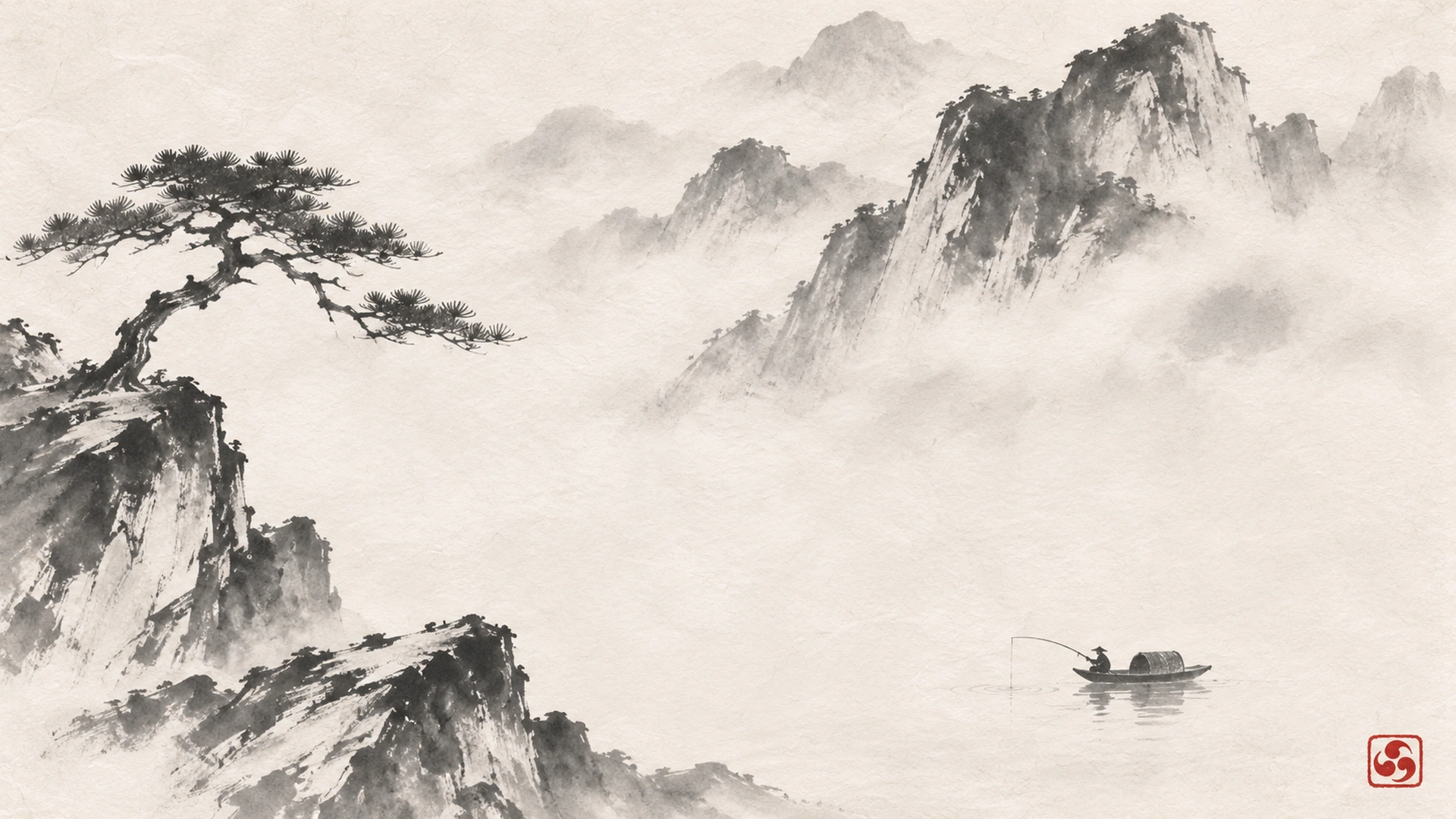
Working on Bambi, he made small, atmospheric paintings in a style shaped by Song dynasty Chinese landscape painting: mist, suggestion and empty space instead of detail. Walt Disney chose them as the film's visual direction. Wong left Disney after the 1941 strike and worked for about 26 years at Warner Bros. as a production illustrator, on films such as Rebel Without a Cause and The Wild Bunch. He also designed greeting cards and painted ceramics, and in later life built and flew elaborate kites. He was named a Disney Legend in 2001 and died in 2016, aged 106.
Visual anatomy of Tyrus Wong
Large areas of mist and emptiness; the scene is suggested, not described.
Few, soft, brush-like marks for trunks and branches.
Soft shafts and glows breaking through haze.
Muted, harmonious washes with small accents of warm or cool colour.
Detail only where the eye should rest.
Quiet, poetic, emotional rather than literal.
Words around Tyrus Wong
An early painting setting the mood and look of a film.
Chinese landscape painting (960–1279) of mist, mountains and space.
An artist who designs and visualises scenes for live-action films.
Distance shown by haze and paler colour.
How to recognize Tyrus Wong's work
- Forest or landscape dissolving into mist.
- A few dark verticals and lots of space.
- Soft light breaking through.
- Muted washes with small colour accents.
Where people get it wrong
Wong is sometimes described as simply 'a Disney background artist'. His contribution was the overall atmosphere of Bambi, drawn from Chinese painting traditions, and his long career outside animation is just as rich.
Words to describe Tyrus Wong
Words for what you see and feel in this work. They are for describing and understanding, not a recipe for copying an artist.
- atmospheric
- mist
- suggestion
- negative space
- soft wash
- brush mark
- shaft of light
- muted palette
- inspirational sketch
- Song dynasty landscape
An original atmospheric forest painting: a young deer standing in a clearing, a few dark tree trunks fading into pale mist, a soft shaft of light from above, muted green-grey washes with one warm touch on the deer, most of the paper left almost empty.
What to learn from Tyrus Wong
- Leave most of the picture as mist or space.
- Put detail only where the eye should land.
- Use soft light breaking through haze.
- Keep colour muted with one accent.
Saying less so the reader feels more
Wong's forests work like a poem with few words: the gaps are where the feeling enters. It is an argument for restraint in any medium, painting a mood by leaving most of it unsaid.
Questions about Tyrus Wong
Who was Tyrus Wong?
A Chinese-American painter, illustrator and kite maker (1910–2016) whose paintings set the visual style of Disney's Bambi.
What did Tyrus Wong do for Bambi?
He made the inspirational paintings, misty and inspired by Song dynasty landscape painting, that defined the film's look and atmosphere.
Where can I learn more about Tyrus Wong?
The documentary Tyrus (2015) by Pamela Tom and the Walt Disney Family Museum's 2013 exhibition on his work are good starting points.
Describe a place you know using only four visual details and leave everything else as mist or light. Which four did you keep, and what did leaving the rest out add?
Sources and further reading
- Wikipedia: Tyrus Wong.
- Walt Disney Family Museum: 'Water to Paper, Paint to Sky: The Art of Tyrus Wong', 2013–14.
- Pamela Tom (dir.), Tyrus, documentary, 2015.