What is watercolor painting?
Watercolor painting is painting with pigments bound in a water-soluble gum, usually gum arabic, thinned with water and applied to paper. The paint is transparent: light passes through it, hits the white paper and comes back, so the paper itself is the brightest colour in the picture. That is why watercolorists plan their whites in advance and build colour from light to dark, in thin layers called washes and glazes.
Painting with water
Watercolor is pigment bound with gum arabic and thinned with water, applied to paper. Because the paint is transparent, nothing is covered up: every layer shows through the next, and the brightest light in a painting is usually just untouched paper. That makes it fast and luminous, and also unforgiving, since you can add darkness easily but take it away only with difficulty.
Painters used water-based colour for centuries, from manuscript illumination to Albrecht Dürer's Young Hare (1502). In eighteenth- and nineteenth-century Britain watercolor became a major art: J. M. W. Turner used it for light, weather and speed; later Winslow Homer and John Singer Sargent made it bold and fluid. Today it is everywhere in illustration, botanical art, travel sketching and children's books, and it is one of the most requested looks in image generation.
Visual anatomy of watercolor
Layers show through each other; colours mix optically as glazes.
Soft, feathered edges wet-on-wet; crisp, hard edges wet-on-dry.
Cold-press texture, deckled edges, the white of the sheet left as light.
Granulation, settling into the paper grain; staining versus lifting colours.
Blooms or 'cauliflowers', backruns, tide lines where wet meets drying paint.
Clear, luminous, often limited palettes; darks built from layers.
Techniques
Paint onto wet paper so colours spread and merge with soft edges.
Paint onto dry paper for crisp, controlled shapes.
Thin transparent layers over dry ones to deepen or shift colour.
A wash that fades from strong to pale, often for skies.
Removing paint with a damp brush or tissue to recover lights.
A rubbery liquid that protects white paper while you paint around it.
Little water, broken strokes that catch the paper's texture.
Salt for crystal textures, flicked paint for spray and life.
How to recognize watercolor
- Light comes from white paper, not white paint.
- Soft blooms and hard tide-line edges in the same image.
- Visible paper grain and granulating pigment.
- Layers that show through each other.
Where people get it wrong
Asking for 'watercolor' and getting a digital picture with a soft filter. Real watercolor has specific behaviour: edges that dry hard, pigment pooling at the rim of a wash, granulation, untouched white paper. Name those behaviours. Also don't confuse it with gouache, which is opaque and matte and can paint light over dark.
Words to describe watercolor
Precise words for the qualities above. Combine a few of them instead of naming the style or artist alone.
- watercolor
- wet-on-wet
- wet-on-dry
- glazing
- graded wash
- granulation
- blooms (cauliflowers)
- hard tide-line edges
- white of the paper
- cold-press paper texture
- dry brush
- limited palette
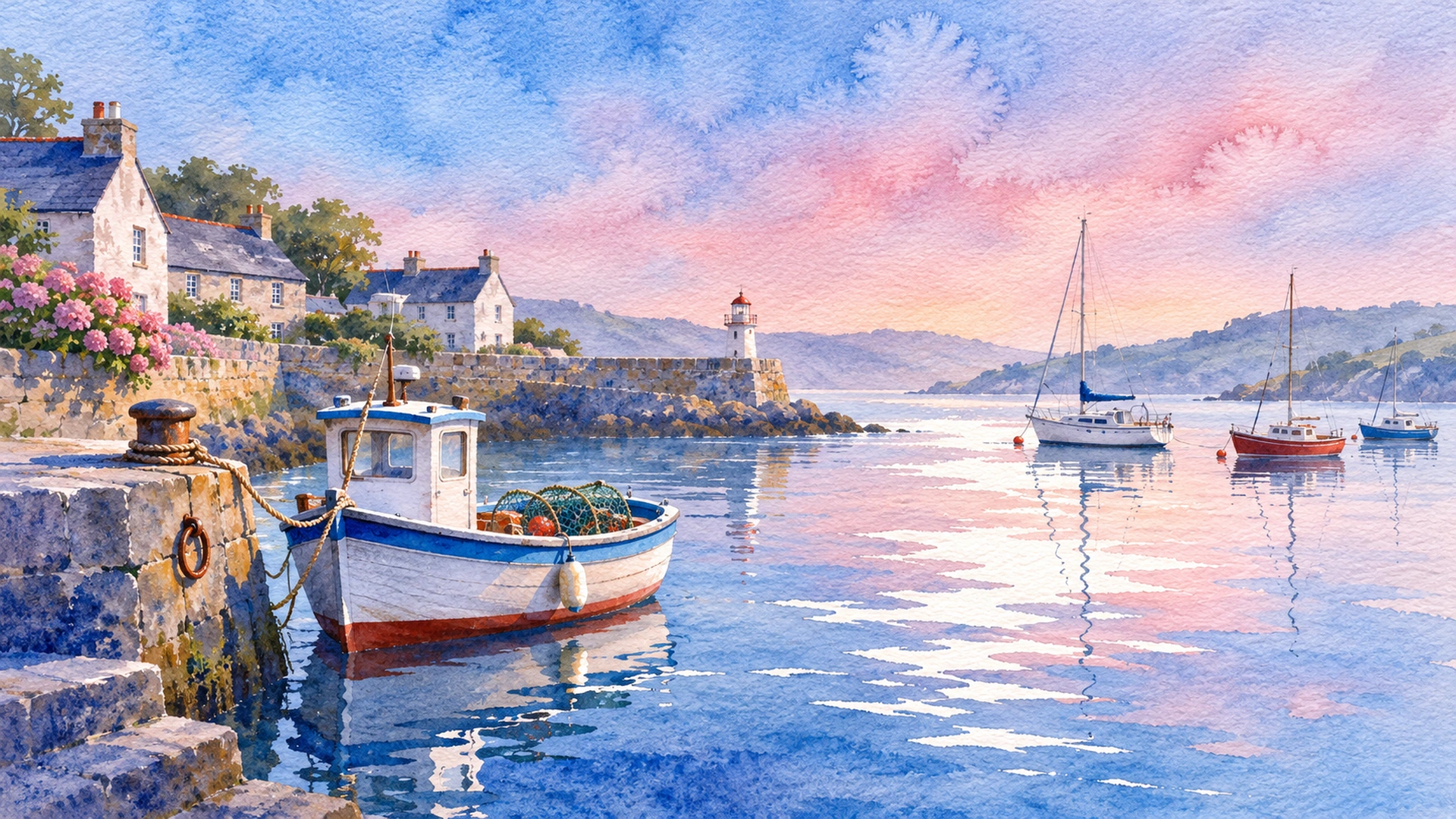
An original watercolor study: a harbour at morning, the sky in a soft wet-on-wet wash of cerulean and rose, boats painted wet-on-dry with crisp edges, untouched white paper for the light on the water, granulating ultramarine in the shadows, a few blooms in the sky, cold-press paper texture and a deckled edge.
What to take from watercolor today
- Say which technique: wet-on-wet sky, wet-on-dry details.
- Leave white paper as light and say so.
- Name paper and edges: cold-press texture, deckled edge, hard tide lines.
- Limit the palette to a few named pigments.
Materials
Tubes (soft, good for large washes) or pans (dry cakes, good for travel). Artist grade has more pigment than student grade.
The most important choice. Heavy paper, often 300 gsm (140 lb), buckles less. Cotton paper holds washes evenly; cheaper wood-pulp paper streaks.
Hot-pressed is smooth, for detail; cold-pressed has a light tooth and suits most work; rough has a strong texture for granulation and dry brush.
Soft brushes that hold a lot of water: round brushes for most work, flat and mop brushes for washes. Natural sable or good synthetics.
Two jars of water, a palette, masking fluid, tape to stretch or fix the paper, and a sponge or tissue for lifting.
A short history
Water-based paint on paper is old, in Asia and in medieval European manuscripts, but watercolor as a European art form grew from the Renaissance. Albrecht Dürer's Young Hare (1502) is one of its early masterpieces. In 18th- and 19th-century Britain it became a national art: topographical views, then the luminous skies of J. M. W. Turner. In America Winslow Homer used it for sea and light, and John Singer Sargent for quick, brilliant travel studies. Today it is everywhere in illustration, botanical art, children's books and urban sketching.
Watercolor, gouache and acrylic
Transparent; light comes from the paper. Can be re-wet and lifted after drying.
The same kind of binder but with more pigment and often a white filler, so it is opaque and matte; light can go over dark.
Pigment in an acrylic polymer; can be thinned with water like watercolor, but dries waterproof and cannot be lifted.
The painting that leaves things out
Watercolor is the medium of the unsaid. Its brightest light is the paper you did not touch, and its best passages are often where the water was allowed to finish the thought. A watercolor that covers every inch loses what makes it watercolor. Describe one by its absences as much as its marks.
Questions about watercolor
What is the difference between watercolor and gouache?
Both are water-based. Watercolor is transparent and relies on the white paper for light; gouache is opaque and matte, so light colours can cover dark ones.
What are the basic watercolor techniques?
Wet-on-wet, wet-on-dry, glazing, graded washes, lifting, dry brush and masking.
What is watercolor painting?
Painting with pigments bound in gum arabic, thinned with water and applied to paper. The paint is transparent, so the white of the paper provides the light.
Is watercolor hard for beginners?
It is less forgiving than acrylic or oil because you cannot easily cover mistakes, but it needs few materials. Good paper makes the biggest difference for a beginner.
What paper is best for watercolor?
Heavy watercolor paper, around 300 gsm (140 lb), ideally 100% cotton. Cold-pressed suits most work; hot-pressed is for fine detail; rough is for texture.
Who are famous watercolor painters?
Albrecht Dürer, J. M. W. Turner, Winslow Homer, John Singer Sargent, Paul Cézanne and, in illustration, Beatrix Potter are among the best known.
Find a watercolor you like in a museum collection online. Describe it only through process: which areas were painted wet-on-wet, where the hard edges are, where the paper was left white, and which colour was laid first.
Sources and further reading
- Marjorie B. Cohn, Wash and Gouache: A Study of the Development of the Materials of Watercolor (1977).
- Andrew Wilton and Anne Lyles, The Great Age of British Watercolours, 1750–1880 (1993).