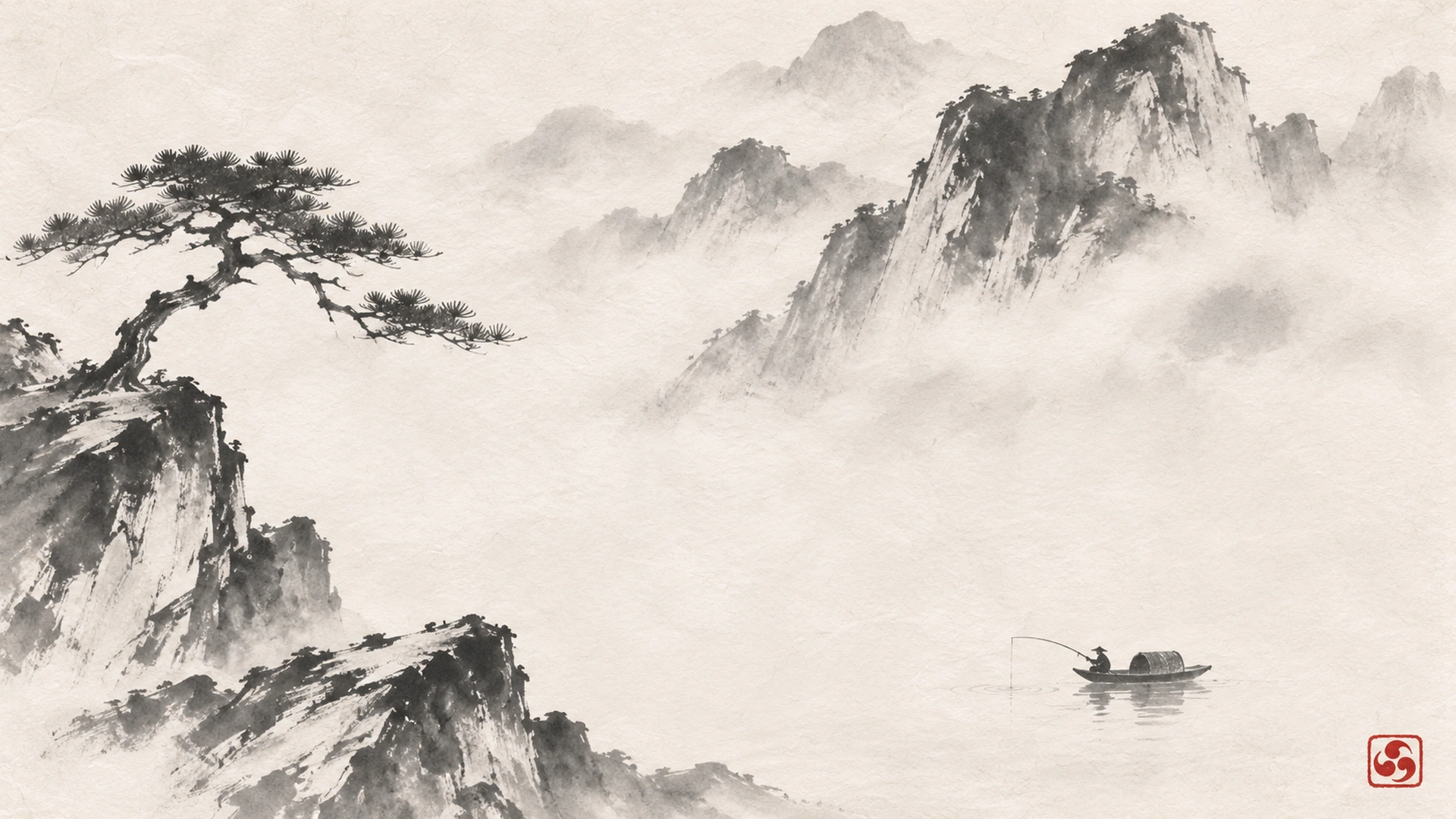
One ink, many colours
Ink wash painting grew in China during the Tang dynasty (618–907), when painters such as Wang Wei began to paint landscapes in ink alone, without colour. In the Song dynasty it became the art of scholars: painting, poetry and calligraphy used the same brush, and a painting was valued for the spirit of its strokes, not for likeness.
Chan Buddhist monks such as Muqi painted persimmons and gibbons with startling economy, and their works travelled to Japan, where ink painting, suibokuga or sumi-e, flourished in Zen temples. Sesshū Tōyō (1420–1506) is its great Japanese master. In Korea it developed its own tradition, with painters such as Jeong Seon painting real Korean mountains.
The materials matter: an ink stick ground with water on an inkstone, a soft brush that holds a lot of ink, and absorbent xuan or washi paper that takes every hesitation. There is no erasing. The famous saying is that ink has five colours, from dense black to the palest wash.
Visual anatomy of ink wash painting
From burnt black to the palest grey; 'ink has five colours': burnt, thick, heavy, light, clear.
One soft brush loaded with several tones at once, so a single stroke shades from dark to light.
Pressure and speed change the width; the 'flying white' of a dry, fast brush lets paper show through.
Large areas of untouched paper become mist, water, sky or silence.
Absorbent paper or silk; wet ink bleeds and feathers, dry ink scratches.
Asymmetric, with a vertical scroll or horizontal handscroll format and high or shifting viewpoints.
Words around ink wash
Japanese ink painting; sumi means ink.
'Leaving white': the deliberate use of empty space in Chinese painting.
'Flying white': streaks of paper showing through a dry, fast brushstroke.
Bamboo, orchid, plum blossom and chrysanthemum, the classic beginner's subjects.
How to recognize ink wash painting
- Only black ink in many greys, sometimes one touch of colour or a red seal.
- Strokes that go from dark to light in one movement.
- Large blank areas read as mist or water.
- Bamboo, mountains, birds, fish, plum branches.
- Soft bleeding edges next to dry, broken strokes.
Where people get it wrong
Ink wash is often imitated with a grey watercolour filter or a digital brush that blurs everything. Its character comes from contrast: crisp, dry strokes against soft wet bleeds, and confident marks against empty paper. It is also not only Japanese; it began in China and has strong Korean traditions.
Words to describe ink wash painting
Precise words for the qualities above. Combine a few of them instead of naming the style or artist alone.
- sumi-e
- black ink on rice paper
- many tones of grey
- flying white dry brush
- wet ink bleeding
- empty space as mist
- hanging scroll
- bamboo brushstrokes
- Zen simplicity
- red seal
- misty mountains
- single loaded brush
A vertical hanging scroll in black ink on absorbent rice paper: a few steep mountain peaks rising out of mist, the near rocks in dark, dry, broken strokes with flying white, the distant peaks in pale wet washes, a small pine leaning from a cliff, two-thirds of the paper left empty as mist, one small red seal in the corner.
What to take from ink wash painting today
- Ask for 'black ink only, many tones of grey', not just 'monochrome'.
- Specify absorbent paper and bleeding wet edges plus dry brush streaks.
- Give the empty space a job: mist, water, sky.
- Name the format: vertical hanging scroll or long horizontal handscroll.
Questions about ink wash painting
What is the difference between sumi-e and Chinese ink painting?
They share the same roots and materials. Chinese ink painting (shuimo hua) came first; Japanese sumi-e developed from it, especially in Zen temples, and tends toward greater simplicity. Korea has its own tradition as well.
What paper is used for ink wash painting?
Absorbent paper such as Chinese xuan paper, often called rice paper, or Japanese washi, and sometimes silk. Absorbent paper makes ink bleed and records every pause of the brush.
Is ink wash painting the same as watercolour?
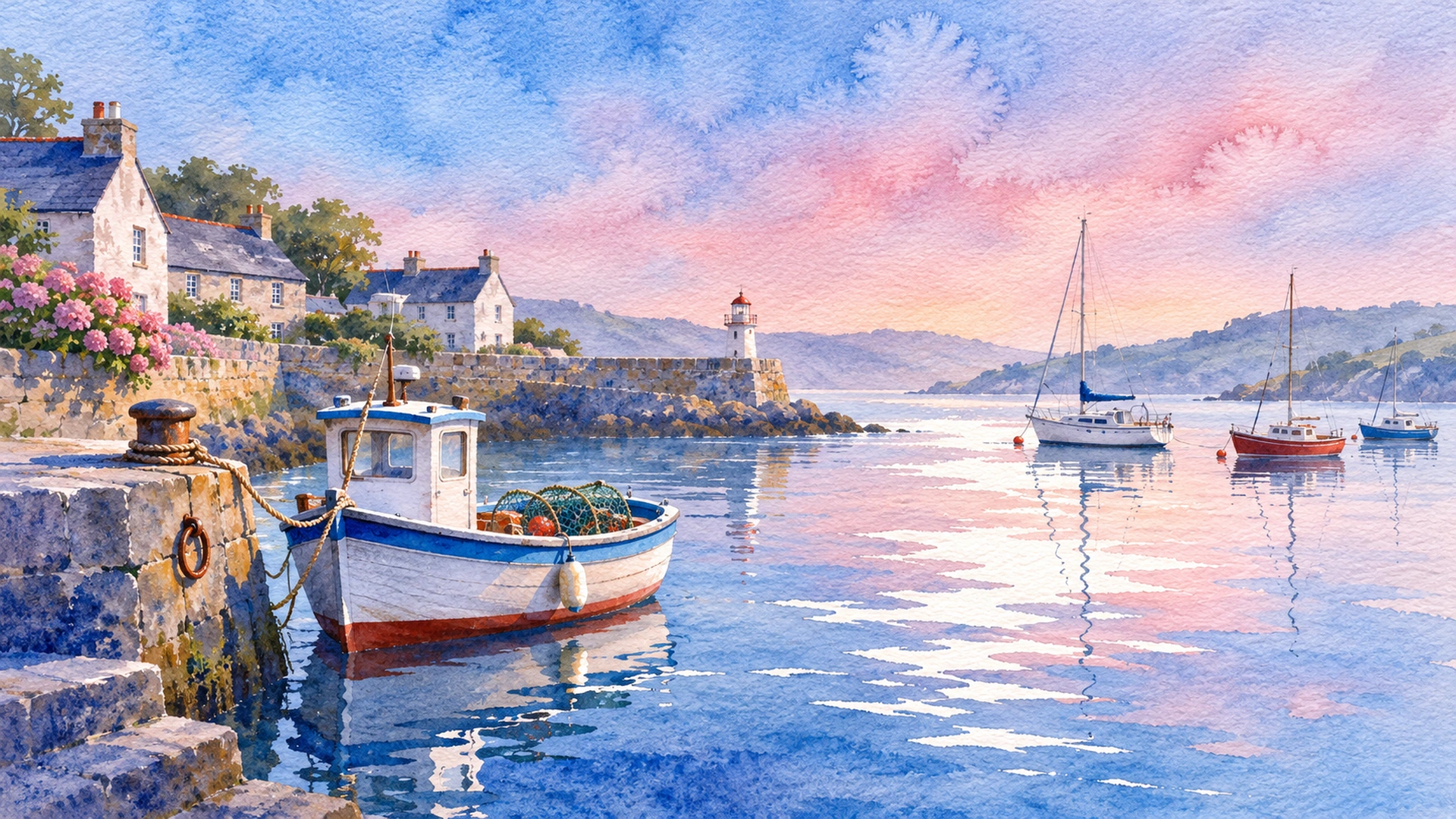
No. Watercolour uses many transparent pigments, usually on sized paper that can be reworked. Ink wash uses ink alone on absorbent paper, where strokes cannot be corrected, and depends on brush control and empty space.
Find a Song dynasty or Sesshū landscape online. Describe only the empty paper: what each blank area becomes, mist, river, sky, distance. Then count how many tones of grey you can name.
Sources and further reading
- The Metropolitan Museum of Art: Chinese and Japanese ink painting collections.
- Tokyo National Museum: Sesshū Tōyō.
- Mai-mai Sze, The Tao of Painting, Princeton University Press, 1956.
- James Cahill, Chinese Painting, Skira/Rizzoli, 1960.