Buildings that hold still
Buildings were ideal subjects for early photography because they did not move during long exposures. By the 1850s photographers were recording cathedrals and monuments across Europe; around 1900 Frederick H. Evans made cathedral interiors into studies of light, as in A Sea of Steps (1903).
In the twentieth century the genre shaped how modern architecture was seen. Julius Shulman's 1960 night photograph of Case Study House No. 22, two women in a glass living room floating above the lights of Los Angeles, became more famous than the house itself. Ezra Stoller's precise images defined the public face of modernism on the American east coast, and Bernd and Hilla Becher photographed water towers and blast furnaces in strict frontal series like scientific specimens. The working rules they shared still hold: keep verticals vertical, choose the hour, find the viewpoint that explains the building, and decide whether people belong in the frame.
Visual anatomy of architectural photography
Parallel and upright, corrected with a shift lens or in editing.
One-point (frontal, symmetrical) or two-point (corner view).
Low sun for texture, overcast for even detail, blue hour with interior lights glowing.
A small human figure, a car or a tree to show size.
Wide angle used with care; longer lenses to flatten and isolate details.
A clean sky, reflections in glass or water, context or isolation.
Kinds of image
Straight-on to a facade, like an architect's drawing.
Two facades in two-point perspective, showing volume.
Blue hour, sky and interior lights balanced.
Rooms with straight walls, balanced window and room light.
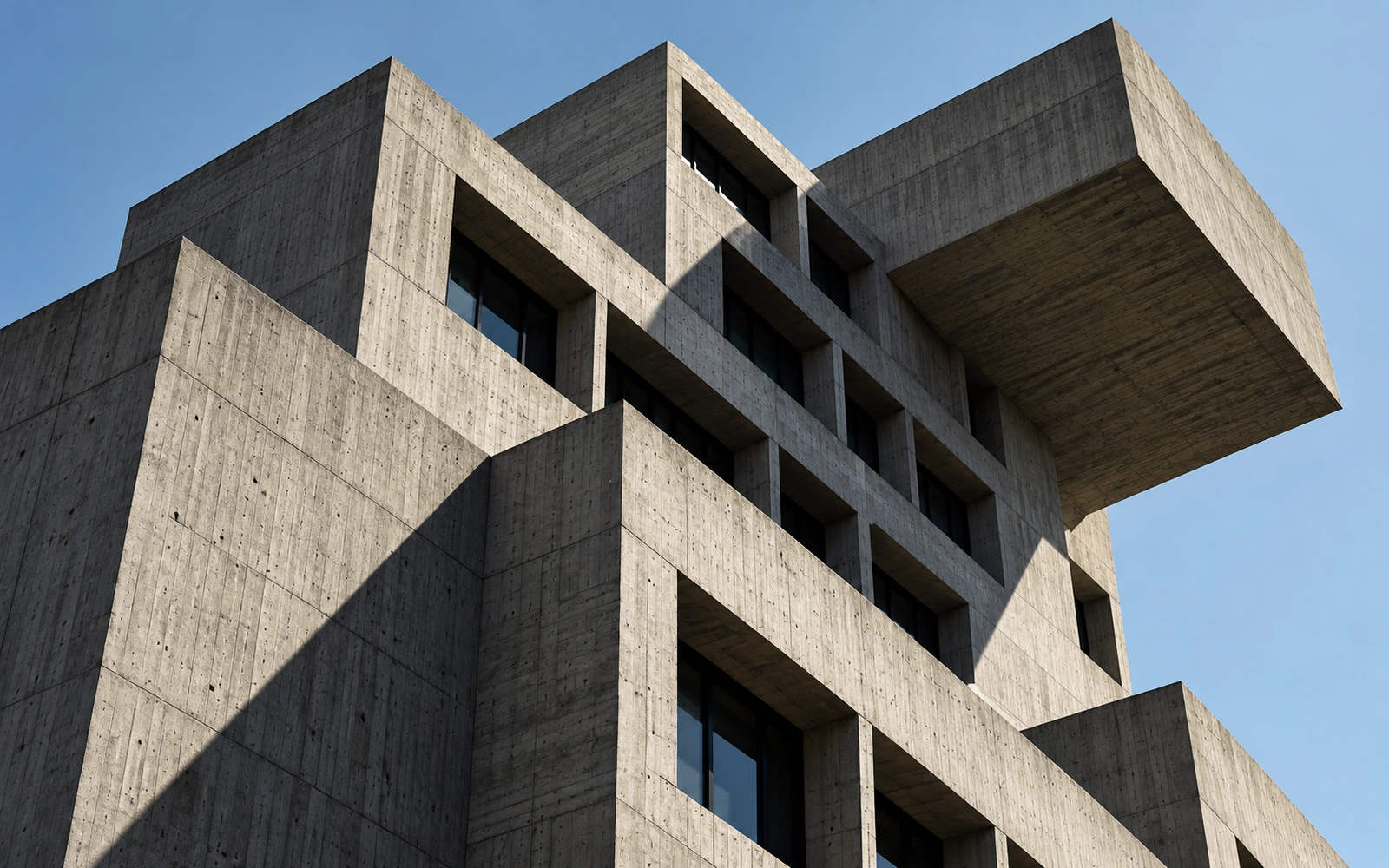
A staircase, a joint, a pattern of windows as pure form.
A series of similar structures photographed the same way, after the Bechers.
How to recognize architectural photography
- Vertical lines are straight and parallel.
- The building, not a person, is the subject.
- Light is chosen to show material and form.
- A deliberate, often symmetrical viewpoint.
Where people get it wrong
Pointing a wide lens upward. Tilting the camera makes verticals converge and the building appear to fall backward. Architectural photographers keep the camera level and shift the lens instead. In prompts, say 'verticals corrected, camera level' and name the time of day; otherwise you get a tourist snapshot.
Words to describe architectural photography
Precise words for the qualities above. Combine a few of them instead of naming the style or artist alone.
- architectural photography
- corrected verticals
- one-point perspective
- two-point perspective
- frontal elevation
- blue hour
- low raking light
- figure for scale
- shift lens
- symmetry
- leading lines
- typology
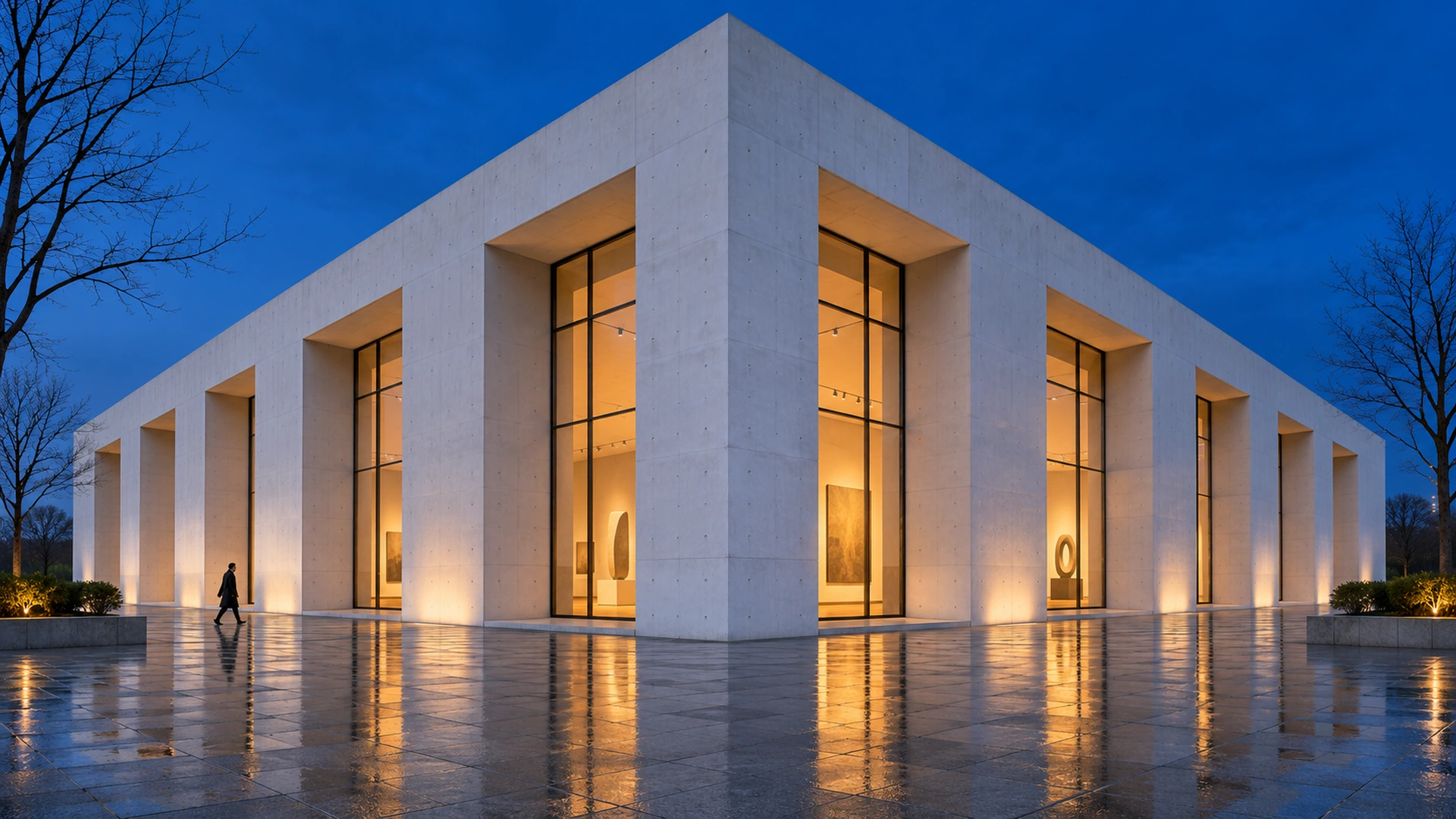
An original architectural photography study: a white concrete museum with deep recessed windows seen from the corner in two-point perspective, verticals perfectly straight, camera level, blue hour with warm interior lights glowing against a deep blue sky, wet stone plaza reflecting the building, one small figure walking for scale.
What to take from architectural photography today
- Say the view: frontal elevation or corner view.
- Ask for corrected verticals and a level camera.
- Choose the hour: low side light, overcast, or blue hour.
- Add one small figure for scale, or none.
Questions about architectural photography
Why do architectural photographers keep vertical lines straight?
Because converging verticals make a building look as if it is leaning back. A level camera with a shift lens keeps walls parallel, as the eye expects.
What is the best time for architectural photography?
Early or late sun for texture and shadow, and blue hour, just after sunset, when sky and interior lights balance.
Choose a building you pass every day. Describe one photograph of it in five lines: the viewpoint, the hour and direction of light, what the verticals do, what gives scale and what you leave out of the frame.
Sources and further reading
- Julius Shulman, Photographing Architecture and Interiors (1962).
- Bernd and Hilla Becher, Anonyme Skulpturen (1970).
- Cervin Robinson and Joel Herschman, Architecture Transformed: A History of the Photography of Buildings (1987).