Honest and heavy
Brutalism is an architectural style of the 1950s to 1970s built from massive forms, usually in exposed concrete. Its name comes from béton brut, French for 'raw concrete', the material Le Corbusier used for the Unité d'Habitation in Marseille (1952). In Britain, Alison and Peter Smithson and the critic Reyner Banham spoke of a 'New Brutalism' that showed structure and materials honestly.
It was used for housing estates, universities, theatres and government buildings, from London's Barbican to buildings across Eastern Europe, South America and Asia. Long criticised as cold, it has been rediscovered for its sculptural power. Since the 2010s 'brutalism' has also named a web and graphic design style: plain default fonts, visible structure, raw grids and no polish.
Visual anatomy of Brutalism
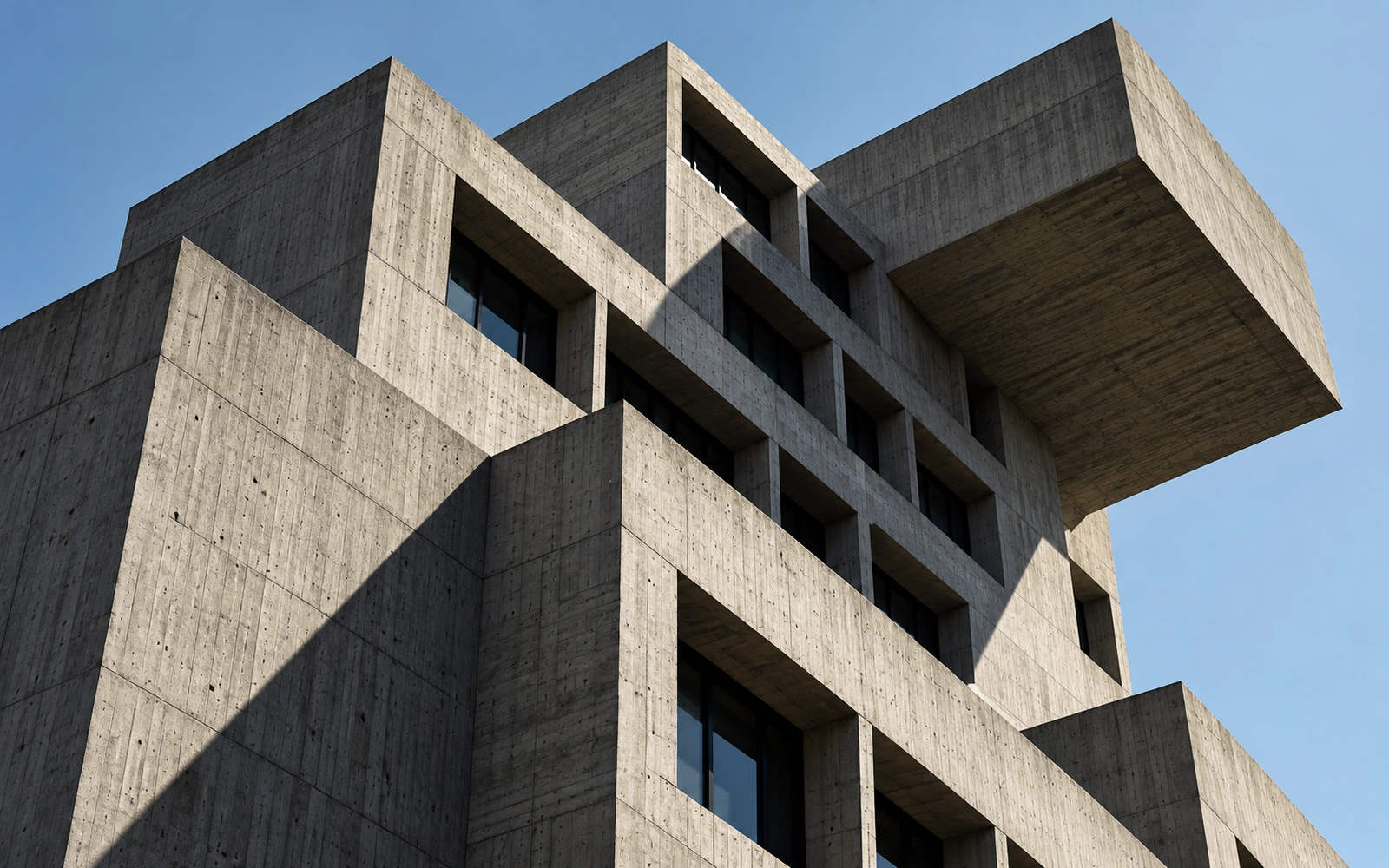
Raw, exposed concrete, often with the wood-grain marks of the moulds.
Heavy, blocky volumes stacked, cantilevered or repeated.
Strong rectangles, deep recesses, repeated window modules, bold angles.
Hard sun and deep shadows that turn façades into graphic patterns.
Monumental, often seen from below against the sky.
Default system fonts, harsh contrast, visible borders and grids, raw layouts.
Key buildings
Le Corbusier's housing block in raw concrete, béton brut, a founding example.
Towers, terraces and walkways in hammered concrete around lakes and gardens.
A heavy, stepped concrete civic building, loved and hated in equal measure.
Moshe Safdie's stacked concrete boxes, a playful side of the style.
How to recognize Brutalism
- Exposed concrete in massive geometric forms.
- Repetition of heavy modules.
- Strong light and shadow on blunt surfaces.
Where people get it wrong
Brutal does not mean violent; it comes from 'brut', raw. And not every concrete building is brutalist. On the web, brutalism is not simply 'ugly design': it is a deliberate refusal of polish that still needs clear structure.
Words to describe Brutalism
Precise words for the qualities above. Combine a few of them instead of naming the style or artist alone.
- brutalist architecture
- raw board-marked concrete
- monolithic blocks
- repeated window modules
- cantilevered volumes
- deep geometric shadows
- worm's-eye view against the sky
- overcast grey light
- monumental scale
- brutalist web layout
An original architectural photograph of a brutalist building seen from below: stacked board-marked concrete blocks with deep recessed windows repeating up the façade, a heavy cantilevered top, hard afternoon sun carving black geometric shadows, a pale blue sky, nobody in the frame.
What to take from Brutalism today
- Name the material and its surface: board-marked concrete, rough, stained.
- Describe the mass: stacked, cantilevered, repeated.
- Say how light shapes it: hard shadows, overcast flatness.
Questions about Brutalism
What is Brutalism in simple terms?
An architecture style from the 1950s to the 1970s that used raw, unfinished concrete and massive, blocky forms, showing structure and materials honestly instead of hiding them.
Why is it called Brutalism?
From the French béton brut, 'raw concrete', used by Le Corbusier. The critic Reyner Banham popularised 'the New Brutalism'. The name is about rawness, not cruelty.
What is brutalism in web design?
A deliberately raw web style: default fonts, visible grids, harsh colours and few decorations, borrowing the idea of honesty and roughness from the architecture.
Find one concrete building near you and describe it as an architectural photograph: viewpoint, time of day, shadows, sky and what makes it feel heavy or light.