The artist's life as a look
'Bohemian' first described the poor young artists and writers of nineteenth-century Paris, who lived outside respectable society. The French had long used bohémien for the Roma, wrongly believed to have come from Bohemia, and the word shifted to anyone with an unconventional, wandering life. Henri Murger's Scènes de la vie de bohème (1851), later the basis of Puccini's opera La Bohème, fixed the image.
The look came later. The hippie movement of the 1960s and 1970s adopted flowing garments, embroidery and handmade jewellery, borrowing freely from many cultures. Around 2004 and 2005 the press named a revival 'boho-chic', worn by Sienna Miller and Kate Moss, and festival fashion kept it alive. In interiors boho means a layered, collected room full of textiles, plants and natural materials. Because the style borrows patterns and objects from many places, it is better to name what something actually is, a kilim, an ikat, a suzani, than to call everything 'ethnic'.
Visual anatomy of Boho Style
Flowing maxi dresses and skirts, peasant blouses, kimonos, wide sleeves.
Embroidery, fringe, tassels, crochet, lace, patchwork.
Layered necklaces, stacked rings and bangles, turquoise and silver.
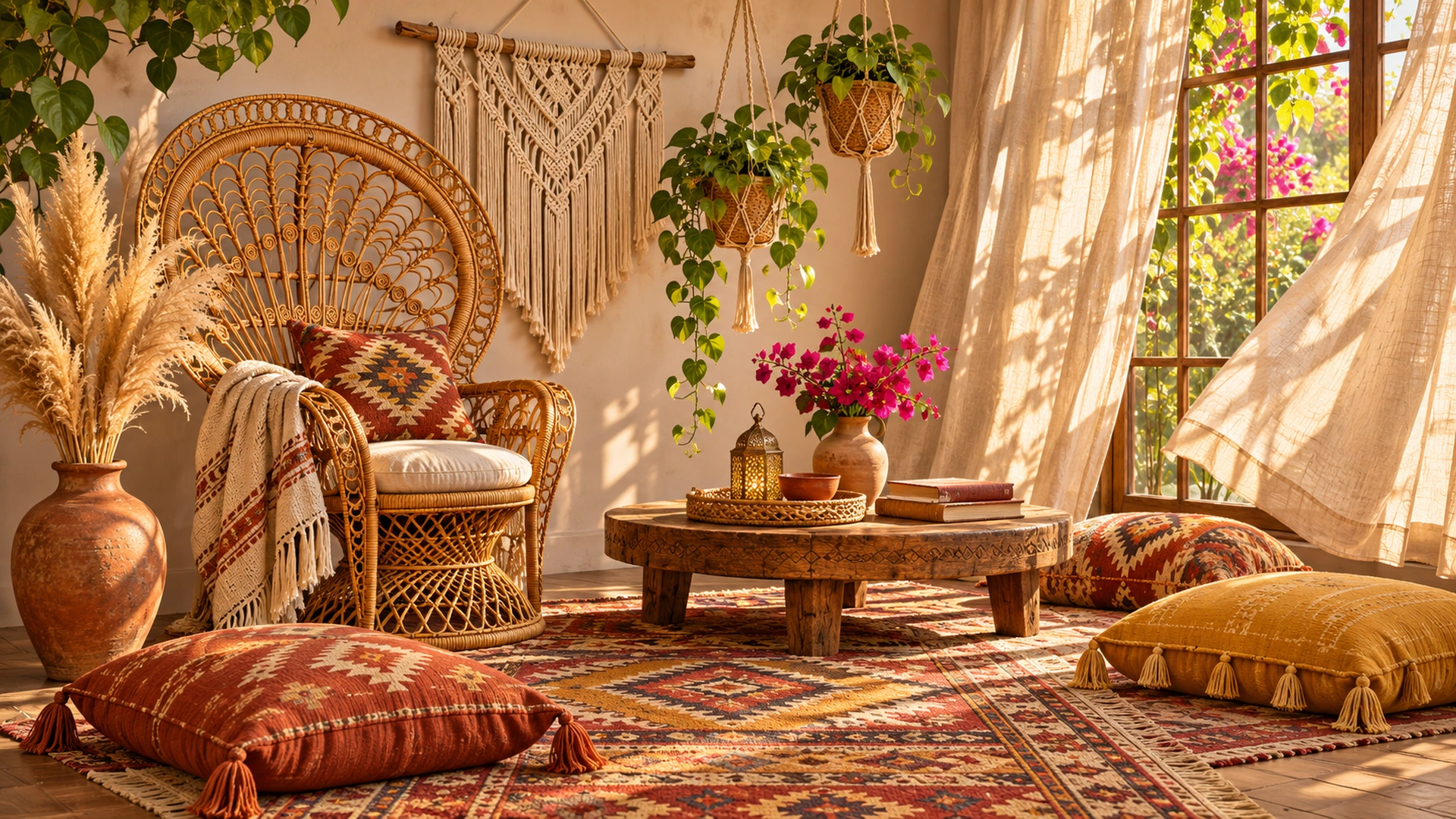
Rattan and wicker, macramé, floor cushions, low seating, layered rugs.
Many houseplants, hanging pots, dried pampas grass.
Warm earthy tones: terracotta, mustard, rust, olive, cream, with jewel accents.
Key ideas
Murger's 1851 stories of poor Paris artists, source of the romantic image.
1960s–1970s counterculture dress that shaped the look.
The mid-2000s fashion revival.
Kilim, ikat, suzani, mudcloth, block print: say which, not 'ethnic print'.
How to recognize Boho Style
- Loose, flowing, layered clothing.
- Lots of texture: fringe, crochet, embroidery, woven things.
- Plants and natural materials everywhere.
- Warm earthy palette, nothing matching exactly.
Where people get it wrong
Using 'boho' as a synonym for any pattern from outside Europe. It flattens very different crafts into one mood. A room with a Turkish kilim, an Indian block-print throw and a Moroccan pouf is three traditions, and naming them gives a far more precise and respectful image. Boho is also not maximalism: it is relaxed and natural, not bold and glossy.
Words to describe Boho Style
Precise words for the qualities above. Combine a few of them instead of naming the style or artist alone.
- boho
- bohemian
- flowing maxi dress
- embroidery and fringe
- layered jewellery
- rattan chair
- macramé wall hanging
- kilim rug
- floor cushions
- hanging plants
- terracotta and mustard
- collected, not matched
An original boho interior study: a sunlit corner with a rattan peacock chair, a low wooden table, layered kilim rugs, floor cushions in terracotta and mustard, a macramé wall hanging, trailing plants in hanging pots, dried pampas grass in a clay vase, linen curtains moving in warm afternoon light.
What to take from Boho Style today
- Describe the layers: rug on rug, cushions, throws.
- Name the materials: rattan, macramé, linen, raw wood.
- Name textiles by tradition: kilim rug, block-print throw.
- Use warm earthy colour and soft natural light.
Questions about Boho Style
What is boho style?
A relaxed, layered style inspired by bohemian and hippie life: flowing clothes, handmade details, natural materials, plants and warm earthy colours.
What is the difference between boho and hippie?
Hippie style belongs to the 1960s–70s counterculture. Boho is the broader, later fashion and interior look that borrows from it without the politics.
Describe a boho reading corner in six lines, naming each textile by what it actually is and where the light comes from.
Sources and further reading
- Henri Murger, Scènes de la vie de bohème (1851).
- Elizabeth Wilson, Bohemians: The Glamorous Outcasts (2000).