Colour mixed by the eye
Pointillism was developed by Georges Seurat and Paul Signac in the mid-1880s, inspired by scientific colour theory such as Michel Eugène Chevreul's work on how neighbouring colours affect each other. Instead of mixing paint on the palette, they placed small dots of pure colour side by side, so the colours would mix in the viewer's eye from a distance.
Seurat's A Sunday Afternoon on the Island of La Grande Jatte (1884–86) became the movement's icon: calm, frozen figures in a park, built from countless dots. The idea, building an image from tiny units of colour, anticipates halftone printing, LED screens and pixel art.
Visual anatomy of Pointillism
Small, regular dots or short dabs of pure colour.
Colours blend in the eye: blue and yellow dots read as green from afar.
A shimmering, vibrating light across the surface.
Calm, ordered, often geometric; figures can look still and formal.
Complementary dots placed together to intensify each other.
Some paintings have dotted painted borders that frame the colour.
Key artists of Pointillism
A Sunday Afternoon on the Island of La Grande Jatte (1884–86).
Brighter, more mosaic-like harbour scenes; wrote the movement's theory.
Luminous Mediterranean landscapes in larger dabs.
How to recognize Pointillism
- Images built from visible dots of colour.
- Shimmering light from optical colour mixing.
- Calm, orderly, still compositions.
Where people get it wrong
Pointillism is not just 'a dotted texture'. Its logic is placing pure, unmixed colours next to each other so they mix optically. A dot filter over a normal image misses that colour science.
Words to describe Pointillism
Precise words for the qualities above. Combine a few of them instead of naming the style or artist alone.
- pointillist dots of pure colour
- optical colour mixing
- shimmering luminous surface
- complementary dots side by side
- calm park scene
- still geometric figures
- neo-impressionist landscape
- painted dotted border
- near and far viewing
- precursor to pixels
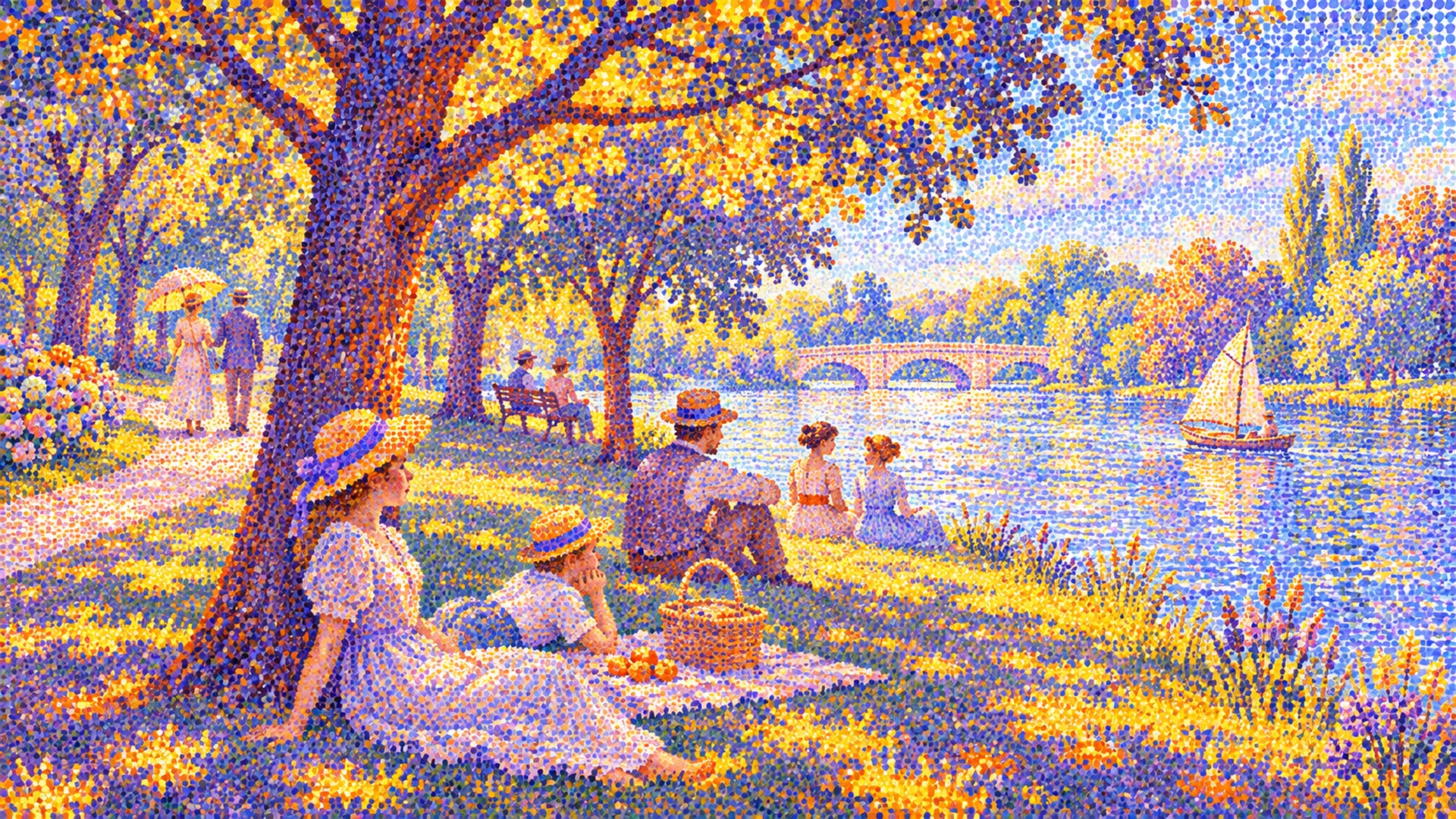
An original pointillist painting study: a quiet riverside park on a summer afternoon, figures resting in the shade, built entirely from small dots of pure orange, blue, yellow and violet that blend into shimmering light from a distance. Not a copy of any existing painting.
What to take from Pointillism today
- Describe the size and regularity of the dots.
- Name which colours sit side by side to make a third.
- Say how the image changes from near to far.
Questions about Pointillism
What is Pointillism?
Painting with thousands of small dots of pure colour that mix in the viewer's eye: Seurat's scientific answer to Impressionism, and an ancestor of halftone and pixels.
How do you recognize Pointillism?
Images built from visible dots of colour. Shimmering light from optical colour mixing. Calm, orderly, still compositions.
How do you describe Pointillism in words or a prompt?
Describe the size and regularity of the dots. Name which colours sit side by side to make a third. Say how the image changes from near to far.
Look at a screen or a printed magazine image with a magnifying glass or a phone zoom. Describe how the tiny dots or pixels build a colour you see from a distance.