Every pixel is a decision
Pixel art is digital art made at very low resolution, where each pixel is placed deliberately. It grew from the limits of early computers and game consoles in the 1970s to 90s, when screens had few pixels and very few colours, so artists had to suggest shapes, light and texture with tiny means.
Those limits became an aesthetic. Today pixel art is chosen on purpose for games, icons, illustrations and animation because of its clarity, its nostalgia and its handmade precision. Susan Kare's icons for the first Macintosh (1984) are among its classic examples outside games.
Visual anatomy of pixel art
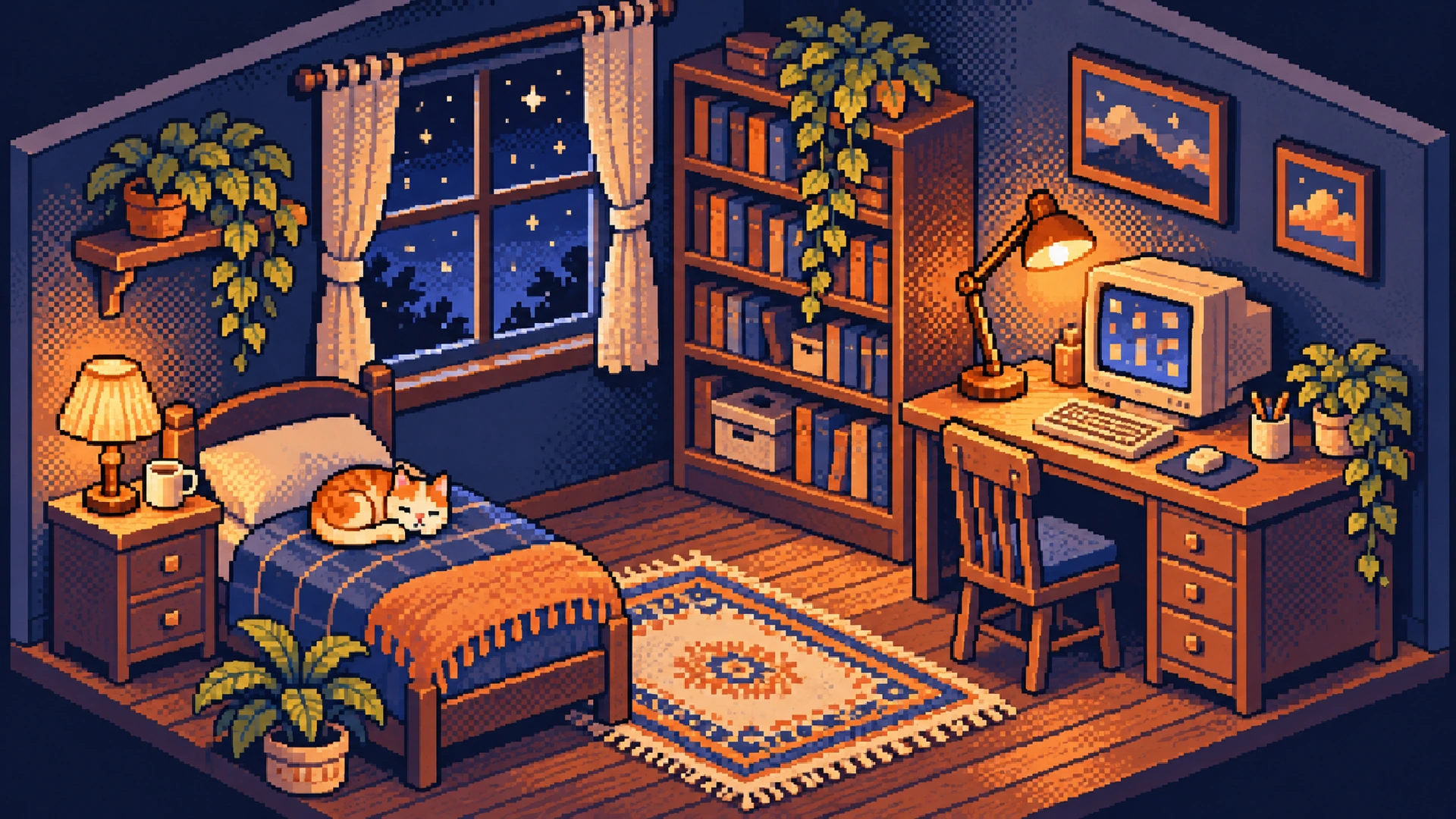
A visible square pixel grid; images are tiny and scaled up without smoothing.
A limited set of colours, sometimes only 4 or 16.
Checkerboard patterns of two colours that suggest a third tone or a gradient.
Clean one-pixel lines, sometimes coloured instead of black (selective outlining).
Small characters and objects, often animated in a few frames.
Flat side views, top-down views or isometric pixel art.
How to recognize pixel art
- Visible square pixels with sharp edges.
- Limited colours and checkerboard dithering.
- Small sprites or tiles in a game-like world.
Where people get it wrong
Pixel art is not a photo with a pixelate filter. Real pixel art is drawn at small size with clean lines and chosen colours; mixed pixel sizes, blurred scaling and too many colours break the style.
Words to describe pixel art
Precise words for the qualities above. Combine a few of them instead of naming the style or artist alone.
- 16-bit pixel art
- 8-bit sprite
- limited 16-colour palette
- checkerboard dithering
- isometric pixel room
- clean one-pixel outlines
- side-scrolling game scene
- tiny animated sprite
- crisp unsmoothed pixels
- retro game aesthetic
A 16-bit pixel art scene: a small cosy room in isometric view, a cat sprite asleep on a bed, a desk with a glowing computer, warm dithered lamp light, a night window with pixel stars, a limited palette of deep blue, warm orange and cream, crisp unsmoothed pixels.
What to take from pixel art today
- Give the resolution or era: 8-bit, 16-bit, a 32 × 32 sprite.
- Name the palette size and main colours.
- Say the view: side, top-down, isometric.
Questions about pixel art
What is pixel art?
Images built pixel by pixel on a small grid: the language of early video games, now a style of its own with limited palettes, dithering and sprites.
How do you recognize pixel art?
Visible square pixels with sharp edges. Limited colours and checkerboard dithering. Small sprites or tiles in a game-like world.
How do you describe pixel art in words or a prompt?
Give the resolution or era: 8-bit, 16-bit, a 32 × 32 sprite. Name the palette size and main colours. Say the view: side, top-down, isometric.
Describe your room as a 16-bit game screen: the view, the palette of 16 colours, which objects become small sprites, and where dithering makes the light from the window.