A future worth wanting
Solarpunk began online around 2008 as a name for science fiction that imagines sustainable, fair and beautiful futures instead of collapse. It gathered a visual identity around 2014 on Tumblr, where artists and writers shared images of cities covered in plants, powered by sun and wind, and built at human scale.
Where cyberpunk shows high technology and broken societies, solarpunk shows appropriate technology and repaired ones: solar panels as stained glass, rooftop farms, trams and bicycles, community workshops, and buildings that borrow the flowing lines of Art Nouveau. It is as much a political and ecological idea as a style, which is why its images are full of people doing things together.
Visual anatomy of Solarpunk
Organic curves, terraces, glass domes and Art Nouveau ironwork carrying gardens.
Solar glass, wind sails, small turbines, visible and repairable.
Vertical gardens, vines on facades, trees in streets, water channels.
Communities working, growing, building, in diverse and practical clothing.
Leaf greens, sky blues, warm whites, sunlit gold, terracotta.
Bright, clean daylight; a sense of fresh air.
Influences
Plant-like curves and ornament that solarpunk adopts for its buildings.
Handmade, repairable objects and pride in craft.
Films where nature and technology coexist shaped the mood for many artists.
The Dispossessed (1974) and her utopian thinking are often cited.
How to recognize Solarpunk
- Plants growing on and through buildings.
- Solar panels and wind turbines worked into the design.
- Curving, organic architecture in bright daylight.
- People in shared, active public spaces.
Where people get it wrong
Painting a futuristic city green. A glass skyscraper with a few trees on it is greenwashing, not solarpunk. The style is about scale, repair and community: small machines you could fix, streets made for walking, gardens that feed people.
Words to describe Solarpunk
Precise words for the qualities above. Combine a few of them instead of naming the style or artist alone.
- solarpunk
- solar glass
- rooftop gardens
- vertical farm
- wind sails
- Art Nouveau curves
- green facade
- community workshop
- bright daylight
- repairable technology
- eco-futurism
- hopeful future
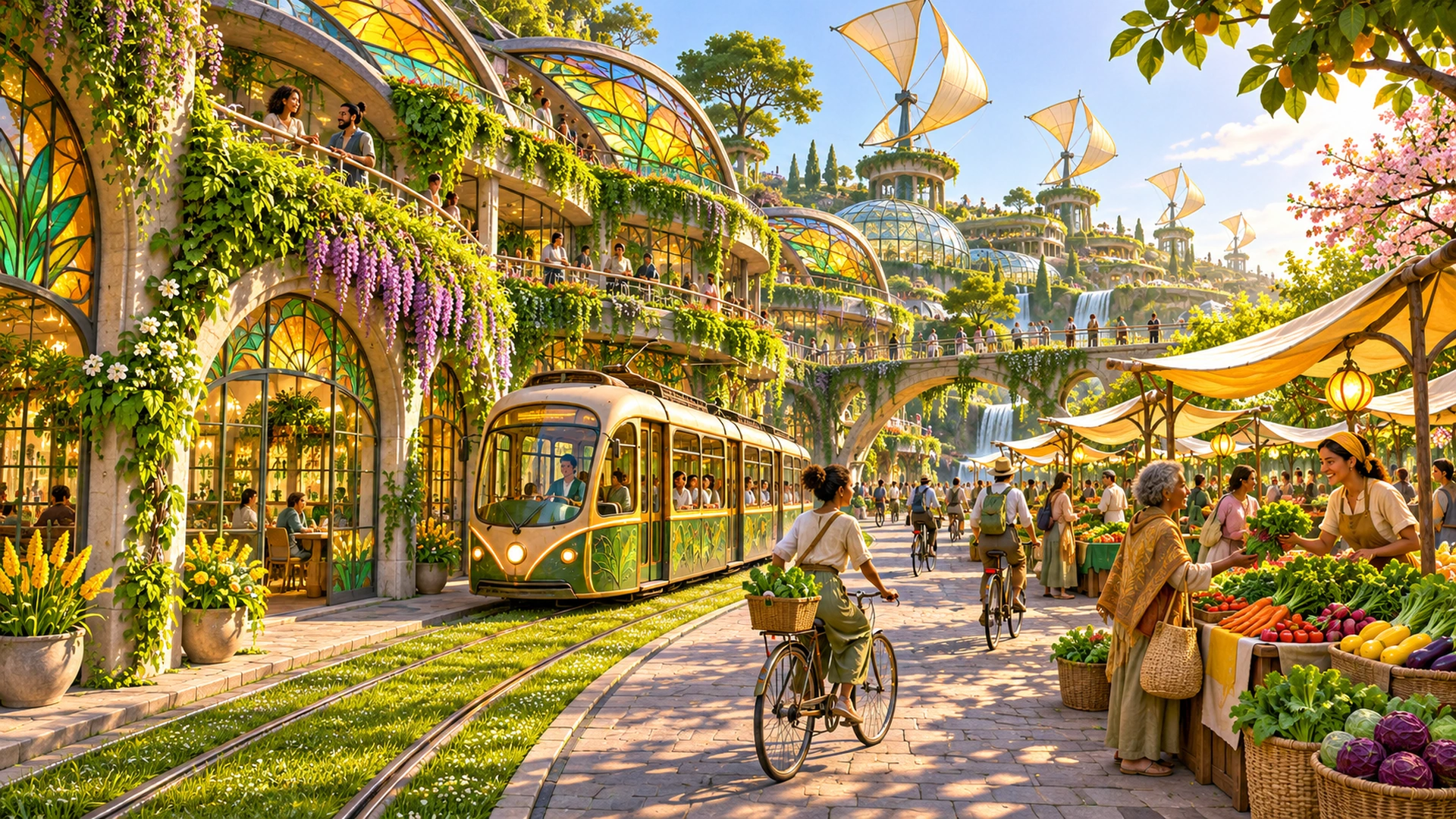
An original solarpunk city study: a sunny street of curving terraced buildings covered in vines, stained-glass solar panels on the roofs, a slow tram passing a market of vegetable stalls, children cycling, wind sails turning above, warm morning light and fresh greens and golds.
What to take from Solarpunk today
- Show how the city is powered: solar glass, wind sails.
- Put plants to work: rooftop farms, vertical gardens.
- Bring people in, doing something together.
- Use Art Nouveau or organic curves for the buildings.
Questions about Solarpunk
What is the difference between solarpunk and cyberpunk?
Cyberpunk imagines high technology in a broken, unequal world, at night and in neon. Solarpunk imagines appropriate technology in a repaired world, in daylight and greenery.
Is solarpunk only an aesthetic?
No. It began as a genre of hopeful science fiction and is also an environmental and social movement. The images are one expression of it.
Take a street you know and redesign it in solarpunk terms in five lines: what replaces the cars, where the gardens grow, how the buildings get power, and what people are doing there on a weekday morning.
Sources and further reading
- Adam Flynn, 'Solarpunk: Notes toward a manifesto' (2014).
- Phoebe Wagner and Brontë Wieland (eds.), Sunvault: Stories of Solarpunk and Eco-Speculation (2017).