From folklore to feed
The witch has been painted for centuries, from Renaissance prints to John William Waterhouse's The Magic Circle (1886, Tate), in which a woman draws a protective ring around herself with a wand. The modern 'witchy' aesthetic grew on Tumblr in the 2010s and on TikTok, where 'WitchTok' became a large community, often linked with interest in astrology, tarot, herbalism and modern paganism.
Visually, witchcore is close to dark academia and cottagecore: rooms full of books, plants, jars and candles, but with moons, crystals, tarot cards, black cats and dark velvet. It ranges from playful and cosy to dark and gothic. It is also worth remembering the real history behind the image: thousands of people, mostly women, were tried and executed as witches in early modern Europe and colonial America.
Visual anatomy of Witchcore
Black, deep plum, forest green, burgundy, candlelit gold, moon silver.
Candles, dried herbs, jars, mortar and pestle, tarot cards, crystals, old books, a broom.
Moon phases, ravens, black cats, mushrooms, woods at dusk.
Velvet, lace, long dark dresses, wool cloaks, rings and pendants.
Candlelight, moonlight, firelight; warm pools in darkness.
Mysterious, cosy, introspective, a little defiant.
Words around witchcore
A shelf or room of herbs and jars, a core motif.
The cycle of new, crescent, full and waning moon, often shown in a row.
The large community of witch-related content on TikTok.
How to recognize Witchcore
- Candles, herbs and jars.
- Moon and celestial symbols.
- Tarot cards, crystals and old books.
- Dark, rich colour and candlelight.
Where people get it wrong
Witchcore is sometimes treated as Halloween decoration. Halloween is costume and fright; witchcore is quiet, domestic and seasonal. A second caution: the aesthetic should not borrow sacred objects from living religious and Indigenous traditions as props.
Words to describe Witchcore
Precise words for the qualities above. Combine a few of them instead of naming the style or artist alone.
- witchcore
- witchy
- apothecary
- tarot
- moon phases
- candlelight
- velvet
- herbalism
- raven
- WitchTok
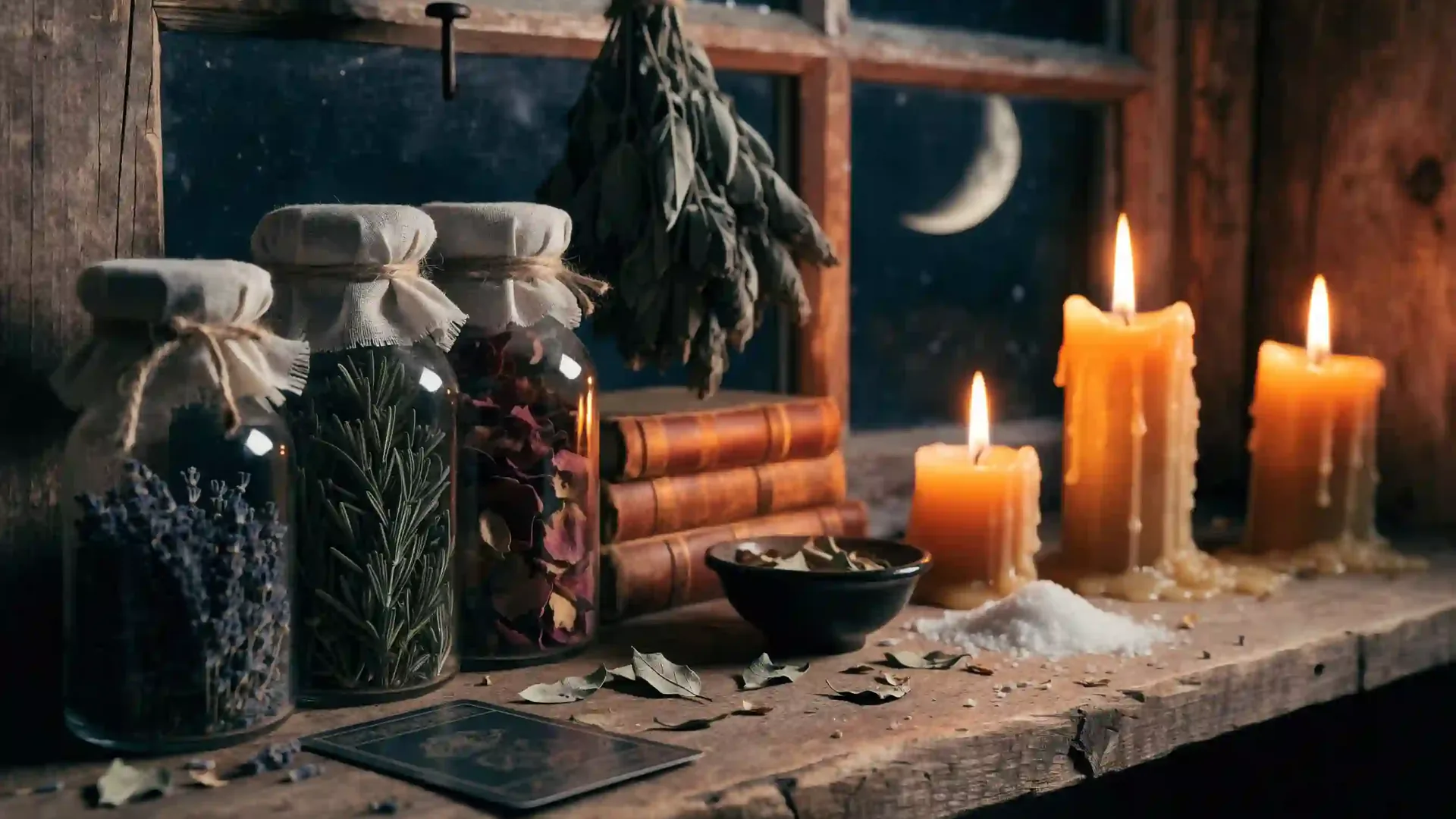
A witchcore still life: a dark wooden shelf with glass jars of dried lavender, rosemary and rose petals, a bundle of sage drying from a nail, three beeswax candles burning, a tarot card face down, a crescent moon visible through the window. No people.
What to take from Witchcore today
- Light the scene with candles or moonlight.
- Name the herbs and the jars.
- Add one celestial symbol.
- Keep colours deep and rich.
Renaming an old story
The figure of the witch is one of history's harshest stories told about women. Witchcore is partly an act of re-authoring, in narrative therapy's terms: taking a name used against people and making it a name for knowledge, plants and solitude. Describing it with that history in mind makes the image deeper.
Questions about Witchcore
What is the witchy aesthetic?
An aesthetic built around the image of the witch: candles, dried herbs, tarot cards, crystals, moon symbols, old books and dark, rich colours, often in cosy domestic spaces.
What is the difference between witchcore and dark academia?
Both use books, candles and dark colours. Dark academia is about study, libraries and classics; witchcore adds herbs, moons, tarot and a sense of magic and nature.
What colours are witchcore?
Black, deep plum, forest green, burgundy, candle gold and moonlight silver.
Describe a kitchen shelf in witchcore style in five sentences: three jars and what is in them, one source of light and one sign of the moon.
Sources and further reading
- Tate: John William Waterhouse, The Magic Circle, 1886.
- Ronald Hutton, The Witch: A History of Fear, from Ancient Times to the Present, Yale University Press, 2017.
- Aesthetics Wiki (fan-run catalogue): Witchcore entry.