The first black
Charcoal is among the first materials people drew with: the animals on the walls of Chauvet Cave, more than 30,000 years old, include charcoal lines. It is simply wood heated without air until only carbon remains, and it makes a mark on almost anything.
For centuries painters used it for preparatory drawings and for sketching compositions on walls and canvases, because it brushes off easily. In the 19th century it became an art in its own right: Odilon Redon made his haunting noirs, Seurat drew velvety figures on textured paper with conté and charcoal, and Käthe Kollwitz used it for powerful images of grief and poverty.
Today charcoal is the standard material in life drawing classes, and artists such as William Kentridge build entire animated films from charcoal drawings that are erased and redrawn frame by frame. Its quickness, its mess and its reversibility make it a material for thinking as much as for finishing.
Visual anatomy of charcoal drawing
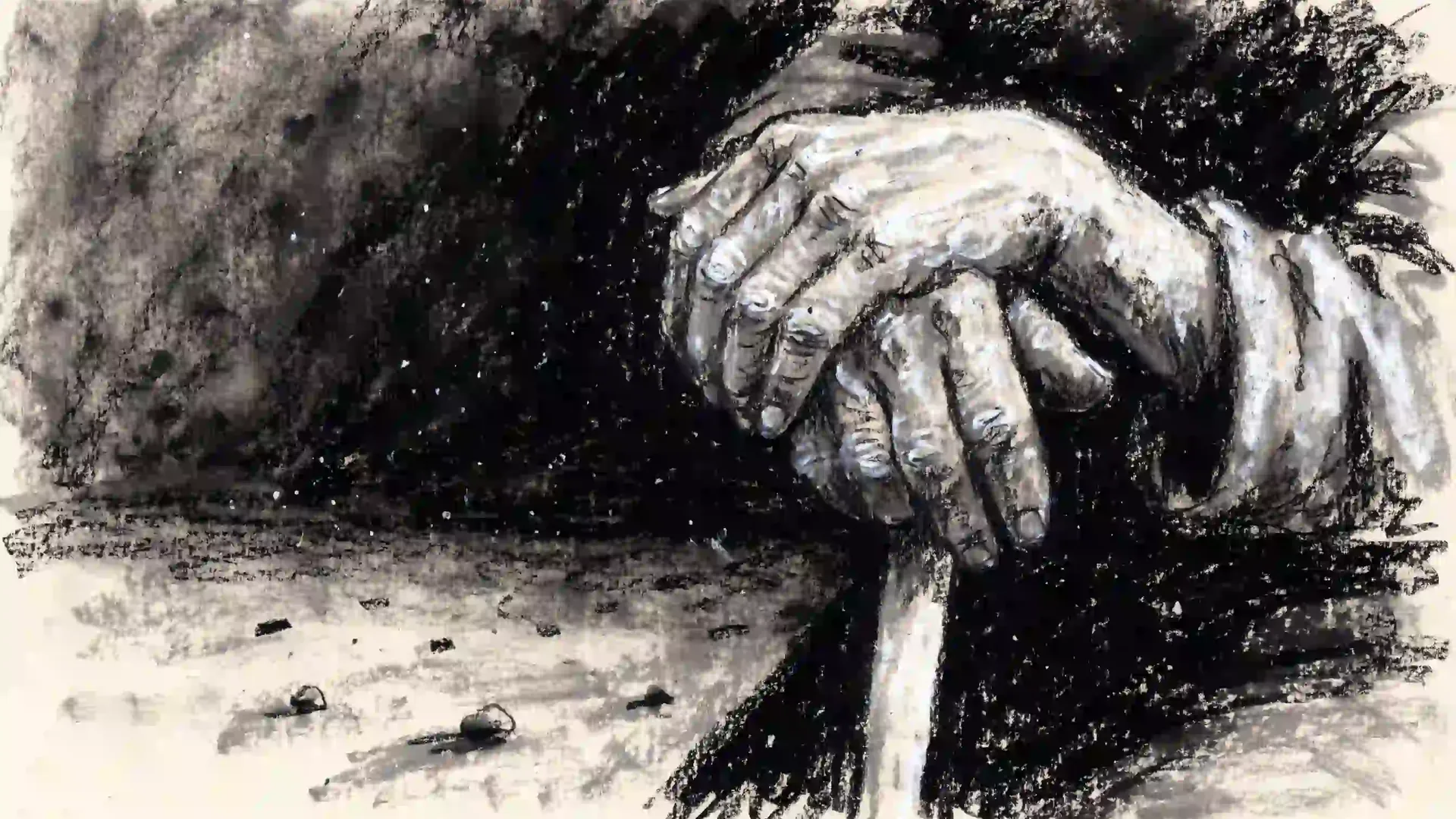
Compressed charcoal gives deep, velvety blacks; vine charcoal greys and soft, silvery darks.
Blending with fingers, cloth, paper stumps or brushes creates smoky mid-tones and atmosphere.
A kneaded eraser lifts light out of dark areas: highlights are drawn subtractively.
Textured, toothy paper catches particles and leaves white specks in the grain.
From fine hard edges to broad side strokes; lines can be soft and lost or sharp and dark.
A spray that binds the powder; without it charcoal smears easily.
Words for charcoal
Thin sticks of burnt willow or vine: light, soft greys, easy to erase.
Charcoal powder bound into sticks or pencils: darker, denser, harder to erase.
Covering paper with charcoal, then erasing to create light.
The surface texture of paper that holds the medium.
How to recognize charcoal drawing
- Monochrome black, grey and white with a powdery, matte surface.
- Smoky, smudged transitions and soft edges.
- Highlights that look erased or lifted from dark.
- Visible paper grain with white specks in dark areas.
- Expressive, broad strokes mixed with sharp accents.
Where people get it wrong
Charcoal is often confused with graphite pencil. Graphite is shiny, grey and precise; charcoal is matte, can go far blacker and is softer and messier. A good charcoal drawing also uses the eraser as a drawing tool, not only for corrections.
Words to describe charcoal drawing
Precise words for the qualities above. Combine a few of them instead of naming the style or artist alone.
- charcoal on paper
- velvety blacks
- smudged mid-tones
- smoky soft edges
- erased highlights
- kneaded eraser
- vine charcoal greys
- compressed charcoal
- textured paper grain
- matte powdery surface
- expressive strokes
- life drawing
A charcoal portrait on textured cream paper: a woman's face half turned toward a window, deep velvety compressed charcoal in the hair and background, soft smudged mid-tones on the cheek, highlights on the nose and forehead lifted out with a kneaded eraser, a few sharp dark accents at the eyes, the paper grain showing as white specks.
What to take from charcoal drawing today
- Say 'matte charcoal', not just 'pencil drawing'.
- Choose vine (soft greys) or compressed (deep blacks).
- Ask for erased highlights and smudged mid-tones.
- Mention the paper: textured, toned, cream or grey.
Questions about charcoal drawing
What is the difference between vine and compressed charcoal?
Vine charcoal is made from burnt sticks of willow or vine; it is light, soft and easy to erase, good for early sketching. Compressed charcoal is powder pressed with a binder; it gives deeper, denser blacks and is harder to remove.
How do you stop charcoal from smudging?
Use fixative spray in light layers, work from top to bottom and from one side to the other, rest your hand on a sheet of paper, and frame finished drawings behind glass with a mat.
Is charcoal better than graphite for portraits?
It depends on the goal. Charcoal is faster and better for strong contrast, mood and large drawings; graphite is better for fine, precise detail and smaller work. Many artists combine them.
Find one of Odilon Redon's charcoal noirs. Describe its darkness in four different words, none of them 'black' or 'dark'. Then describe one light area: was it left as paper, erased out, or never touched?
Sources and further reading
- Museum of Modern Art: Odilon Redon, Beyond the Visible, collection notes.
- Art Institute of Chicago: Redon and Seurat drawings.
- Ralph Mayer, The Artist's Handbook of Materials and Techniques, Viking, 1991.
- William Kentridge, Drawings for Projection, film series, 1989–.