Chemistry and patience
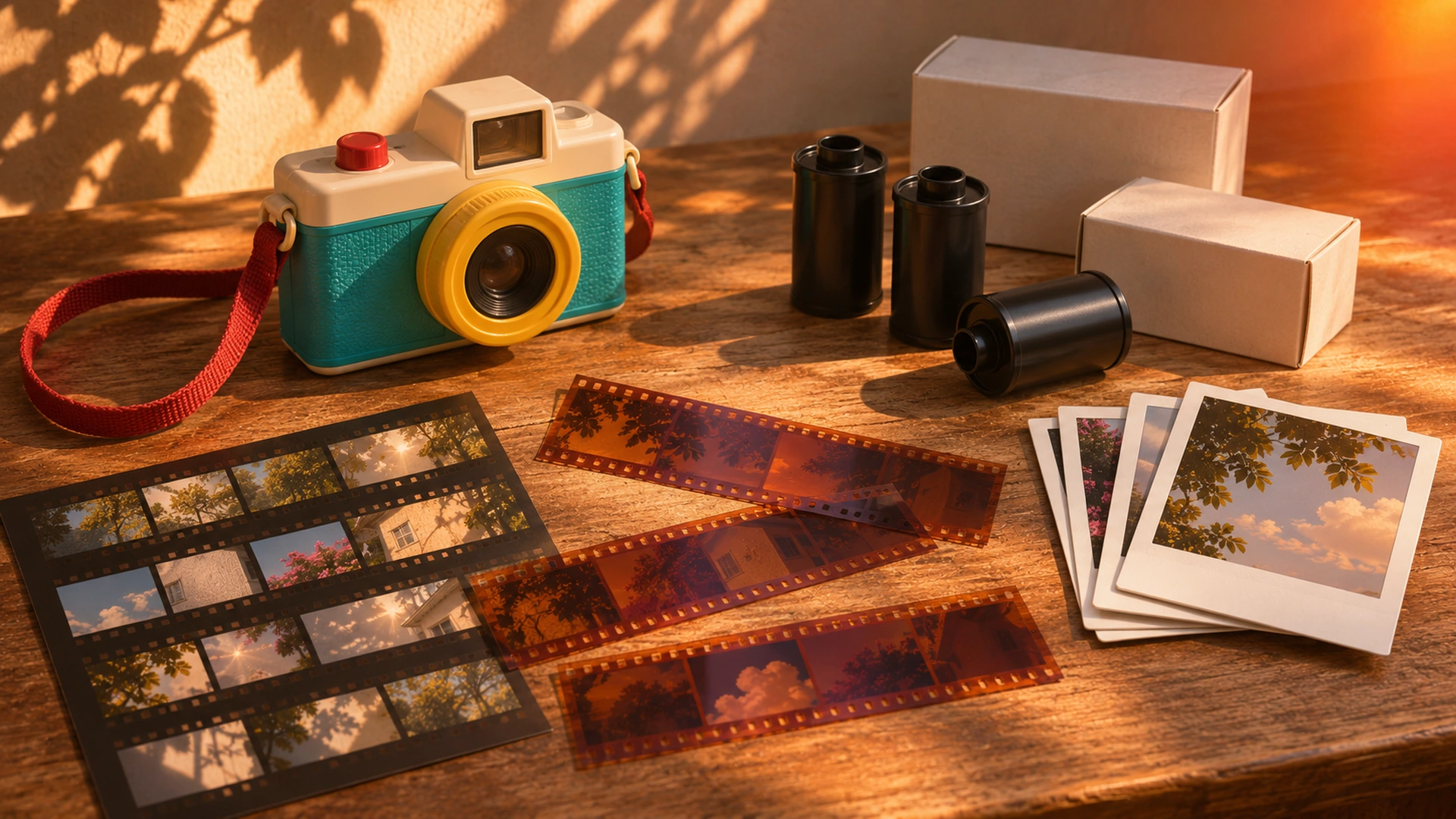
Film records light on a strip coated with silver halide crystals; after developing, the image appears as a negative or a positive slide. For most of the 20th century it was simply photography. Digital cameras replaced it for most uses in the 2000s, and several famous stocks were discontinued, including Kodachrome, whose production ended in 2009.
From the 2010s, younger photographers turned back to film, for its look and for its slowness: a limited number of frames, no screen, and days before the results arrive. Labs, film stocks and second-hand cameras became popular again, and the 'film look' became something digital photographers and Gen AI users try to imitate.
Visual anatomy of film photography
Fine, random texture, more visible in faster film and shadows.
Distinct palettes by stock: warm skin, soft greens, gentle highlights.
Smooth roll-off instead of hard clipping; halation glow around bright lights in some films.
Light leaks, frame edges, dust, scratches, double exposures.
35mm (3:2), medium format (6×6, 6×7), each with its own proportions.
Warm, nostalgic, deliberate, imperfect.
Words around film
Film that produces a negative image, printed or scanned into a positive.
Positive transparency film with rich colour and little exposure latitude.
A glow around bright highlights caused by light reflecting back through the film.
Developing film longer to increase its effective speed, adding grain and contrast.
How to recognize film photography
- Random grain rather than digital noise.
- Soft, glowing highlights.
- A stock-specific colour palette.
- Frame edges, dust or light leaks.
Where people get it wrong
The 'film look' is often imitated with heavy grain and orange tint everywhere. Real film looks depend on the stock, the exposure, the light and the scan, and most are subtle. Another mistake is to treat film as automatically more authentic; a careless photograph on film is still careless.
Words to describe film photography
Precise words for the qualities above. Combine a few of them instead of naming the style or artist alone.
- film
- 35mm
- medium format
- grain
- halation
- colour negative
- slide film
- light leak
- push processing
- scan
A film photography study: a woman reading on a sunlit balcony in medium-format colour negative, soft warm skin tones, fine grain in the shadows, a faint red glow around the bright window frame, the dark rebate of the film edge visible. Adult.
What to take from film photography today
- Name the format and type: 35mm colour negative, medium-format black and white.
- Describe grain and highlight glow.
- Name the palette in plain words.
- Mention one accident: a light leak, a frame edge.
The photograph you have to wait for
Film adds time between seeing and knowing. That delay changes what people photograph: fewer frames, more choice. It is a reminder that attention, not resolution, is what makes an image particular.
Questions about film photography
Why is film photography popular again?
Many photographers like its look and its slower, more deliberate process: limited frames, no screen and a wait before seeing results.
What is halation in film?
A glow around bright highlights caused by light passing through the film, reflecting off the back and exposing the emulsion again. Some films show it strongly.
What is the difference between 35mm and medium format?
35mm film gives 3:2 frames on small rolls. Medium format uses wider film for larger frames, such as 6×6 or 6×7 cm, with more detail and different proportions.
Take a roll of film, or set your phone to take only 24 photos in a day. Before each shot, write one sentence on why this frame. Compare those sentences with the photos.
Sources and further reading
- Kodak: history of Kodachrome and film product notes.
- Ilford Photo: technical information on black-and-white film.
- George Eastman Museum, Rochester: photography and film collections.