Painting the soul's weather
Edvard Munch grew up in Kristiania, now Oslo, in a house marked by illness. His mother died when he was five and his favourite sister Sophie when he was fourteen; both deaths return again and again in his work. After early naturalist painting he spent years in Paris and Berlin, absorbing Gauguin's flat colour and the Symbolist idea that painting should show inner states, not appearances.
In the 1890s he began the Frieze of Life, a cycle about love, anxiety and death. The Scream (1893), a figure on a bridge under a blood-red sky, became one of the most reproduced images in the world. He made it in several versions: paint, pastel, crayon and a lithograph. He was also a radical printmaker, cutting his woodblocks into pieces, inking them separately and letting the grain of the wood show.
After a breakdown in 1908 his palette brightened. He lived the rest of his life near Oslo, painting landscapes, workers and an unsparing series of self-portraits into old age. He left his work to the city, and it is now at the MUNCH museum.
Visual anatomy of Edvard Munch
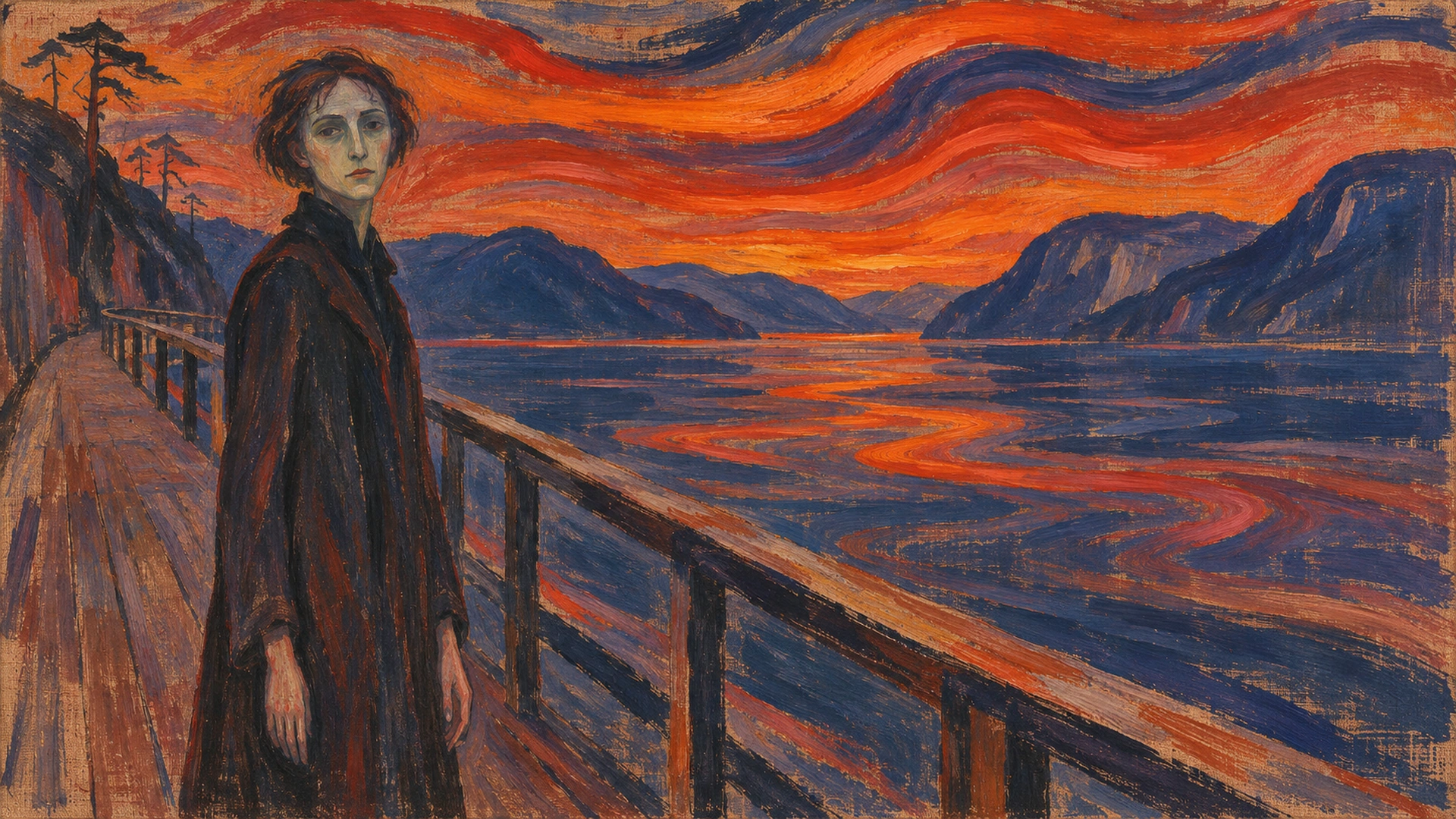
Long, wavy lines that run through sky, water and figures alike, so the world seems to vibrate with one mood.
Simplified bodies, mask-like faces, hollow eyes; figures often frontal, isolated or dissolving at the edges.
Non-naturalistic and emotional: blood-red skies, sick greens, deep Prussian blues, orange shorelines.
Steep diagonals like the bridge railing in The Scream, pulling the eye fast into depth.
Thin, scraped and dripping paint, unfinished-looking areas, sometimes canvases left out in the weather on purpose.
Woodcuts where the wood grain becomes part of the image; jigsaw-cut blocks inked in separate colours.
Words around Munch
His own name for the cycle of paintings on love, anxiety and death, meant to be seen together.
The late-19th-century movement that painted ideas and inner states rather than the visible world.
Munch's work came before Expressionism and fed it directly, especially in Germany.
Munch's phrase for leaving paintings outdoors in the weather to age and roughen them.
How to recognize Edvard Munch's work
- A sky or landscape made of long, rhythmic wavy bands.
- A pale, mask-like face with hollow eyes, often facing us.
- Colour used for feeling: red skies, green faces, deep blue nights.
- A strong diagonal, a road, pier or railing, rushing into the distance.
- Thin, scraped paint with parts left raw.
Where people get it wrong
Munch is often reduced to The Scream, and The Scream to a meme of panic. The figure is not screaming; in Munch's own note he hears a scream passing through nature. His work is equally tender: Madonna, The Sick Child, kissing couples merging into one shape, sunlit late landscapes. And he is not an Expressionist in the strict sense; he came just before them.
Words to describe Edvard Munch
Words for what you see and feel in this work. They are for describing and understanding, not a recipe for copying an artist.
- swirling sky
- wavy rhythmic lines
- mask-like face
- hollow eyes
- blood-red sunset
- Prussian blue night
- steep diagonal railing
- scraped thin paint
- woodcut with visible grain
- anxiety made visible
- Scandinavian twilight
- figure dissolving into landscape
A figure on a wooden pier at twilight, painted in thin scraped oil: the sky and the fjord made of long wavy bands of orange, red and deep blue, the railing a steep diagonal into the distance, the face pale and mask-like with hollow eyes, the whole scene vibrating with one anxious rhythm.
What to learn from Edvard Munch
- Name the feeling first, then decide what colour the sky would be if the world felt it too.
- Let one line run through figure and landscape so they share one mood.
- Use a steep diagonal to make a calm scene feel urgent.
- Leave part of the surface raw; finish is not the same as truth.
Questions about Edvard Munch
What is The Scream about?
Munch wrote that he was walking at sunset when the sky turned blood red and he felt 'an infinite scream passing through nature'. The painting shows that moment: a figure overwhelmed by a feeling that seems to come from the world itself, not a person shouting.
Was Edvard Munch an Expressionist?
He is usually called a Symbolist and a forerunner of Expressionism. German Expressionists such as Die Brücke saw his exhibitions in Berlin and learned directly from his colour, distortion and woodcuts.
How many versions of The Scream are there?
Munch made two painted versions, two pastels and a lithograph from which many prints were pulled, plus related drawings. The best known are at the National Museum and the MUNCH museum in Oslo.
Choose one Munch painting. Write one sentence about what is in it. Then write one sentence about the weather inside the main figure. Compare: which sentence explains the colours better?
Sources and further reading
- MUNCH museum, Oslo: collection and archive of Munch's writings (emunch.no).
- Sue Prideaux, Edvard Munch: Behind the Scream, Yale University Press, 2005.
- National Museum of Norway: The Scream (1893).
- Jay A. Clarke, Becoming Edvard Munch: Influence, Anxiety and Myth, Art Institute of Chicago, 2009.