A painter of the edge of the world
Jheronimus van Aken took his name from his town, 's-Hertogenbosch in the Duchy of Brabant, where he lived and worked almost all his life. He came from a family of painters and was a member of a devout religious brotherhood. Few documents about him survive, and only around twenty-five paintings are firmly attributed to him today.
His great works are altarpieces and triptychs whose subject is the human soul: creation, temptation, sin and judgement. The Garden of Earthly Delights (c. 1490–1510) opens from a grey globe on its outer wings to Eden on the left, a crowded garden of naked lovers, giant birds and fruit in the centre, and a musical hell on the right, where a man is crucified on a harp and a bird-headed creature eats sinners.
Bosch painted at the meeting point of the late Gothic and the Northern Renaissance, with the fine oil technique of the Netherlands but a medieval moral imagination. Philip II of Spain collected him passionately, which is why so much of his work is in the Prado in Madrid. In the 20th century the Surrealists saw him as an ancestor.
Visual anatomy of Hieronymus Bosch
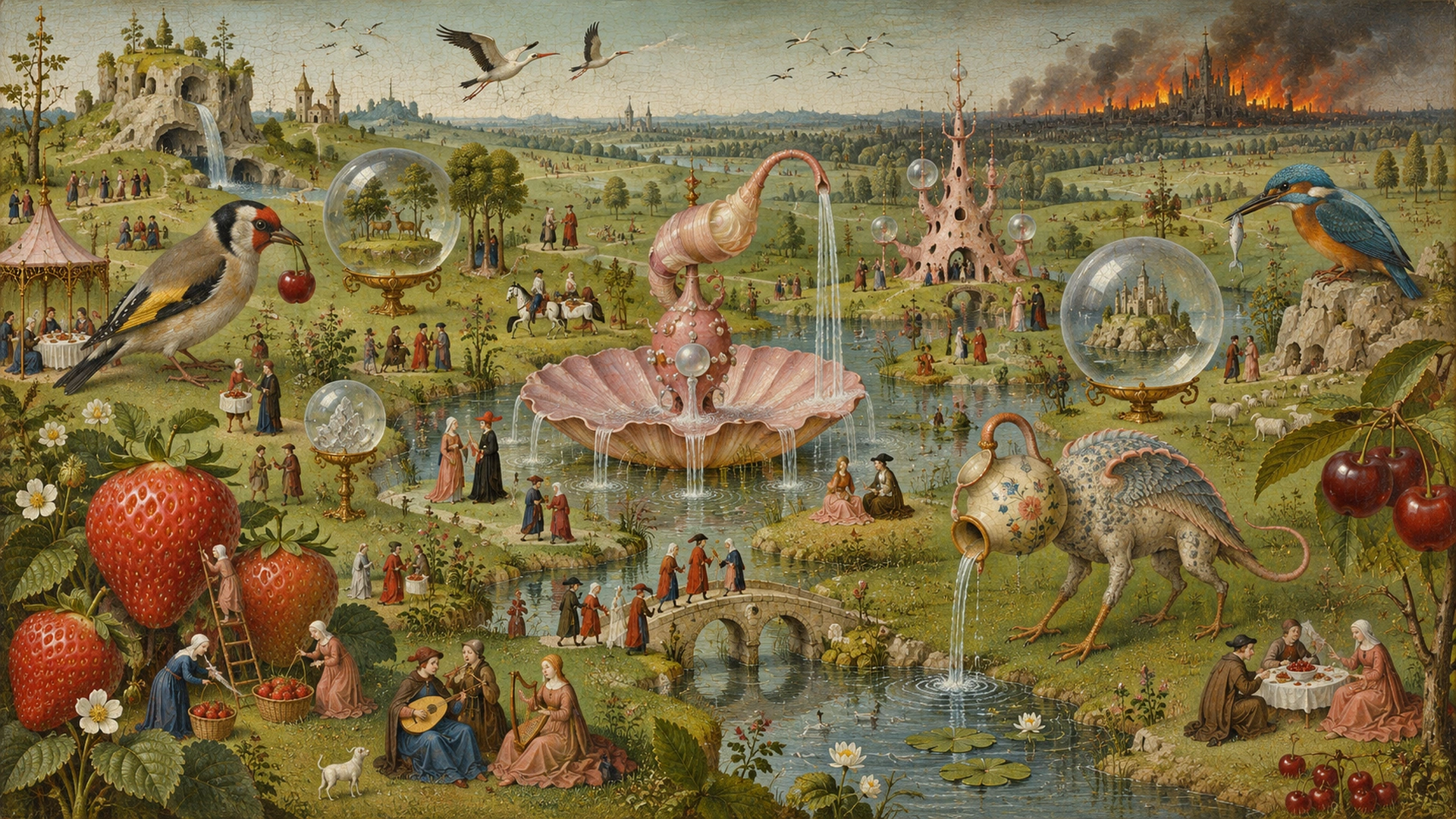
Hundreds of small figures spread over a huge panel, each doing something different; the eye wanders like reading.
Hybrids made of animals, tools and bodies: fish with legs, egg-shell bodies, a jug-headed knight, a bird on a throne.
High horizons, pale fantastical rock and glass structures, pink fountains, distant burning cities.
Clear pinks, pale blues and greens in paradise; black, brown and fire-orange in hell.
Thin layers of oil over a white ground, fine brushwork, small bright highlights.
Triptychs that read left to right like a sermon: origin, temptation, punishment.
Words around Bosch
A painting in three hinged panels; the wings can close over the centre.
Painting in shades of grey, used on the closed outer wings of his triptychs.
The comic hybrid creatures drawn in the margins of medieval manuscripts, a source for Bosch's monsters.
A reminder of death; much of his work is a moral warning dressed as spectacle.
How to recognize Hieronymus Bosch's work
- A crowded panel of tiny figures with no single focus.
- Hybrid creatures made of animals, objects and human parts.
- Giant fruit, shells, eggs and birds at human scale.
- Pale pink and blue fantasy architecture against a high horizon.
- A dark hell lit by distant fire, full of strange punishments.
Where people get it wrong
Bosch is often called a surrealist before his time, painting dreams. His images were not free fantasy: they draw on sermons, proverbs, alchemy, manuscript margins and the religious culture of his town. They were meant to be decoded as moral lessons, even if we have lost many of the codes. And not every fantastic Netherlandish painting is by him; many are by followers.
Words to describe Hieronymus Bosch
Words for what you see and feel in this work. They are for describing and understanding, not a recipe for copying an artist.
- triptych
- crowded panorama
- hybrid creature
- giant fruit
- high horizon
- pink fantastical fountain
- burning city at night
- tiny figures
- Netherlandish oil
- medieval moral allegory
- grisaille globe
- infernal machine
A wide painted panel in fine Netherlandish oil: a pale green landscape with a high horizon crowded with hundreds of tiny naked figures, giant strawberries and glass spheres, pink fountains shaped like shells and horns, birds larger than people, and in the far distance a dark city burning orange.
What to learn from Hieronymus Bosch
- Build a scene from many small actions instead of one central event.
- Make a creature by joining two things that should not meet, and give it a job.
- Change scale: a strawberry the size of a house says more than a big strawberry.
- Let a picture read in sequence, left to right, like a story with a moral.
Questions about Hieronymus Bosch
What is The Garden of Earthly Delights about?
Most scholars read it as a warning: Eden on the left, a world given over to pleasure in the centre, and its punishment in hell on the right. Others see the central panel as a lost paradise or an innocent dream. The uncertainty is part of why it fascinates.
Where can you see Hieronymus Bosch's paintings?
The largest group is in the Museo del Prado in Madrid, including The Garden of Earthly Delights. Others are in Lisbon, Vienna, Venice, Rotterdam and 's-Hertogenbosch, which has a Bosch art centre with reproductions.
Was Bosch a Surrealist?
No. He lived around 1450–1516. The Surrealists, especially Dalí and Max Ernst, admired him and called him a forerunner because of his hybrid creatures and dream logic.
Zoom into one small corner of The Garden of Earthly Delights online. Describe one creature as if writing a field guide: what it is made of, what it is doing, where it lives. Then guess, in one line, what sin or lesson it stands for.
Sources and further reading
- Museo del Prado: The Garden of Earthly Delights, catalogue entry and Bosch: The 5th Centenary Exhibition, 2016.
- Bosch Research and Conservation Project, boschproject.org.
- Larry Silver, Hieronymus Bosch, Abbeville Press, 2006.
- Stefan Fischer, Hieronymus Bosch: The Complete Works, Taschen, 2013.